Samrat Sahu, Benjamin Emenike, Christian Michel Beusch, Pritha Bagchi, David Ezra Gordon, Monika Raj
{"title":"Copper(I)-nitrene platform for chemoproteomic profiling of methionine","authors":"Samrat Sahu, Benjamin Emenike, Christian Michel Beusch, Pritha Bagchi, David Ezra Gordon, Monika Raj","doi":"10.1038/s41467-024-48403-0","DOIUrl":null,"url":null,"abstract":"<p>Methionine plays a critical role in various biological and cell regulatory processes, making its chemoproteomic profiling indispensable for exploring its functions and potential in protein therapeutics. Building on the principle of rapid oxidation of methionine, we report Copper(I)-Nitrene Platform for robust, and selective labeling of methionine to generate stable sulfonyl sulfimide conjugates under physiological conditions. We demonstrate the versatility of this platform to label methionine in bioactive peptides, intact proteins (6.5-79.5 kDa), and proteins in complex cell lysate mixtures with varying payloads. We discover ligandable proteins and sites harboring hyperreactive methionine within the human proteome. Furthermore, this has been utilized to profile oxidation-sensitive methionine residues, which might increase our understanding of the protective role of methionine in diseases associated with elevated levels of reactive oxygen species. The Copper(I)-Nitrene Platform allows labeling methionine residues in live cancer cells, observing minimal cytotoxic effects and achieving dose-dependent labeling. Confocal imaging further reveals the spatial distribution of modified proteins within the cell membrane, cytoplasm, and nucleus, underscoring the platform’s potential in profiling the cellular interactome.</p>","PeriodicalId":19066,"journal":{"name":"Nature Communications","volume":"48 1","pages":""},"PeriodicalIF":15.7000,"publicationDate":"2024-05-18","publicationTypes":"Journal Article","fieldsOfStudy":null,"isOpenAccess":false,"openAccessPdf":"","citationCount":"0","resultStr":null,"platform":"Semanticscholar","paperid":null,"PeriodicalName":"Nature Communications","FirstCategoryId":"103","ListUrlMain":"https://doi.org/10.1038/s41467-024-48403-0","RegionNum":1,"RegionCategory":"综合性期刊","ArticlePicture":[],"TitleCN":null,"AbstractTextCN":null,"PMCID":null,"EPubDate":"","PubModel":"","JCR":"Q1","JCRName":"MULTIDISCIPLINARY SCIENCES","Score":null,"Total":0}
引用次数: 0
Abstract
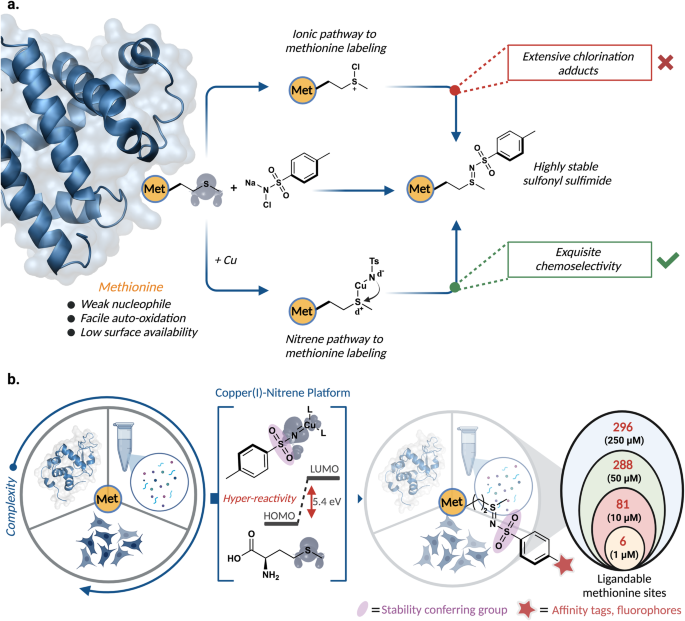
Methionine plays a critical role in various biological and cell regulatory processes, making its chemoproteomic profiling indispensable for exploring its functions and potential in protein therapeutics. Building on the principle of rapid oxidation of methionine, we report Copper(I)-Nitrene Platform for robust, and selective labeling of methionine to generate stable sulfonyl sulfimide conjugates under physiological conditions. We demonstrate the versatility of this platform to label methionine in bioactive peptides, intact proteins (6.5-79.5 kDa), and proteins in complex cell lysate mixtures with varying payloads. We discover ligandable proteins and sites harboring hyperreactive methionine within the human proteome. Furthermore, this has been utilized to profile oxidation-sensitive methionine residues, which might increase our understanding of the protective role of methionine in diseases associated with elevated levels of reactive oxygen species. The Copper(I)-Nitrene Platform allows labeling methionine residues in live cancer cells, observing minimal cytotoxic effects and achieving dose-dependent labeling. Confocal imaging further reveals the spatial distribution of modified proteins within the cell membrane, cytoplasm, and nucleus, underscoring the platform’s potential in profiling the cellular interactome.
期刊介绍:
Nature Communications, an open-access journal, publishes high-quality research spanning all areas of the natural sciences. Papers featured in the journal showcase significant advances relevant to specialists in each respective field. With a 2-year impact factor of 16.6 (2022) and a median time of 8 days from submission to the first editorial decision, Nature Communications is committed to rapid dissemination of research findings. As a multidisciplinary journal, it welcomes contributions from biological, health, physical, chemical, Earth, social, mathematical, applied, and engineering sciences, aiming to highlight important breakthroughs within each domain.




 京公网安备 11010802042870号
京ICP备2023020795号-1
京公网安备 11010802042870号
京ICP备2023020795号-1

 分享
分享
 求助内容:
求助内容: 应助结果提醒方式:
 扫码关注我们
