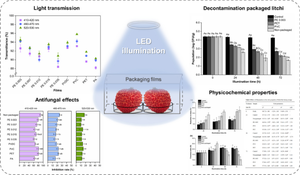
{"title":"Antifungal Efficacy of LEDs for Spoilage Pathogens on Litchi Fruit Packaged with Different Types and Thicknesses of Films","authors":"Xinpeng Yu, Jinglei Chen, Junyong Zhong, Ziqian Zhang, Yingyin Wu, Yuan Zou, Tao Wei, Junfang Lin, Qianwang Zheng","doi":"10.1007/s11947-024-03440-x","DOIUrl":null,"url":null,"abstract":"<div><p>Penetration ability is one of the biggest concerns of light-emitting diode (LED) technology in the food industry, as most food matrices are usually in packaged conditions. This study aimed to evaluate the antifungal effects of LEDs on both pure culture and litchi fruit, which are packaged by nine commonly used commercial packaging films. Results showed that LEDs could penetrate these films with more than 88% energy transmittance. Under the same illumination condition, the inhibition rate in film packaged samples decreased by 8–35%. The difference might be due to the partial shielding of light by the films selected. However, when the illumination time was further extended, 410–420 nm LED still achieved complete inhibition of <i>Fusarium</i> sp. and <i>Geotrichum candidum</i> conidia in all tested films, particularly polyethylene (PE) 0.003 mm, polyethylene terephthalate (PET), and polyvinyl chloride (PVC). <i>In vivo</i> trials showed that LED illumination reduced the fungal populations on packaged litchi by ~ 99% with better physicochemical properties than the non-packaged ones. Although the presence of packaging films did affect the inactivation efficacy of LED, this study demonstrated that LED technology has the potential to be used for the decontamination of packaged litchi fruit and other packaged foods.</p><h3>Graphical Abstract</h3>\n<div><figure><div><div><picture><source><img></source></picture></div></div></figure></div></div>","PeriodicalId":562,"journal":{"name":"Food and Bioprocess Technology","volume":"17 12","pages":"5053 - 5065"},"PeriodicalIF":5.8000,"publicationDate":"2024-05-17","publicationTypes":"Journal Article","fieldsOfStudy":null,"isOpenAccess":false,"openAccessPdf":"","citationCount":"0","resultStr":null,"platform":"Semanticscholar","paperid":null,"PeriodicalName":"Food and Bioprocess Technology","FirstCategoryId":"97","ListUrlMain":"https://link.springer.com/article/10.1007/s11947-024-03440-x","RegionNum":2,"RegionCategory":"农林科学","ArticlePicture":[],"TitleCN":null,"AbstractTextCN":null,"PMCID":null,"EPubDate":"","PubModel":"","JCR":"Q1","JCRName":"FOOD SCIENCE & TECHNOLOGY","Score":null,"Total":0}
引用次数: 0
Abstract
Penetration ability is one of the biggest concerns of light-emitting diode (LED) technology in the food industry, as most food matrices are usually in packaged conditions. This study aimed to evaluate the antifungal effects of LEDs on both pure culture and litchi fruit, which are packaged by nine commonly used commercial packaging films. Results showed that LEDs could penetrate these films with more than 88% energy transmittance. Under the same illumination condition, the inhibition rate in film packaged samples decreased by 8–35%. The difference might be due to the partial shielding of light by the films selected. However, when the illumination time was further extended, 410–420 nm LED still achieved complete inhibition of Fusarium sp. and Geotrichum candidum conidia in all tested films, particularly polyethylene (PE) 0.003 mm, polyethylene terephthalate (PET), and polyvinyl chloride (PVC). In vivo trials showed that LED illumination reduced the fungal populations on packaged litchi by ~ 99% with better physicochemical properties than the non-packaged ones. Although the presence of packaging films did affect the inactivation efficacy of LED, this study demonstrated that LED technology has the potential to be used for the decontamination of packaged litchi fruit and other packaged foods.
由于大多数食品基质通常处于包装状态,因此穿透能力是发光二极管(LED)技术在食品工业中最受关注的问题之一。本研究旨在评估 LED 对用九种常用商业包装膜包装的纯培养物和荔枝果的抗真菌效果。结果表明,LED 可以穿透这些薄膜,能量透过率超过 88%。在相同的照明条件下,薄膜包装样品的抑制率降低了 8-35%。造成这种差异的原因可能是所选薄膜对光有部分屏蔽作用。然而,当照明时间进一步延长时,410-420 nm LED 仍能完全抑制所有测试薄膜中的镰刀菌和念珠菌分生孢子,尤其是 0.003 mm 聚乙烯(PE)、聚对苯二甲酸乙二醇酯(PET)和聚氯乙烯(PVC)。体内试验表明,LED 照明可使包装荔枝上的真菌数量减少约 99%,其理化特性优于非包装荔枝。虽然包装膜的存在会影响 LED 的灭活效果,但这项研究表明,LED 技术有潜力用于包装荔枝和其他包装食品的净化。
期刊介绍:
Food and Bioprocess Technology provides an effective and timely platform for cutting-edge high quality original papers in the engineering and science of all types of food processing technologies, from the original food supply source to the consumer’s dinner table. It aims to be a leading international journal for the multidisciplinary agri-food research community.
The journal focuses especially on experimental or theoretical research findings that have the potential for helping the agri-food industry to improve process efficiency, enhance product quality and, extend shelf-life of fresh and processed agri-food products. The editors present critical reviews on new perspectives to established processes, innovative and emerging technologies, and trends and future research in food and bioproducts processing. The journal also publishes short communications for rapidly disseminating preliminary results, letters to the Editor on recent developments and controversy, and book reviews.



 京公网安备 11010802042870号
京ICP备2023020795号-1
京公网安备 11010802042870号
京ICP备2023020795号-1

 分享
分享
 求助内容:
求助内容: 应助结果提醒方式:
 扫码关注我们
