Aika Yokoyama, Hanami Aoki, Mizuki Funayama, Ryo Shinozaki, Hiroto Yoshida, Dr. Akinobu Z. Suzuki, Prof. Dr. Toshiaki Furuta
{"title":"Design, Synthesis, and Photochemical Properties of Gene-directed Caged RyR Probes for Photopharmacological Studies","authors":"Aika Yokoyama, Hanami Aoki, Mizuki Funayama, Ryo Shinozaki, Hiroto Yoshida, Dr. Akinobu Z. Suzuki, Prof. Dr. Toshiaki Furuta","doi":"10.1002/cptc.202400140","DOIUrl":null,"url":null,"abstract":"<p>Ryanodine receptor (RyR) is a crucial intracellular Ca<sup>2+</sup> channel involved in various physiological processes associated with several diseases. This paper presents the synthesis and evaluation of novel photoactivatable caged compounds for the RyR. We used (6-bromo-7-hydroxycoumarn-4-yl)methyl (Bhc) as the photolabile protecting group to develop caged versions of 4-CmC, a broad-spectrum RyR agonist, and FLA365, an antagonist. The synthesized compounds, <b>Bhcmoc-4-CmC</b> and <b>Bhcmoc-FLA365</b>, exhibited photoreactivity that enabled spatiotemporal control over the RyR activity. <b>Bhcmoc-4-CmC</b> presents a quantum yield of 25 % and a photolysis efficiency of 1,075 M<sup>−1</sup> cm<sup>−1</sup> under 405 nm light, triggering Ca<sup>2+</sup> release from the endoplasmic reticulum. Conversely, <b>Bhcmoc-FLA365</b> presents a reduced quantum yield of 0.61 %, which can be attributed to the quenching effects of its tertiary amine structure. We also applied gene-directed caging, synthesizing β-galactosidase (β-Gal) activatable <b>Gal-Bhcmoc-4-CmC</b> and <b>Gal-Bhcmoc-FLA365</b>, and porcine liver esterase (PLE)-activatable <b>CM-Bhcmoc-FLA365</b>, to target these probes to the specific cell types. These caged compounds contribute significantly to photopharmacology, providing tools for the precise analysis and manipulation of the RyR functions. Future research objectives involve further optimization and analysis of the photochemical mechanisms of these caged compounds to enhance their applications in biological and medical research.</p>","PeriodicalId":10108,"journal":{"name":"ChemPhotoChem","volume":"8 8","pages":""},"PeriodicalIF":3.0000,"publicationDate":"2024-05-21","publicationTypes":"Journal Article","fieldsOfStudy":null,"isOpenAccess":false,"openAccessPdf":"https://onlinelibrary.wiley.com/doi/epdf/10.1002/cptc.202400140","citationCount":"0","resultStr":null,"platform":"Semanticscholar","paperid":null,"PeriodicalName":"ChemPhotoChem","FirstCategoryId":"92","ListUrlMain":"https://chemistry-europe.onlinelibrary.wiley.com/doi/10.1002/cptc.202400140","RegionNum":4,"RegionCategory":"化学","ArticlePicture":[],"TitleCN":null,"AbstractTextCN":null,"PMCID":null,"EPubDate":"","PubModel":"","JCR":"Q3","JCRName":"CHEMISTRY, PHYSICAL","Score":null,"Total":0}
引用次数: 0
Abstract
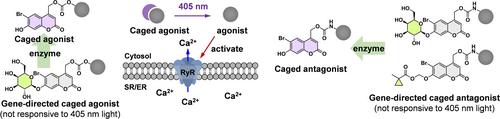
Ryanodine receptor (RyR) is a crucial intracellular Ca2+ channel involved in various physiological processes associated with several diseases. This paper presents the synthesis and evaluation of novel photoactivatable caged compounds for the RyR. We used (6-bromo-7-hydroxycoumarn-4-yl)methyl (Bhc) as the photolabile protecting group to develop caged versions of 4-CmC, a broad-spectrum RyR agonist, and FLA365, an antagonist. The synthesized compounds, Bhcmoc-4-CmC and Bhcmoc-FLA365, exhibited photoreactivity that enabled spatiotemporal control over the RyR activity. Bhcmoc-4-CmC presents a quantum yield of 25 % and a photolysis efficiency of 1,075 M−1 cm−1 under 405 nm light, triggering Ca2+ release from the endoplasmic reticulum. Conversely, Bhcmoc-FLA365 presents a reduced quantum yield of 0.61 %, which can be attributed to the quenching effects of its tertiary amine structure. We also applied gene-directed caging, synthesizing β-galactosidase (β-Gal) activatable Gal-Bhcmoc-4-CmC and Gal-Bhcmoc-FLA365, and porcine liver esterase (PLE)-activatable CM-Bhcmoc-FLA365, to target these probes to the specific cell types. These caged compounds contribute significantly to photopharmacology, providing tools for the precise analysis and manipulation of the RyR functions. Future research objectives involve further optimization and analysis of the photochemical mechanisms of these caged compounds to enhance their applications in biological and medical research.
ChemPhotoChemChemistry-Physical and Theoretical Chemistry
CiteScore
5.80
自引率
5.40%
发文量
165
期刊介绍:
Light plays a crucial role in natural processes and leads to exciting phenomena in molecules and materials. ChemPhotoChem welcomes exceptional international research in the entire scope of pure and applied photochemistry, photobiology, and photophysics. Our thorough editorial practices aid us in publishing authoritative research fast. We support the photochemistry community to be a leading light in science.
We understand the huge pressures the scientific community is facing every day and we want to support you. Chemistry Europe is an association of 16 chemical societies from 15 European countries. Run by chemists, for chemists—we evaluate, publish, disseminate, and amplify the scientific excellence of chemistry researchers from around the globe.





 京公网安备 11010802042870号
京ICP备2023020795号-1
京公网安备 11010802042870号
京ICP备2023020795号-1

 分享
分享
 求助内容:
求助内容: 应助结果提醒方式:
 扫码关注我们
