Dr. Liyi Zhao, Dr. Qingyu Dong, Ms. Xuechun Wang, Ms. Zhiyun Li, Dr. Hui Shao, Prof. Yanbin Shen, Prof. Liwei Chen
{"title":"Organic Mixed Ionic-Electronic Conductors as Multi-Functional Binders for Energy-Dense Carbon-Free Solid-State Batteries","authors":"Dr. Liyi Zhao, Dr. Qingyu Dong, Ms. Xuechun Wang, Ms. Zhiyun Li, Dr. Hui Shao, Prof. Yanbin Shen, Prof. Liwei Chen","doi":"10.1002/batt.202400132","DOIUrl":null,"url":null,"abstract":"<p>Solid-state lithium-metal batteries are considered as one of the most promising candidates for next-generation energy storage devices with high energy density and enhanced safety. Great efforts have been made to design solid-state electrolytes with enhanced ionic conductivity and to protect the electrochemical interface of the lithium anode. However, the obstruction of ionic-electronic transport within the cathode remains as another key challenge that needs to be addressed for the practical application of solid-state batteries. Here, we prepared organic mixed ionic-electronic conductors (OMIECs) by in-situ co-polymerization of three organic monomers (boron-type crosslinker, ionic liquid, and sulfolene) in the network of poly(3,4-ethylenedioxythiophene)/poly(4-styrenesulfonate). The as-prepared OMIECs show an electronic conductivity up to 33.6 S cm<sup>−1</sup> and ionic conductivity of 1.7×10<sup>−4</sup> S cm<sup>−1</sup> at 30 °C, and also binder functionality, providing a combined path for Li<sup>+</sup>/e<sup>−</sup> transport in cathodes and maintaining mechanical/(electro−)chemical stability. As a result, solid-state cathodes composed of 90.0 wt % active materials and only 10.0 wt % OMIECs display exceptional electrochemical characteristics at 30 °C, including high C-rate capabilities and prolonged cycle life. This novel design of all-in-one OMIECs for carbon-free cathodes demonstrates a promising strategy for developing multifunctional additives for high-performance solid-state batteries.</p>","PeriodicalId":132,"journal":{"name":"Batteries & Supercaps","volume":"7 8","pages":""},"PeriodicalIF":4.7000,"publicationDate":"2024-05-31","publicationTypes":"Journal Article","fieldsOfStudy":null,"isOpenAccess":false,"openAccessPdf":"","citationCount":"0","resultStr":null,"platform":"Semanticscholar","paperid":null,"PeriodicalName":"Batteries & Supercaps","FirstCategoryId":"88","ListUrlMain":"https://chemistry-europe.onlinelibrary.wiley.com/doi/10.1002/batt.202400132","RegionNum":4,"RegionCategory":"材料科学","ArticlePicture":[],"TitleCN":null,"AbstractTextCN":null,"PMCID":null,"EPubDate":"","PubModel":"","JCR":"Q2","JCRName":"ELECTROCHEMISTRY","Score":null,"Total":0}
引用次数: 0
Abstract
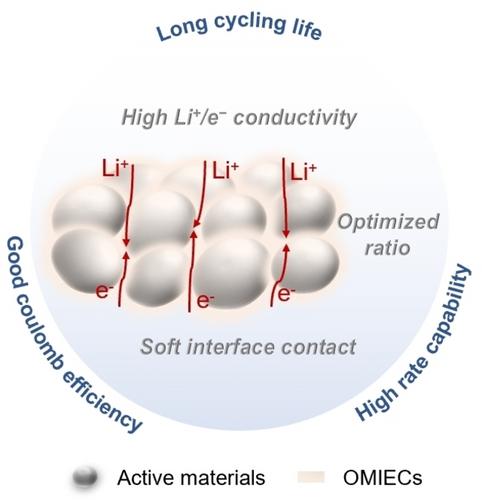
Solid-state lithium-metal batteries are considered as one of the most promising candidates for next-generation energy storage devices with high energy density and enhanced safety. Great efforts have been made to design solid-state electrolytes with enhanced ionic conductivity and to protect the electrochemical interface of the lithium anode. However, the obstruction of ionic-electronic transport within the cathode remains as another key challenge that needs to be addressed for the practical application of solid-state batteries. Here, we prepared organic mixed ionic-electronic conductors (OMIECs) by in-situ co-polymerization of three organic monomers (boron-type crosslinker, ionic liquid, and sulfolene) in the network of poly(3,4-ethylenedioxythiophene)/poly(4-styrenesulfonate). The as-prepared OMIECs show an electronic conductivity up to 33.6 S cm−1 and ionic conductivity of 1.7×10⁻⁴ S cm−1 at 30 °C, and also binder functionality, providing a combined path for Li+/e− transport in cathodes and maintaining mechanical/(electro−)chemical stability. As a result, solid-state cathodes composed of 90.0 wt % active materials and only 10.0 wt % OMIECs display exceptional electrochemical characteristics at 30 °C, including high C-rate capabilities and prolonged cycle life. This novel design of all-in-one OMIECs for carbon-free cathodes demonstrates a promising strategy for developing multifunctional additives for high-performance solid-state batteries.
期刊介绍:
Electrochemical energy storage devices play a transformative role in our societies. They have allowed the emergence of portable electronics devices, have triggered the resurgence of electric transportation and constitute key components in smart power grids. Batteries & Supercaps publishes international high-impact experimental and theoretical research on the fundamentals and applications of electrochemical energy storage. We support the scientific community to advance energy efficiency and sustainability.




 京公网安备 11010802042870号
京ICP备2023020795号-1
京公网安备 11010802042870号
京ICP备2023020795号-1

 分享
分享
 求助内容:
求助内容: 应助结果提醒方式:
 扫码关注我们
