Peng Chen, Qianju Song, Can Ma, Zao Yi, Liang Bian, Shubo Cheng, Zhiqiang Hao, Tangyou Sun, Pinghui Wu and Qingdong Zeng
{"title":"Multilayer stacked ultra-wideband perfect solar absorber and thermal emitter based on SiO2-InAs-TiN nanofilm structure","authors":"Peng Chen, Qianju Song, Can Ma, Zao Yi, Liang Bian, Shubo Cheng, Zhiqiang Hao, Tangyou Sun, Pinghui Wu and Qingdong Zeng","doi":"10.1039/D4DT01626B","DOIUrl":null,"url":null,"abstract":"<p >In this paper, a broadband solar absorber is constructed and simulated based on the finite difference time domain method (FDTD). The modeled structure of the absorber consists of cyclic stacking of five absorber cells with different periods on refractory metal W, where a single absorber cell is composed of a three-layer SiO<small><sub>2</sub></small>-InAs-TiN square film. Due to the Fabry–Perot resonance and the surface plasmon resonance (SPR), an absorptivity greater than 90% within a bandwidth of 2599.5 nm was achieved for the absorber. Notably, one of these bands, 2001 nm, is a high-efficiency absorption with an absorption rate greater than 99%. The average absorption efficiency reaches 99.31% at an air mass of 1.5 (AM 1.5), and the thermal radiation efficiencies are 97.35% and 97.83% at 1000 K and 1200 K, respectively. At the same time, the structure of the absorber is also polarization-independent, and when the solar incidence angle is increased to 60°, it still achieves an average absorption of 90.83% over the entire wavelength band (280 nm to 3000 nm). The novelty of our work is to provide a design idea based on a unit structure with multiple cycles, which can effectively expand the absorption bandwidth of the absorber in the visible-near-infrared wavelengths. The excellent performances make the structure widely used in the field of solar energy absorption.</p>","PeriodicalId":71,"journal":{"name":"Dalton Transactions","volume":" 29","pages":" 12098-12106"},"PeriodicalIF":3.3000,"publicationDate":"2024-07-02","publicationTypes":"Journal Article","fieldsOfStudy":null,"isOpenAccess":false,"openAccessPdf":"","citationCount":"0","resultStr":null,"platform":"Semanticscholar","paperid":null,"PeriodicalName":"Dalton Transactions","FirstCategoryId":"92","ListUrlMain":"https://pubs.rsc.org/en/content/articlelanding/2024/dt/d4dt01626b","RegionNum":3,"RegionCategory":"化学","ArticlePicture":[],"TitleCN":null,"AbstractTextCN":null,"PMCID":null,"EPubDate":"","PubModel":"","JCR":"Q2","JCRName":"CHEMISTRY, INORGANIC & NUCLEAR","Score":null,"Total":0}
引用次数: 0
Abstract
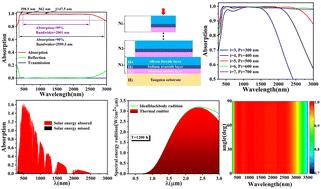
In this paper, a broadband solar absorber is constructed and simulated based on the finite difference time domain method (FDTD). The modeled structure of the absorber consists of cyclic stacking of five absorber cells with different periods on refractory metal W, where a single absorber cell is composed of a three-layer SiO2-InAs-TiN square film. Due to the Fabry–Perot resonance and the surface plasmon resonance (SPR), an absorptivity greater than 90% within a bandwidth of 2599.5 nm was achieved for the absorber. Notably, one of these bands, 2001 nm, is a high-efficiency absorption with an absorption rate greater than 99%. The average absorption efficiency reaches 99.31% at an air mass of 1.5 (AM 1.5), and the thermal radiation efficiencies are 97.35% and 97.83% at 1000 K and 1200 K, respectively. At the same time, the structure of the absorber is also polarization-independent, and when the solar incidence angle is increased to 60°, it still achieves an average absorption of 90.83% over the entire wavelength band (280 nm to 3000 nm). The novelty of our work is to provide a design idea based on a unit structure with multiple cycles, which can effectively expand the absorption bandwidth of the absorber in the visible-near-infrared wavelengths. The excellent performances make the structure widely used in the field of solar energy absorption.
期刊介绍:
Dalton Transactions is a journal for all areas of inorganic chemistry, which encompasses the organometallic, bioinorganic and materials chemistry of the elements, with applications including synthesis, catalysis, energy conversion/storage, electrical devices and medicine. Dalton Transactions welcomes high-quality, original submissions in all of these areas and more, where the advancement of knowledge in inorganic chemistry is significant.



 京公网安备 11010802042870号
京ICP备2023020795号-1
京公网安备 11010802042870号
京ICP备2023020795号-1

 分享
分享
 求助内容:
求助内容: 应助结果提醒方式:
 扫码关注我们
