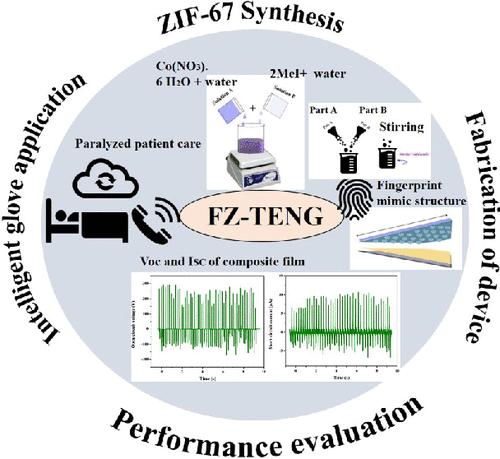
{"title":"Fingerprint-Mimicking, ZIF-67 Decorated, Triboelectric Nanogenerator for IoT Cloud-Supported Self-Powered Smart Glove for Paralyzed Patient Care","authors":"Nitha P K, Arunkumar Chandrasekhar","doi":"10.1021/acsaelm.4c00942","DOIUrl":null,"url":null,"abstract":"Zeolitic imidazole framework (ZIF) is a subclass of porous materials with a relevant position in the triboelectric series. Triboelectric nanogenerator (TENG) transforms motion energy into electrical energy, in which MOF (metal–organic framework) material enhances the performance. MOF/polymer composite is one of the vital aspects of MOF-TENG fabrication; until now, the ZIF-67 composite with a surface modification has not been introduced. This study investigates the performance of a composite structure with ZIF-67 and ecoflex where the film mimics fingerprint structure, which is this work’s state of the art. Ecofriendly synthesis of MOF results in an e-skin, where the electron trapping property of ZIF-67 in the polymer matrix is deployed. Moreover, a self-powered smart glove has been introduced to assist paralyzed persons in ICUs. As a paralyzed person cannot move and ask for help, this e-skin-based smart glove will play a significant role in assisting through a phone call alert on a smartphone, and a waveform will be generated in the Arduino IoT cloud dashboard. Node MCU ESP-32, IFTTT webhook service, and VoIP (Voice over Internet Protocol) services are leveraged in deploying this. Till now, remote healthcare applications have not been implemented with MOF-TENG, and this IoT-supported intelligent glove will revolutionize modern healthcare (m-healthcare).","PeriodicalId":3,"journal":{"name":"ACS Applied Electronic Materials","volume":"132 1","pages":""},"PeriodicalIF":4.7000,"publicationDate":"2024-07-02","publicationTypes":"Journal Article","fieldsOfStudy":null,"isOpenAccess":false,"openAccessPdf":"","citationCount":"0","resultStr":null,"platform":"Semanticscholar","paperid":null,"PeriodicalName":"ACS Applied Electronic Materials","FirstCategoryId":"88","ListUrlMain":"https://doi.org/10.1021/acsaelm.4c00942","RegionNum":3,"RegionCategory":"材料科学","ArticlePicture":[],"TitleCN":null,"AbstractTextCN":null,"PMCID":null,"EPubDate":"","PubModel":"","JCR":"Q1","JCRName":"ENGINEERING, ELECTRICAL & ELECTRONIC","Score":null,"Total":0}
引用次数: 0
Abstract
Zeolitic imidazole framework (ZIF) is a subclass of porous materials with a relevant position in the triboelectric series. Triboelectric nanogenerator (TENG) transforms motion energy into electrical energy, in which MOF (metal–organic framework) material enhances the performance. MOF/polymer composite is one of the vital aspects of MOF-TENG fabrication; until now, the ZIF-67 composite with a surface modification has not been introduced. This study investigates the performance of a composite structure with ZIF-67 and ecoflex where the film mimics fingerprint structure, which is this work’s state of the art. Ecofriendly synthesis of MOF results in an e-skin, where the electron trapping property of ZIF-67 in the polymer matrix is deployed. Moreover, a self-powered smart glove has been introduced to assist paralyzed persons in ICUs. As a paralyzed person cannot move and ask for help, this e-skin-based smart glove will play a significant role in assisting through a phone call alert on a smartphone, and a waveform will be generated in the Arduino IoT cloud dashboard. Node MCU ESP-32, IFTTT webhook service, and VoIP (Voice over Internet Protocol) services are leveraged in deploying this. Till now, remote healthcare applications have not been implemented with MOF-TENG, and this IoT-supported intelligent glove will revolutionize modern healthcare (m-healthcare).
期刊介绍:
ACS Applied Electronic Materials is an interdisciplinary journal publishing original research covering all aspects of electronic materials. The journal is devoted to reports of new and original experimental and theoretical research of an applied nature that integrate knowledge in the areas of materials science, engineering, optics, physics, and chemistry into important applications of electronic materials. Sample research topics that span the journal's scope are inorganic, organic, ionic and polymeric materials with properties that include conducting, semiconducting, superconducting, insulating, dielectric, magnetic, optoelectronic, piezoelectric, ferroelectric and thermoelectric.
Indexed/Abstracted:
Web of Science SCIE
Scopus
CAS
INSPEC
Portico




 京公网安备 11010802042870号
京ICP备2023020795号-1
京公网安备 11010802042870号
京ICP备2023020795号-1

 分享
分享
 求助内容:
求助内容: 应助结果提醒方式:
 扫码关注我们
