Localized incompletely resected standard risk rhabdomyosarcoma in children and adolescents: Results from the European Paediatric Soft Tissue Sarcoma Study Group RMS 2005 trial
Henry C. Mandeville MBChB, MD(Res), Gianni Bisogno MD, PhD, Veronique Minard-Colin MD, PhD, Rita Alaggio MD, Myriam Ben-Arush MD, Cyrus Chargari MD, PhD, Beatrice Coppadoro BSc, Ross Craigie MBChB, Christine Devalck MD, Sima Ferman MD, PhD, Andrea Ferrari MD, Heidi Glosli MD, Raquel Hladun Alvaro MD, Marinka Hol MD, PhD, Peter Mudry MD, Daniel Orbach MD, Monica Ramos Albiac MD, Johannes H. M. Merks MD, PhD, Meriel E. M. Jenney MBChB, MD
{"title":"Localized incompletely resected standard risk rhabdomyosarcoma in children and adolescents: Results from the European Paediatric Soft Tissue Sarcoma Study Group RMS 2005 trial","authors":"Henry C. Mandeville MBChB, MD(Res), Gianni Bisogno MD, PhD, Veronique Minard-Colin MD, PhD, Rita Alaggio MD, Myriam Ben-Arush MD, Cyrus Chargari MD, PhD, Beatrice Coppadoro BSc, Ross Craigie MBChB, Christine Devalck MD, Sima Ferman MD, PhD, Andrea Ferrari MD, Heidi Glosli MD, Raquel Hladun Alvaro MD, Marinka Hol MD, PhD, Peter Mudry MD, Daniel Orbach MD, Monica Ramos Albiac MD, Johannes H. M. Merks MD, PhD, Meriel E. M. Jenney MBChB, MD","doi":"10.1002/cncr.35497","DOIUrl":null,"url":null,"abstract":"<div>\n \n \n <section>\n \n <h3> Background</h3>\n \n <p>The authors report the prospective evaluation of reduced dose alkylator chemotherapy combined with radiotherapy for European Pediatric Soft Tissue Sarcoma Study Group (EpSSG) standard risk nonalveolar rhabdomyosarcoma (NA-RMS).</p>\n </section>\n \n <section>\n \n <h3> Patients and Methods</h3>\n \n <p>Localized node negative Intergroup Rhabdomyosarcoma Study (IRS) II/III NA-RMS at favorable sites (subgroup C), <25 years old, received five cycles of ifosfamide, vincristine, and dactinomycin (IVA) chemotherapy (30 g/m<sup>2</sup> ifosfamide) and four cycles of vincristine and dactinomycin (if receiving radiotherapy), or nine cycles of IVA (54 g/m<sup>2</sup> ifosfamide) ± radiotherapy. Delayed primary tumor excision was considered for IRS III tumors. The primary end points were event-free survival (EFS) and overall survival (OS).</p>\n </section>\n \n <section>\n \n <h3> Results</h3>\n \n <p>From October 2005 to December 2016, 359 evaluable patients were recruited: orbit, 164 (45.7%); head and neck nonparameningeal, 77 (21.4%); and genitourinary non–bladder/prostate, 118 (32.9%). EFS and OS were 77.4% (95% confidence interval [CI], 72.5–81.6) and 93.5% (95% CI, 90.1–95.8), respectively. Lower dose alkylator chemotherapy and radiotherapy achieved 5-year OS of 93.7% but the difference with higher dose alkylator chemotherapy +/- radiotherapy was not significant (<i>p</i> = 0.8003). Adjuvant radiotherapy improved EFS with 5-year estimates of 84.7% versus 65.2% for nonirradiated (<i>p</i> < .0001), but not OS (<i>p</i> = .9298). Omitting radiotherapy for orbital tumors reduced OS (5-year was 87.1% vs. 97.3% for irradiated, <i>p</i> = .0257). Following R0 resection (<i>n</i> = 60), radiotherapy did not significantly improve EFS or OS.</p>\n </section>\n \n <section>\n \n <h3> Conclusions</h3>\n \n <p>Radiotherapy for local tumor control allows for reduction of cumulative dose of alkylators in EpSSG standard risk subgroup C RMS patients. The omission of radiotherapy did not affect OS in all patients except those with orbital RMS and was associated with inferior EFS.</p>\n </section>\n </div>","PeriodicalId":138,"journal":{"name":"Cancer","volume":"130 23","pages":"4071-4084"},"PeriodicalIF":5.6000,"publicationDate":"2024-07-26","publicationTypes":"Journal Article","fieldsOfStudy":null,"isOpenAccess":false,"openAccessPdf":"https://onlinelibrary.wiley.com/doi/epdf/10.1002/cncr.35497","citationCount":"0","resultStr":null,"platform":"Semanticscholar","paperid":null,"PeriodicalName":"Cancer","FirstCategoryId":"3","ListUrlMain":"https://acsjournals.onlinelibrary.wiley.com/doi/10.1002/cncr.35497","RegionNum":2,"RegionCategory":"医学","ArticlePicture":[],"TitleCN":null,"AbstractTextCN":null,"PMCID":null,"EPubDate":"","PubModel":"","JCR":"Q1","JCRName":"ONCOLOGY","Score":null,"Total":0}
引用次数: 0
Abstract
Background
The authors report the prospective evaluation of reduced dose alkylator chemotherapy combined with radiotherapy for European Pediatric Soft Tissue Sarcoma Study Group (EpSSG) standard risk nonalveolar rhabdomyosarcoma (NA-RMS).
Patients and Methods
Localized node negative Intergroup Rhabdomyosarcoma Study (IRS) II/III NA-RMS at favorable sites (subgroup C), <25 years old, received five cycles of ifosfamide, vincristine, and dactinomycin (IVA) chemotherapy (30 g/m2 ifosfamide) and four cycles of vincristine and dactinomycin (if receiving radiotherapy), or nine cycles of IVA (54 g/m2 ifosfamide) ± radiotherapy. Delayed primary tumor excision was considered for IRS III tumors. The primary end points were event-free survival (EFS) and overall survival (OS).
Results
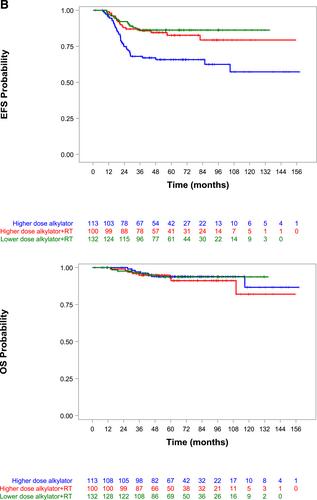
From October 2005 to December 2016, 359 evaluable patients were recruited: orbit, 164 (45.7%); head and neck nonparameningeal, 77 (21.4%); and genitourinary non–bladder/prostate, 118 (32.9%). EFS and OS were 77.4% (95% confidence interval [CI], 72.5–81.6) and 93.5% (95% CI, 90.1–95.8), respectively. Lower dose alkylator chemotherapy and radiotherapy achieved 5-year OS of 93.7% but the difference with higher dose alkylator chemotherapy +/- radiotherapy was not significant (p = 0.8003). Adjuvant radiotherapy improved EFS with 5-year estimates of 84.7% versus 65.2% for nonirradiated (p < .0001), but not OS (p = .9298). Omitting radiotherapy for orbital tumors reduced OS (5-year was 87.1% vs. 97.3% for irradiated, p = .0257). Following R0 resection (n = 60), radiotherapy did not significantly improve EFS or OS.
Conclusions
Radiotherapy for local tumor control allows for reduction of cumulative dose of alkylators in EpSSG standard risk subgroup C RMS patients. The omission of radiotherapy did not affect OS in all patients except those with orbital RMS and was associated with inferior EFS.
期刊介绍:
The CANCER site is a full-text, electronic implementation of CANCER, an Interdisciplinary International Journal of the American Cancer Society, and CANCER CYTOPATHOLOGY, a Journal of the American Cancer Society.
CANCER publishes interdisciplinary oncologic information according to, but not limited to, the following disease sites and disciplines: blood/bone marrow; breast disease; endocrine disorders; epidemiology; gastrointestinal tract; genitourinary disease; gynecologic oncology; head and neck disease; hepatobiliary tract; integrated medicine; lung disease; medical oncology; neuro-oncology; pathology radiation oncology; translational research





 京公网安备 11010802042870号
京ICP备2023020795号-1
京公网安备 11010802042870号
京ICP备2023020795号-1

 分享
分享
 求助内容:
求助内容: 应助结果提醒方式:
 扫码关注我们
