Matías Olmo, Pep Cos, Ángel G. Muñoz, Vicent Altava-Ortiz, Antoni Barrera-Escoda, Diego Campos, Albert Soret, Francisco Doblas-Reyes
{"title":"Cross-time scale analysis of year-round atmospheric circulation patterns and their impacts on rainfall and temperatures in the Iberian Peninsula","authors":"Matías Olmo, Pep Cos, Ángel G. Muñoz, Vicent Altava-Ortiz, Antoni Barrera-Escoda, Diego Campos, Albert Soret, Francisco Doblas-Reyes","doi":"10.1175/jcli-d-23-0735.1","DOIUrl":null,"url":null,"abstract":"\nThis study presents a framework to assess climate variability and change through atmospheric circulation patterns (CPs) and their link with regional processes across time scales. We evaluate the CPs impacts on daily rainfall, and maximum and minimum temperatures in the Iberian Peninsula using sea-level pressure (SLP) during 1950–2022. Different sensitivity analyses are performed, employing multiple spatial domains and number of patterns. An optimal classification is found in midlatitudes, centered over the Mediterranean basin and covering part of the North Atlantic Ocean, which can identify atmospheric configurations significantly related to discriminated rainfall and temperature anomalies, with clear seasonal behavior. The temporal variability of CPs is studied across time scales showing, e.g., that transitions between patterns are faster in autumn and spring, and that CPs exhibit distinct temporal variability at intraseasonal, seasonal, interannual and decadal scales, including significant long-term trends on their frequency. CPs influence temperature and precipitation variations throughout the year. The winter season exhibits the largest atmospheric circulation variability, while the summer is dominated by persistent high-pressure structures –the Subtropical Azores High– leading to warm and dry conditions. Based on an interannual correlation analysis, some CPs are significantly associated with the North Atlantic Oscillation (NAO), stronger during winter, indicating the NAO modulation on the regional-to-local climatic features. Overall, this approach arises as a dynamic cross-time scale framework that can be adapted to specific user needs and levels of regional detail, being useful to study climate drivers for climate change and to perform a process-based evaluation of climate models.","PeriodicalId":4,"journal":{"name":"ACS Applied Energy Materials","volume":"31 13","pages":""},"PeriodicalIF":5.5000,"publicationDate":"2024-07-26","publicationTypes":"Journal Article","fieldsOfStudy":null,"isOpenAccess":false,"openAccessPdf":"","citationCount":"0","resultStr":null,"platform":"Semanticscholar","paperid":null,"PeriodicalName":"ACS Applied Energy Materials","FirstCategoryId":"89","ListUrlMain":"https://doi.org/10.1175/jcli-d-23-0735.1","RegionNum":3,"RegionCategory":"材料科学","ArticlePicture":[],"TitleCN":null,"AbstractTextCN":null,"PMCID":null,"EPubDate":"","PubModel":"","JCR":"Q2","JCRName":"CHEMISTRY, PHYSICAL","Score":null,"Total":0}
引用次数: 0
Abstract
This study presents a framework to assess climate variability and change through atmospheric circulation patterns (CPs) and their link with regional processes across time scales. We evaluate the CPs impacts on daily rainfall, and maximum and minimum temperatures in the Iberian Peninsula using sea-level pressure (SLP) during 1950–2022. Different sensitivity analyses are performed, employing multiple spatial domains and number of patterns. An optimal classification is found in midlatitudes, centered over the Mediterranean basin and covering part of the North Atlantic Ocean, which can identify atmospheric configurations significantly related to discriminated rainfall and temperature anomalies, with clear seasonal behavior. The temporal variability of CPs is studied across time scales showing, e.g., that transitions between patterns are faster in autumn and spring, and that CPs exhibit distinct temporal variability at intraseasonal, seasonal, interannual and decadal scales, including significant long-term trends on their frequency. CPs influence temperature and precipitation variations throughout the year. The winter season exhibits the largest atmospheric circulation variability, while the summer is dominated by persistent high-pressure structures –the Subtropical Azores High– leading to warm and dry conditions. Based on an interannual correlation analysis, some CPs are significantly associated with the North Atlantic Oscillation (NAO), stronger during winter, indicating the NAO modulation on the regional-to-local climatic features. Overall, this approach arises as a dynamic cross-time scale framework that can be adapted to specific user needs and levels of regional detail, being useful to study climate drivers for climate change and to perform a process-based evaluation of climate models.
期刊介绍:
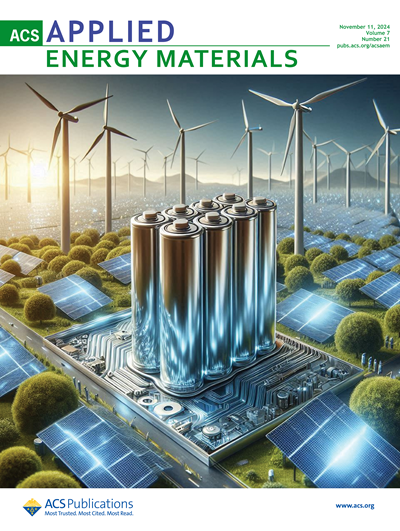
ACS Applied Energy Materials is an interdisciplinary journal publishing original research covering all aspects of materials, engineering, chemistry, physics and biology relevant to energy conversion and storage. The journal is devoted to reports of new and original experimental and theoretical research of an applied nature that integrate knowledge in the areas of materials, engineering, physics, bioscience, and chemistry into important energy applications.




 京公网安备 11010802042870号
京ICP备2023020795号-1
京公网安备 11010802042870号
京ICP备2023020795号-1

 分享
分享
 求助内容:
求助内容: 应助结果提醒方式:
 扫码关注我们
