{"title":"[Early auditory processing of speech in prelingually-deafened children with cochlear implants based on event-related potentials].","authors":"X R Xu, J Q Sun, R R Guan, X T Guo, J W Sun","doi":"10.3760/cma.j.cn115330-20231122-00234","DOIUrl":null,"url":null,"abstract":"<p><p><b>Objective:</b> To investigate the early auditory discrimination of vowels, consonants and lexical tones in prelingually-deafened children with cochlear implants (CI) using auditory event-related potentials. <b>Methods:</b> Nineteen prelingually-deafened CI children and 19 normal hearing (NH) children were recruited in this study. A multi-deviant oddball paradigm was constructed using the monosyllable/ta1/as the standard stimulus and monosyllables/tu1/,/te1/, /da1/,/ra1/,/ta4/and/ta2/as the deviant stimuli. The event-related potentials evoked by vowel, consonant and lexical tone contrasts were recorded and analyzed in the two groups. <b>Results:</b> NH children showed robust mismatch negativities (MMNs) to vowel, consonant and lexical tone contrasts (<i>P<</i>0.05), whereas CI children only showed positive mismatch responses (pMMRs) and P3a responses to the vowel (<i>P<</i>0.05) and consonant contrasts (<i>P<</i>0.05) and no significant event-related potential to the lexical tone contrasts (<i>P</i>>0.05). The longer pMMR and P3a peak latencies (<i>P</i><0.01) but similar amplitudes (<i>P</i>>0.05) were found in CI children than in NH children. CI children showed weaker phase synchronization of θ oscillations than NH children (<i>P</i><0.05). The duration of CI use was positively correlated with the scores of Categories of Auditory Performance (CAP) (<i>P</i>=0.004), Speech Intelligibility Rate (SIR) (<i>P</i>=0.044) and Meaningful Auditory Integration Scale (MAIS) (<i>P</i>=0.001) in CI children. <b>Conclusions:</b> Prelingually-deafened CI children can process vowels and consonants at an early stage. However, their ability of processing speech, especially lexical tones, is still more immature compared with their NH peers. The event-related potentials could be objective electrophysiological indicators reflecting the maturity of CI children's auditory speech functions. Long-term CI use is beneficial for prelingually-deafened children to improve auditory and speech performance.</p>","PeriodicalId":23987,"journal":{"name":"Chinese journal of otorhinolaryngology head and neck surgery","volume":"59 7","pages":"705-713"},"PeriodicalIF":0.0000,"publicationDate":"2024-07-07","publicationTypes":"Journal Article","fieldsOfStudy":null,"isOpenAccess":false,"openAccessPdf":"","citationCount":"0","resultStr":null,"platform":"Semanticscholar","paperid":null,"PeriodicalName":"Chinese journal of otorhinolaryngology head and neck surgery","FirstCategoryId":"3","ListUrlMain":"https://doi.org/10.3760/cma.j.cn115330-20231122-00234","RegionNum":0,"RegionCategory":null,"ArticlePicture":[],"TitleCN":null,"AbstractTextCN":null,"PMCID":null,"EPubDate":"","PubModel":"","JCR":"Q4","JCRName":"Medicine","Score":null,"Total":0}
引用次数: 0
Abstract
Objective: To investigate the early auditory discrimination of vowels, consonants and lexical tones in prelingually-deafened children with cochlear implants (CI) using auditory event-related potentials. Methods: Nineteen prelingually-deafened CI children and 19 normal hearing (NH) children were recruited in this study. A multi-deviant oddball paradigm was constructed using the monosyllable/ta1/as the standard stimulus and monosyllables/tu1/,/te1/, /da1/,/ra1/,/ta4/and/ta2/as the deviant stimuli. The event-related potentials evoked by vowel, consonant and lexical tone contrasts were recorded and analyzed in the two groups. Results: NH children showed robust mismatch negativities (MMNs) to vowel, consonant and lexical tone contrasts (P<0.05), whereas CI children only showed positive mismatch responses (pMMRs) and P3a responses to the vowel (P<0.05) and consonant contrasts (P<0.05) and no significant event-related potential to the lexical tone contrasts (P>0.05). The longer pMMR and P3a peak latencies (P<0.01) but similar amplitudes (P>0.05) were found in CI children than in NH children. CI children showed weaker phase synchronization of θ oscillations than NH children (P<0.05). The duration of CI use was positively correlated with the scores of Categories of Auditory Performance (CAP) (P=0.004), Speech Intelligibility Rate (SIR) (P=0.044) and Meaningful Auditory Integration Scale (MAIS) (P=0.001) in CI children. Conclusions: Prelingually-deafened CI children can process vowels and consonants at an early stage. However, their ability of processing speech, especially lexical tones, is still more immature compared with their NH peers. The event-related potentials could be objective electrophysiological indicators reflecting the maturity of CI children's auditory speech functions. Long-term CI use is beneficial for prelingually-deafened children to improve auditory and speech performance.
期刊介绍:
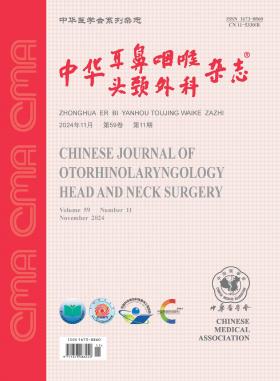
Chinese journal of otorhinolaryngology head and neck surgery is a high-level medical science and technology journal sponsored and published directly by the Chinese Medical Association, reflecting the significant research progress in the field of otorhinolaryngology head and neck surgery in China, and striving to promote the domestic and international academic exchanges for the purpose of running the journal.
Over the years, the journal has been ranked first in the total citation frequency list of national scientific and technical journals published by the Documentation and Intelligence Center of the Chinese Academy of Sciences and the China Science Citation Database, and has always ranked first among the scientific and technical journals in the related fields.
Chinese journal of otorhinolaryngology head and neck surgery has been included in the authoritative databases PubMed, Chinese core journals, CSCD.



 京公网安备 11010802042870号
京ICP备2023020795号-1
京公网安备 11010802042870号
京ICP备2023020795号-1

 分享
分享
 求助内容:
求助内容: 应助结果提醒方式:
 扫码关注我们
