Dr. Caio de O. G. Silva, Dr. Peicheng Sun, Dr. Kristian Barrett, Dr. Mark G. Sanders, Prof. Willem J. H. van Berkel, Prof. Mirjam A. Kabel, Prof. Anne S. Meyer, Prof. Jane W. Agger
{"title":"Polyphenol Oxidase Activity on Guaiacyl and Syringyl Lignin Units","authors":"Dr. Caio de O. G. Silva, Dr. Peicheng Sun, Dr. Kristian Barrett, Dr. Mark G. Sanders, Prof. Willem J. H. van Berkel, Prof. Mirjam A. Kabel, Prof. Anne S. Meyer, Prof. Jane W. Agger","doi":"10.1002/anie.202409324","DOIUrl":null,"url":null,"abstract":"<p>The natural heterogeneity of guaiacyl (G) and syringyl (S) compounds resulting from lignin processing hampers their direct use as plant-based chemicals and materials. Herein, we explore six short polyphenol oxidases (PPOs) from lignocellulose-degrading ascomycetes for their capacity to react with G-type and S-type phenolic compounds. All six PPOs catalyze the <i>ortho-</i>hydroxylation of G-type compounds (guaiacol, vanillic acid, and ferulic acid), forming the corresponding methoxy-<i>ortho</i>-diphenols. Remarkably, a subset of these PPOs is also active towards S-compounds (syringol, syringic acid, and sinapic acid) resulting in identical methoxy-<i>ortho-</i>diphenols. Assays with <sup>18</sup>O<sub>2</sub> demonstrate that these PPOs in particular catalyze <i>ortho</i>-hydroxylation and <i>ortho</i>-demethoxylation of S-compounds and generate methanol as a co-product. Oxidative (<i>ortho</i>−) demethoxylation of S-compounds is a novel reaction for PPOs, which we propose occurs by a distinct reaction mechanism as compared to aryl-O-demethylases. We further show that addition of a reducing agent can steer the PPO reaction to form methoxy-<i>ortho</i>-diphenols from both G- and S-type substrates rather than reactive quinones that lead to unfavorable polymerization. Application of PPOs opens for new routes to reduce the heterogeneity and methoxylation degree of mixtures of G and S lignin-derived compounds.</p>","PeriodicalId":125,"journal":{"name":"Angewandte Chemie International Edition","volume":"63 48","pages":""},"PeriodicalIF":16.9000,"publicationDate":"2024-09-17","publicationTypes":"Journal Article","fieldsOfStudy":null,"isOpenAccess":false,"openAccessPdf":"https://onlinelibrary.wiley.com/doi/epdf/10.1002/anie.202409324","citationCount":"0","resultStr":null,"platform":"Semanticscholar","paperid":null,"PeriodicalName":"Angewandte Chemie International Edition","FirstCategoryId":"92","ListUrlMain":"https://onlinelibrary.wiley.com/doi/10.1002/anie.202409324","RegionNum":1,"RegionCategory":"化学","ArticlePicture":[],"TitleCN":null,"AbstractTextCN":null,"PMCID":null,"EPubDate":"","PubModel":"","JCR":"Q1","JCRName":"CHEMISTRY, MULTIDISCIPLINARY","Score":null,"Total":0}
引用次数: 0
Abstract
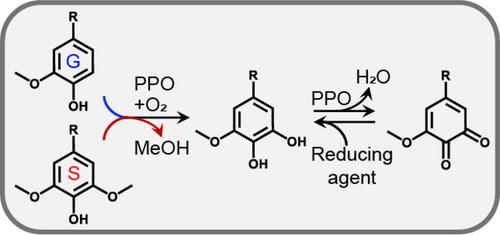
The natural heterogeneity of guaiacyl (G) and syringyl (S) compounds resulting from lignin processing hampers their direct use as plant-based chemicals and materials. Herein, we explore six short polyphenol oxidases (PPOs) from lignocellulose-degrading ascomycetes for their capacity to react with G-type and S-type phenolic compounds. All six PPOs catalyze the ortho-hydroxylation of G-type compounds (guaiacol, vanillic acid, and ferulic acid), forming the corresponding methoxy-ortho-diphenols. Remarkably, a subset of these PPOs is also active towards S-compounds (syringol, syringic acid, and sinapic acid) resulting in identical methoxy-ortho-diphenols. Assays with 18O2 demonstrate that these PPOs in particular catalyze ortho-hydroxylation and ortho-demethoxylation of S-compounds and generate methanol as a co-product. Oxidative (ortho−) demethoxylation of S-compounds is a novel reaction for PPOs, which we propose occurs by a distinct reaction mechanism as compared to aryl-O-demethylases. We further show that addition of a reducing agent can steer the PPO reaction to form methoxy-ortho-diphenols from both G- and S-type substrates rather than reactive quinones that lead to unfavorable polymerization. Application of PPOs opens for new routes to reduce the heterogeneity and methoxylation degree of mixtures of G and S lignin-derived compounds.
木质素加工过程中产生的愈创木基(G)和丁香基(S)化合物的天然异质性阻碍了它们作为植物基化学品和材料的直接使用。在本文中,我们研究了木质纤维素降解子囊菌中的六种短多酚氧化酶(PPOs)与 G 型和 S 型酚类化合物反应的能力。所有六种 PPO 都能催化 G 型化合物(愈创木酚、香草酸和阿魏酸)的正羟化反应,形成相应的甲氧基正二苯酚。值得注意的是,这些 PPO 中的一个子集对 S 型化合物(丁香酚、丁香酸和山奈酸)也具有活性,可生成相同的甲氧基邻二苯酚。用 18O2 进行的检测表明,这些 PPO 尤其能催化 S-化合物的正羟化和正去甲氧基化反应,并生成甲醇作为副产品。值得注意的是,S-化合物的氧化(正)去甲氧基化是 PPOs 的一种新反应,我们认为其反应机制与芳基-O-去甲基化酶不同。我们进一步证明,添加还原剂可以引导 PPO 反应,使 G 型和 S 型底物形成甲氧基邻二苯酚,而不是导致不利聚合的活性醌。PPO 的应用为降低 G 型和 S 型木质素衍生化合物混合物的异质性和甲氧基化程度开辟了新的途径。
期刊介绍:
Angewandte Chemie, a journal of the German Chemical Society (GDCh), maintains a leading position among scholarly journals in general chemistry with an impressive Impact Factor of 16.6 (2022 Journal Citation Reports, Clarivate, 2023). Published weekly in a reader-friendly format, it features new articles almost every day. Established in 1887, Angewandte Chemie is a prominent chemistry journal, offering a dynamic blend of Review-type articles, Highlights, Communications, and Research Articles on a weekly basis, making it unique in the field.



 京公网安备 11010802042870号
京ICP备2023020795号-1
京公网安备 11010802042870号
京ICP备2023020795号-1

 分享
分享
 求助内容:
求助内容: 应助结果提醒方式:
 扫码关注我们
