Priyanshi Agnihotri, Divya Dheer, Anvi Sangwan, Vysakh C. Chandran, Nimisha A. Mavlankar, Gunjan Hooda, Debabrata Patra and Asish Pal
{"title":"Design of multi-responsive and actuating microgels toward on-demand drug release†","authors":"Priyanshi Agnihotri, Divya Dheer, Anvi Sangwan, Vysakh C. Chandran, Nimisha A. Mavlankar, Gunjan Hooda, Debabrata Patra and Asish Pal","doi":"10.1039/D4NR02728K","DOIUrl":null,"url":null,"abstract":"<p >Multifunctional colloidal microgels that exhibit stimuli-responsive behaviour and excellent biocompatibility have attracted particular attention for developing functional compartmentalized networks. Herein, a series of stimuli-responsive microgels (<strong>M0</strong>, <strong>M1</strong>, and <strong>M2</strong>) were designed through the copolymerization of di(ethylene glycol) methyl ether methacrylate (DEGMA) and methacrylic acid (MAA) monomers using hydroxy ethyl methacrylate-coupled azobenzene (HEMA-Az) and ethylene glycol dimetharylate (EGDMA) as crosslinkers. The behaviour of the microgels in response to temperature, pH, and light was thoroughly investigated using spectroscopic, microscopic, and light-scattering techniques. Interestingly, the microgels deswelled with an increase in temperature, decrease in pH, and under the irradiation of UV light. Such a reversible swelling/deswelling behaviour was exploited for microgel <strong>M2</strong>, which showed better photoactuation at pH 5 with a higher fluid pumping velocity. The actuating microgel <strong>M2</strong> was optimized for loading the drug ciprofloxacin (<strong>Cf</strong>) to study its release at different temperature, pH, and light conditions. Microgel <strong>M2</strong> exhibited photoresponsive <strong>Cf</strong> release at pH 5 and 37 °C, demonstrating its potential for application in on-demand drug release.</p>","PeriodicalId":92,"journal":{"name":"Nanoscale","volume":" 41","pages":" 19254-19265"},"PeriodicalIF":5.1000,"publicationDate":"2024-09-18","publicationTypes":"Journal Article","fieldsOfStudy":null,"isOpenAccess":false,"openAccessPdf":"","citationCount":"0","resultStr":null,"platform":"Semanticscholar","paperid":null,"PeriodicalName":"Nanoscale","FirstCategoryId":"88","ListUrlMain":"https://pubs.rsc.org/en/content/articlelanding/2024/nr/d4nr02728k","RegionNum":3,"RegionCategory":"材料科学","ArticlePicture":[],"TitleCN":null,"AbstractTextCN":null,"PMCID":null,"EPubDate":"","PubModel":"","JCR":"Q1","JCRName":"CHEMISTRY, MULTIDISCIPLINARY","Score":null,"Total":0}
引用次数: 0
Abstract
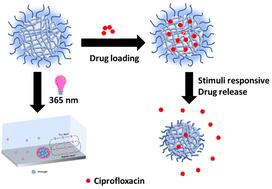
Multifunctional colloidal microgels that exhibit stimuli-responsive behaviour and excellent biocompatibility have attracted particular attention for developing functional compartmentalized networks. Herein, a series of stimuli-responsive microgels (M0, M1, and M2) were designed through the copolymerization of di(ethylene glycol) methyl ether methacrylate (DEGMA) and methacrylic acid (MAA) monomers using hydroxy ethyl methacrylate-coupled azobenzene (HEMA-Az) and ethylene glycol dimetharylate (EGDMA) as crosslinkers. The behaviour of the microgels in response to temperature, pH, and light was thoroughly investigated using spectroscopic, microscopic, and light-scattering techniques. Interestingly, the microgels deswelled with an increase in temperature, decrease in pH, and under the irradiation of UV light. Such a reversible swelling/deswelling behaviour was exploited for microgel M2, which showed better photoactuation at pH 5 with a higher fluid pumping velocity. The actuating microgel M2 was optimized for loading the drug ciprofloxacin (Cf) to study its release at different temperature, pH, and light conditions. Microgel M2 exhibited photoresponsive Cf release at pH 5 and 37 °C, demonstrating its potential for application in on-demand drug release.
期刊介绍:
Nanoscale is a high-impact international journal, publishing high-quality research across nanoscience and nanotechnology. Nanoscale publishes a full mix of research articles on experimental and theoretical work, including reviews, communications, and full papers.Highly interdisciplinary, this journal appeals to scientists, researchers and professionals interested in nanoscience and nanotechnology, quantum materials and quantum technology, including the areas of physics, chemistry, biology, medicine, materials, energy/environment, information technology, detection science, healthcare and drug discovery, and electronics.



 京公网安备 11010802042870号
京ICP备2023020795号-1
京公网安备 11010802042870号
京ICP备2023020795号-1

 分享
分享
 求助内容:
求助内容: 应助结果提醒方式:
 扫码关注我们
