Julieta A. Rubio-Rueda , Juan P. Quevedo-Hernandez , Mónica B. López , Johan Fabian Galindo , Gina Hincapié-Triviño
{"title":"Mg/Al and Cu-Mg/Al mixed oxides derived from hydrotalcites as catalysts to produce 1-butanol from ethanol","authors":"Julieta A. Rubio-Rueda , Juan P. Quevedo-Hernandez , Mónica B. López , Johan Fabian Galindo , Gina Hincapié-Triviño","doi":"10.1016/j.mcat.2024.114528","DOIUrl":null,"url":null,"abstract":"<div><p>The interaction between ethanol molecules to produce 1<em>-</em>butanol over surfaces of Mg/Al and Cu-Mg/Al oxides derived from hydrotalcites (HT) was studied experimentally and computationally. For Mg/Al catalyst, the insertion of Al in the MgO lattice generates a selectivity of 11.7 % for 1-butanol and of 5.8 % for diethyl ether at 300 °C, indicating the importance of the presence of acid sites for dehydration. For Cu-Mg/Al catalyst, Cu<sup>2+</sup> cations have been structural substituted, instead of superficial substituted, exhibiting the highest selectivity for 1-butanol at 250 °C (16.5 %). The inclusion of copper increases the number of acid-base pairs, which are important in the dehydrogenation of ethanol molecules, the aldol condensation of acetaldehyde molecules and the subsequent steps to get 1-butanol. According to DFT results, the presence of copper favors the adsorption of ethanol on the surface, weakening the C<sub>α</sub>-H<sub>α</sub> bond of the molecule, contributing to the formation of acetaldehyde.</p></div>","PeriodicalId":393,"journal":{"name":"Molecular Catalysis","volume":"569 ","pages":"Article 114528"},"PeriodicalIF":4.9000,"publicationDate":"2024-12-01","publicationTypes":"Journal Article","fieldsOfStudy":null,"isOpenAccess":false,"openAccessPdf":"https://www.sciencedirect.com/science/article/pii/S2468823124007107/pdfft?md5=fc6a96d8a5fd7a22447b088095b5dc50&pid=1-s2.0-S2468823124007107-main.pdf","citationCount":"0","resultStr":null,"platform":"Semanticscholar","paperid":null,"PeriodicalName":"Molecular Catalysis","FirstCategoryId":"92","ListUrlMain":"https://www.sciencedirect.com/science/article/pii/S2468823124007107","RegionNum":2,"RegionCategory":"化学","ArticlePicture":[],"TitleCN":null,"AbstractTextCN":null,"PMCID":null,"EPubDate":"2024/9/16 0:00:00","PubModel":"Epub","JCR":"Q2","JCRName":"CHEMISTRY, PHYSICAL","Score":null,"Total":0}
引用次数: 0
Abstract
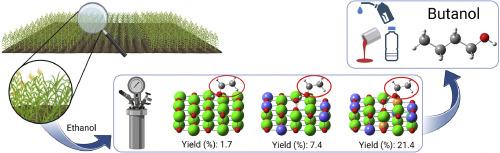
The interaction between ethanol molecules to produce 1-butanol over surfaces of Mg/Al and Cu-Mg/Al oxides derived from hydrotalcites (HT) was studied experimentally and computationally. For Mg/Al catalyst, the insertion of Al in the MgO lattice generates a selectivity of 11.7 % for 1-butanol and of 5.8 % for diethyl ether at 300 °C, indicating the importance of the presence of acid sites for dehydration. For Cu-Mg/Al catalyst, Cu2+ cations have been structural substituted, instead of superficial substituted, exhibiting the highest selectivity for 1-butanol at 250 °C (16.5 %). The inclusion of copper increases the number of acid-base pairs, which are important in the dehydrogenation of ethanol molecules, the aldol condensation of acetaldehyde molecules and the subsequent steps to get 1-butanol. According to DFT results, the presence of copper favors the adsorption of ethanol on the surface, weakening the Cα-Hα bond of the molecule, contributing to the formation of acetaldehyde.
期刊介绍:
Molecular Catalysis publishes full papers that are original, rigorous, and scholarly contributions examining the molecular and atomic aspects of catalytic activation and reaction mechanisms. The fields covered are:
Heterogeneous catalysis including immobilized molecular catalysts
Homogeneous catalysis including organocatalysis, organometallic catalysis and biocatalysis
Photo- and electrochemistry
Theoretical aspects of catalysis analyzed by computational methods



 京公网安备 11010802042870号
京ICP备2023020795号-1
京公网安备 11010802042870号
京ICP备2023020795号-1

 分享
分享
 求助内容:
求助内容: 应助结果提醒方式:
 扫码关注我们
