Hesam Abouali, Michelle Przedborski, Mohammad Kohandel and Mahla Poudineh
{"title":"Investigating nano-sized tumor-derived extracellular vesicles in enhancing anti-PD-1 immunotherapy†","authors":"Hesam Abouali, Michelle Przedborski, Mohammad Kohandel and Mahla Poudineh","doi":"10.1039/D4NR00729H","DOIUrl":null,"url":null,"abstract":"<p >Anti-PD1 immune checkpoint blockade (ICB) has shown promising results for treating several aggressive cancers, enhancing patient survival rates. The variability in clinical response to anti-PD1 ICB is thought to be driven by patient-specific biology and heterogeneity within the tumor microenvironment. Tumor-derived extracellular vesicles (TDEVs), nano-sized particles released from tumor cells, can modulate the tumor microenvironment, leading to immunosuppression and tumor progression. Hence, TDEVs may contribute to the variability in treatment response and play a crucial role in the failure of anti-PD1 immunotherapy. In this study, we develop a systems biology approach to interrogate the role of TDEVs on the response dynamics for anti-PD1 blockade. Our results suggest that the detection and profiling of TDEVs can help screen patients for anti-PD-1 immunotherapy. Moreover, the results in this study suggest that TDEVs and IL-12 can potentially be liquid biopsy biomarkers to profile patient response to anti-PD1 ICB and tailor patient-specific treatment protocols. Importantly, the methodology is generalizable to other types of cancer immunotherapies. Therefore, the collection of patient-specific liquid biopsy data, and the implementation of those data into the systems biology framework, may offer the opportunity to discover new biomarkers for patient drug screening and enable the continuous monitoring of patient response to treatment and adaptation of patient-specific immunotherapy treatment protocols to overcome therapeutic resistance.</p>","PeriodicalId":92,"journal":{"name":"Nanoscale","volume":" 40","pages":" 19062-19073"},"PeriodicalIF":5.1000,"publicationDate":"2024-09-20","publicationTypes":"Journal Article","fieldsOfStudy":null,"isOpenAccess":false,"openAccessPdf":"","citationCount":"0","resultStr":null,"platform":"Semanticscholar","paperid":null,"PeriodicalName":"Nanoscale","FirstCategoryId":"88","ListUrlMain":"https://pubs.rsc.org/en/content/articlelanding/2024/nr/d4nr00729h","RegionNum":3,"RegionCategory":"材料科学","ArticlePicture":[],"TitleCN":null,"AbstractTextCN":null,"PMCID":null,"EPubDate":"","PubModel":"","JCR":"Q1","JCRName":"CHEMISTRY, MULTIDISCIPLINARY","Score":null,"Total":0}
引用次数: 0
Abstract
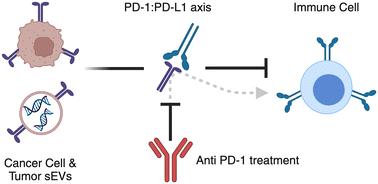
Anti-PD1 immune checkpoint blockade (ICB) has shown promising results for treating several aggressive cancers, enhancing patient survival rates. The variability in clinical response to anti-PD1 ICB is thought to be driven by patient-specific biology and heterogeneity within the tumor microenvironment. Tumor-derived extracellular vesicles (TDEVs), nano-sized particles released from tumor cells, can modulate the tumor microenvironment, leading to immunosuppression and tumor progression. Hence, TDEVs may contribute to the variability in treatment response and play a crucial role in the failure of anti-PD1 immunotherapy. In this study, we develop a systems biology approach to interrogate the role of TDEVs on the response dynamics for anti-PD1 blockade. Our results suggest that the detection and profiling of TDEVs can help screen patients for anti-PD-1 immunotherapy. Moreover, the results in this study suggest that TDEVs and IL-12 can potentially be liquid biopsy biomarkers to profile patient response to anti-PD1 ICB and tailor patient-specific treatment protocols. Importantly, the methodology is generalizable to other types of cancer immunotherapies. Therefore, the collection of patient-specific liquid biopsy data, and the implementation of those data into the systems biology framework, may offer the opportunity to discover new biomarkers for patient drug screening and enable the continuous monitoring of patient response to treatment and adaptation of patient-specific immunotherapy treatment protocols to overcome therapeutic resistance.
期刊介绍:
Nanoscale is a high-impact international journal, publishing high-quality research across nanoscience and nanotechnology. Nanoscale publishes a full mix of research articles on experimental and theoretical work, including reviews, communications, and full papers.Highly interdisciplinary, this journal appeals to scientists, researchers and professionals interested in nanoscience and nanotechnology, quantum materials and quantum technology, including the areas of physics, chemistry, biology, medicine, materials, energy/environment, information technology, detection science, healthcare and drug discovery, and electronics.



 京公网安备 11010802042870号
京ICP备2023020795号-1
京公网安备 11010802042870号
京ICP备2023020795号-1

 分享
分享
 求助内容:
求助内容: 应助结果提醒方式:
 扫码关注我们
