{"title":"Metal–organic framework-based membranes for ion separation/selection from salt lake brines and seawater","authors":"Lirong Li, Biyuan Liu and Zhigang Li","doi":"10.1039/D4NR02454K","DOIUrl":null,"url":null,"abstract":"<p >Nanofiltration (NF) technologies have evolved into a stage ready for industrial commercialization. NF membranes with unique separation characteristics are widely used for ion selection in water environments. Although many materials have been synthesized and functionalized for specific ion separation, the permeability-selectivity trade-off is still a major challenge. Metal–organic frameworks (MOFs), as a class of promising materials to meet industrial demands, are gaining increasing attention. Many experimental and theoretical studies have been conducted on the applications of MOF-based membranes in ion selection. This review focuses on MOF-based NF membranes for ion separation/selection from seawater and salt lake brines, including their applications in industry. First, a brief discussion on the development of membrane technology for ion selection is given, with the principles of ion separation <em>via</em> NF membranes, industrial implementations, and technical difficulties being discussed. Next, the benefits and challenges of using MOF membranes in NF processes are elaborated, including the basic properties of MOFs, approaches to fabricate MOF membranes for efficient ion selection and challenges in constructing industrially viable membranes. Finally, state-of-the-art studies on key characteristics of MOFs for NF membrane fabrication are presented. It indicates that the utilization of MOF-based membranes has significant potential to improve ion separation performance. However, the lack of sufficient data under industrial conditions highlights the need for further development in this area.</p>","PeriodicalId":92,"journal":{"name":"Nanoscale","volume":" 42","pages":" 19543-19563"},"PeriodicalIF":5.1000,"publicationDate":"2024-09-20","publicationTypes":"Journal Article","fieldsOfStudy":null,"isOpenAccess":false,"openAccessPdf":"","citationCount":"0","resultStr":null,"platform":"Semanticscholar","paperid":null,"PeriodicalName":"Nanoscale","FirstCategoryId":"88","ListUrlMain":"https://pubs.rsc.org/en/content/articlelanding/2024/nr/d4nr02454k","RegionNum":3,"RegionCategory":"材料科学","ArticlePicture":[],"TitleCN":null,"AbstractTextCN":null,"PMCID":null,"EPubDate":"","PubModel":"","JCR":"Q1","JCRName":"CHEMISTRY, MULTIDISCIPLINARY","Score":null,"Total":0}
引用次数: 0
Abstract
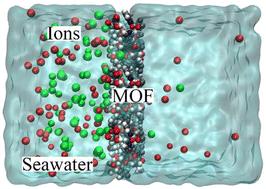
Nanofiltration (NF) technologies have evolved into a stage ready for industrial commercialization. NF membranes with unique separation characteristics are widely used for ion selection in water environments. Although many materials have been synthesized and functionalized for specific ion separation, the permeability-selectivity trade-off is still a major challenge. Metal–organic frameworks (MOFs), as a class of promising materials to meet industrial demands, are gaining increasing attention. Many experimental and theoretical studies have been conducted on the applications of MOF-based membranes in ion selection. This review focuses on MOF-based NF membranes for ion separation/selection from seawater and salt lake brines, including their applications in industry. First, a brief discussion on the development of membrane technology for ion selection is given, with the principles of ion separation via NF membranes, industrial implementations, and technical difficulties being discussed. Next, the benefits and challenges of using MOF membranes in NF processes are elaborated, including the basic properties of MOFs, approaches to fabricate MOF membranes for efficient ion selection and challenges in constructing industrially viable membranes. Finally, state-of-the-art studies on key characteristics of MOFs for NF membrane fabrication are presented. It indicates that the utilization of MOF-based membranes has significant potential to improve ion separation performance. However, the lack of sufficient data under industrial conditions highlights the need for further development in this area.
期刊介绍:
Nanoscale is a high-impact international journal, publishing high-quality research across nanoscience and nanotechnology. Nanoscale publishes a full mix of research articles on experimental and theoretical work, including reviews, communications, and full papers.Highly interdisciplinary, this journal appeals to scientists, researchers and professionals interested in nanoscience and nanotechnology, quantum materials and quantum technology, including the areas of physics, chemistry, biology, medicine, materials, energy/environment, information technology, detection science, healthcare and drug discovery, and electronics.



 京公网安备 11010802042870号
京ICP备2023020795号-1
京公网安备 11010802042870号
京ICP备2023020795号-1

 分享
分享
 求助内容:
求助内容: 应助结果提醒方式:
 扫码关注我们
