{"title":"Inorganic porous carbon as the supporter of H2TiO3 via in-situ polymerization synchronous conversion for lithium recovery from aqueous solutions","authors":"Junmin Wu, Wenxing Wang, Wenzhe Chen, Can Liu, Tianlong Deng, Xiaoping Yu","doi":"10.1016/j.seppur.2024.129806","DOIUrl":null,"url":null,"abstract":"<div><div>The extraction of lithium from liquid minerals, such as salt lake brines and underground brines, has garnered extensive interest due to its eco-friendly and cost-effective properties. However, the effectiveness of this method is constrained by the stability and capacity of the materials. Herein, a new-type inorganic carbon-supported H<sub>2</sub>TiO<sub>3</sub> adsorbent was developed by a novel in-situ polymerization synchronous conversion strategy. It was found that when resorcinol and formaldehyde containing Li<sub>2</sub>CO<sub>3</sub> and TiO<sub>2</sub> were polymerized in-situ and then calcined at 973.15 K, the resin was successfully carbonized to obtain the carbon supporter with a low degree of disorder, and the Li<sub>2</sub>CO<sub>3</sub> and TiO<sub>2</sub> in the supporter were synchronously converted into Li<sub>2</sub>TiO<sub>3</sub> and uniformly dispersed in the carbon matrix. Because of the large specific surface area and strong hydrophilicity of the carbon supporter, the material exhibited a maximum Li<sup>+</sup> adsorption capacity of 52.14 mg·g<sup>−1</sup>, which was far higher than that of inorganic composite materials reported at present. Even the equilibrium adsorption capacity for Li<sup>+</sup> at a low concentration of 29.26 mg·L<sup>−1</sup> reached 28.51 mg·g<sup>−1</sup>. Following adsorption, the Li<sup>+</sup> in the material was easily eluted by 0.25 mol·L<sup>−1</sup> HCl, and the elution rate was more than 90 % within 2 h. Dynamic adsorption using a fixed-bed was also performed at 298.15 and 343.15 K, and the adsorption capacity for the same concentration of Li<sup>+</sup> was 7.08 and 9.44 mg·g<sup>−1</sup>, respectively. Because of the high capacity for low-concentration Li<sup>+</sup> and the promoting effect of temperature on adsorption, the material is well-suited for recovering Li<sup>+</sup> from liquid resources, particularly from geothermal water with high temperatures and low Li<sup>+</sup> concentrations.</div></div>","PeriodicalId":427,"journal":{"name":"Separation and Purification Technology","volume":"356 ","pages":"Article 129806"},"PeriodicalIF":9.0000,"publicationDate":"2025-04-01","publicationTypes":"Journal Article","fieldsOfStudy":null,"isOpenAccess":false,"openAccessPdf":"","citationCount":"0","resultStr":null,"platform":"Semanticscholar","paperid":null,"PeriodicalName":"Separation and Purification Technology","FirstCategoryId":"5","ListUrlMain":"https://www.sciencedirect.com/science/article/pii/S1383586624035457","RegionNum":1,"RegionCategory":"工程技术","ArticlePicture":[],"TitleCN":null,"AbstractTextCN":null,"PMCID":null,"EPubDate":"2024/9/21 0:00:00","PubModel":"Epub","JCR":"Q1","JCRName":"ENGINEERING, CHEMICAL","Score":null,"Total":0}
引用次数: 0
Abstract
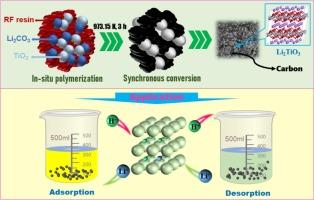
The extraction of lithium from liquid minerals, such as salt lake brines and underground brines, has garnered extensive interest due to its eco-friendly and cost-effective properties. However, the effectiveness of this method is constrained by the stability and capacity of the materials. Herein, a new-type inorganic carbon-supported H2TiO3 adsorbent was developed by a novel in-situ polymerization synchronous conversion strategy. It was found that when resorcinol and formaldehyde containing Li2CO3 and TiO2 were polymerized in-situ and then calcined at 973.15 K, the resin was successfully carbonized to obtain the carbon supporter with a low degree of disorder, and the Li2CO3 and TiO2 in the supporter were synchronously converted into Li2TiO3 and uniformly dispersed in the carbon matrix. Because of the large specific surface area and strong hydrophilicity of the carbon supporter, the material exhibited a maximum Li+ adsorption capacity of 52.14 mg·g−1, which was far higher than that of inorganic composite materials reported at present. Even the equilibrium adsorption capacity for Li+ at a low concentration of 29.26 mg·L−1 reached 28.51 mg·g−1. Following adsorption, the Li+ in the material was easily eluted by 0.25 mol·L−1 HCl, and the elution rate was more than 90 % within 2 h. Dynamic adsorption using a fixed-bed was also performed at 298.15 and 343.15 K, and the adsorption capacity for the same concentration of Li+ was 7.08 and 9.44 mg·g−1, respectively. Because of the high capacity for low-concentration Li+ and the promoting effect of temperature on adsorption, the material is well-suited for recovering Li+ from liquid resources, particularly from geothermal water with high temperatures and low Li+ concentrations.
期刊介绍:
Separation and Purification Technology is a premier journal committed to sharing innovative methods for separation and purification in chemical and environmental engineering, encompassing both homogeneous solutions and heterogeneous mixtures. Our scope includes the separation and/or purification of liquids, vapors, and gases, as well as carbon capture and separation techniques. However, it's important to note that methods solely intended for analytical purposes are not within the scope of the journal. Additionally, disciplines such as soil science, polymer science, and metallurgy fall outside the purview of Separation and Purification Technology. Join us in advancing the field of separation and purification methods for sustainable solutions in chemical and environmental engineering.



 京公网安备 11010802042870号
京ICP备2023020795号-1
京公网安备 11010802042870号
京ICP备2023020795号-1

 分享
分享
 求助内容:
求助内容: 应助结果提醒方式:
 扫码关注我们
