Shuang Fu , Yuanyuan Zhang , Yingbo Chen , Linzhe Xu , Xintong Wu , Liu Ye
{"title":"Photosensitive and high temperature resistant polyamide composite nanofiltration membranes with high flux and stable retention","authors":"Shuang Fu , Yuanyuan Zhang , Yingbo Chen , Linzhe Xu , Xintong Wu , Liu Ye","doi":"10.1016/j.seppur.2024.129754","DOIUrl":null,"url":null,"abstract":"<div><div>Currently, most commercial membranes are used at temperatures below 50 °C. For high temperature water treatment, nanofiltration membranes with good thermal stability are highly sought after. In order to construct a novel polyamide thin-film composite nanofiltration (TFC NF) membrane, Congo red (CR) as monomer was introduced to the aqueous phase and the chemical structure of the selective layer was changed. Next, a thorough investigation was conducted into the impacts of the piperazine (PIP) to CR ratio on the surface morphology, separation efficiency and chemical structure of the membranes. The TFC NF membrane prepared after parameter optimization exhibited high retention (Na<sub>2</sub>SO<sub>4</sub>, >98 %) and flux up to 30 L·m<sup>−2</sup>·h<sup>−1</sup>·bar<sup>−1</sup> at room temperature. Moreover, the Na<sub>2</sub>SO<sub>4</sub> retention of the TFC NF membrane decreased by less than 1 % when used at 90 °C, demonstrating excellent heat resistance. Meanwhile, the incorporation of CR allowed the structure of the TFC NF membranes to be altered under UV irradiation conditions, which provided new insights into the optical modulation of the composite membrane properties. A promising and reproducible methodology for the development of high flux TFC NF membrane with thermal stability was offered, achieving a breakthrough in water treatment technology under high-temperature conditions.</div></div>","PeriodicalId":427,"journal":{"name":"Separation and Purification Technology","volume":"356 ","pages":"Article 129754"},"PeriodicalIF":9.0000,"publicationDate":"2025-04-01","publicationTypes":"Journal Article","fieldsOfStudy":null,"isOpenAccess":false,"openAccessPdf":"","citationCount":"0","resultStr":null,"platform":"Semanticscholar","paperid":null,"PeriodicalName":"Separation and Purification Technology","FirstCategoryId":"5","ListUrlMain":"https://www.sciencedirect.com/science/article/pii/S1383586624034932","RegionNum":1,"RegionCategory":"工程技术","ArticlePicture":[],"TitleCN":null,"AbstractTextCN":null,"PMCID":null,"EPubDate":"2024/9/21 0:00:00","PubModel":"Epub","JCR":"Q1","JCRName":"ENGINEERING, CHEMICAL","Score":null,"Total":0}
引用次数: 0
Abstract
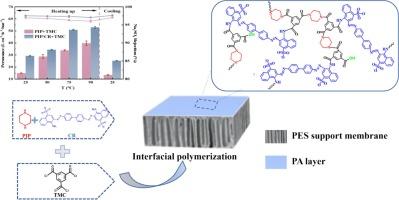
Currently, most commercial membranes are used at temperatures below 50 °C. For high temperature water treatment, nanofiltration membranes with good thermal stability are highly sought after. In order to construct a novel polyamide thin-film composite nanofiltration (TFC NF) membrane, Congo red (CR) as monomer was introduced to the aqueous phase and the chemical structure of the selective layer was changed. Next, a thorough investigation was conducted into the impacts of the piperazine (PIP) to CR ratio on the surface morphology, separation efficiency and chemical structure of the membranes. The TFC NF membrane prepared after parameter optimization exhibited high retention (Na2SO4, >98 %) and flux up to 30 L·m−2·h−1·bar−1 at room temperature. Moreover, the Na2SO4 retention of the TFC NF membrane decreased by less than 1 % when used at 90 °C, demonstrating excellent heat resistance. Meanwhile, the incorporation of CR allowed the structure of the TFC NF membranes to be altered under UV irradiation conditions, which provided new insights into the optical modulation of the composite membrane properties. A promising and reproducible methodology for the development of high flux TFC NF membrane with thermal stability was offered, achieving a breakthrough in water treatment technology under high-temperature conditions.
期刊介绍:
Separation and Purification Technology is a premier journal committed to sharing innovative methods for separation and purification in chemical and environmental engineering, encompassing both homogeneous solutions and heterogeneous mixtures. Our scope includes the separation and/or purification of liquids, vapors, and gases, as well as carbon capture and separation techniques. However, it's important to note that methods solely intended for analytical purposes are not within the scope of the journal. Additionally, disciplines such as soil science, polymer science, and metallurgy fall outside the purview of Separation and Purification Technology. Join us in advancing the field of separation and purification methods for sustainable solutions in chemical and environmental engineering.



 京公网安备 11010802042870号
京ICP备2023020795号-1
京公网安备 11010802042870号
京ICP备2023020795号-1

 分享
分享
 求助内容:
求助内容: 应助结果提醒方式:
 扫码关注我们
