Jinfeng Liu, Shiwen Du, Wenjun Fan, Qinglin Li, Qi Yang, Lin Luo, Jiangnan Li and Fuxiang Zhang
{"title":"Vertically aligned hematite nanosheets with (110) facets controllably exposed for ammonia synthesis with high Faraday efficiency beyond 2.5 A cm−2†","authors":"Jinfeng Liu, Shiwen Du, Wenjun Fan, Qinglin Li, Qi Yang, Lin Luo, Jiangnan Li and Fuxiang Zhang","doi":"10.1039/D4EE03987D","DOIUrl":null,"url":null,"abstract":"<p >Hematite has been widely investigated for promising (photo)electrocatalysis due to its good robustness and abundant element content on earth, but its application in the electrochemical synthesis of ammonia is still plagued by unsatisfactory Faraday efficiency at ampere-scale current density. Herein, we prepared vertically aligned hematite nanosheet (denoted as Fe<small><sub>2</sub></small>O<small><sub>3</sub></small>-NS) arrays with a high-aspect-ratio (110) crystal facet exposed by applying a simple <em>in situ</em> electrochemical reconstruction strategy, which delivers unprecedentedly efficient ammonia yield of 189.05 mg h<small><sup>−1</sup></small> cm<small><sup>−2</sup></small> accompanied by faradaic efficiency of <em>ca.</em> 95% at a current density of exceeding 2.5 A cm<small><sup>−2</sup></small>, outperforming the state-of-the-art Fe-based electrocatalysts. It is experimentally and theoretically revealed that the exposed (110) crystal plane of Fe<small><sub>2</sub></small>O<small><sub>3</sub></small>-NS is favorable for the adsorption and activation of intermediate species during electrocatalysis, and its vertically aligned nanosheet arrays provide abundant active sites and favorable charge transfer channels. The as-obtained hematite nanosheet arrays were finally employed as the cathode of a Zn–nitrate battery to deliver an outstanding discharge power density of 36.2 mW cm<small><sup>−2</sup></small>.</p>","PeriodicalId":72,"journal":{"name":"Energy & Environmental Science","volume":" 23","pages":" 9093-9099"},"PeriodicalIF":30.5000,"publicationDate":"2024-10-16","publicationTypes":"Journal Article","fieldsOfStudy":null,"isOpenAccess":false,"openAccessPdf":"","citationCount":"0","resultStr":null,"platform":"Semanticscholar","paperid":null,"PeriodicalName":"Energy & Environmental Science","FirstCategoryId":"88","ListUrlMain":"https://pubs.rsc.org/en/content/articlelanding/2024/ee/d4ee03987d","RegionNum":1,"RegionCategory":"材料科学","ArticlePicture":[],"TitleCN":null,"AbstractTextCN":null,"PMCID":null,"EPubDate":"","PubModel":"","JCR":"Q1","JCRName":"CHEMISTRY, MULTIDISCIPLINARY","Score":null,"Total":0}
引用次数: 0
Abstract
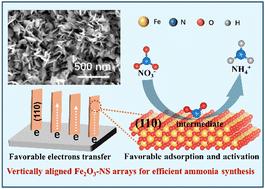
Hematite has been widely investigated for promising (photo)electrocatalysis due to its good robustness and abundant element content on earth, but its application in the electrochemical synthesis of ammonia is still plagued by unsatisfactory Faraday efficiency at ampere-scale current density. Herein, we prepared vertically aligned hematite nanosheet (denoted as Fe2O3-NS) arrays with a high-aspect-ratio (110) crystal facet exposed by applying a simple in situ electrochemical reconstruction strategy, which delivers unprecedentedly efficient ammonia yield of 189.05 mg h−1 cm−2 accompanied by faradaic efficiency of ca. 95% at a current density of exceeding 2.5 A cm−2, outperforming the state-of-the-art Fe-based electrocatalysts. It is experimentally and theoretically revealed that the exposed (110) crystal plane of Fe2O3-NS is favorable for the adsorption and activation of intermediate species during electrocatalysis, and its vertically aligned nanosheet arrays provide abundant active sites and favorable charge transfer channels. The as-obtained hematite nanosheet arrays were finally employed as the cathode of a Zn–nitrate battery to deliver an outstanding discharge power density of 36.2 mW cm−2.
期刊介绍:
Energy & Environmental Science, a peer-reviewed scientific journal, publishes original research and review articles covering interdisciplinary topics in the (bio)chemical and (bio)physical sciences, as well as chemical engineering disciplines. Published monthly by the Royal Society of Chemistry (RSC), a not-for-profit publisher, Energy & Environmental Science is recognized as a leading journal. It boasts an impressive impact factor of 8.500 as of 2009, ranking 8th among 140 journals in the category "Chemistry, Multidisciplinary," second among 71 journals in "Energy & Fuels," second among 128 journals in "Engineering, Chemical," and first among 181 scientific journals in "Environmental Sciences."
Energy & Environmental Science publishes various types of articles, including Research Papers (original scientific work), Review Articles, Perspectives, and Minireviews (feature review-type articles of broad interest), Communications (original scientific work of an urgent nature), Opinions (personal, often speculative viewpoints or hypotheses on current topics), and Analysis Articles (in-depth examination of energy-related issues).




 京公网安备 11010802042870号
京ICP备2023020795号-1
京公网安备 11010802042870号
京ICP备2023020795号-1

 分享
分享
 求助内容:
求助内容: 应助结果提醒方式:
 扫码关注我们
