Jiaming Zhu, Cong Kang, Xiangjun Xiao, Ya Mao, Ying Luo, Yuheng Wang, Quansheng Zhang, Yulin Ma, Chunyu Du, Shuaifeng Lou, Fanpeng Kong, Jingying Xie and Geping Yin
{"title":"Regulating local chemical softness of the collector to homogenize Li deposition for anode-free Li-metal batteries†","authors":"Jiaming Zhu, Cong Kang, Xiangjun Xiao, Ya Mao, Ying Luo, Yuheng Wang, Quansheng Zhang, Yulin Ma, Chunyu Du, Shuaifeng Lou, Fanpeng Kong, Jingying Xie and Geping Yin","doi":"10.1039/D4EE03673E","DOIUrl":null,"url":null,"abstract":"<p >Regulating the surface structure of the collector to synergistically reduce the nucleation and lateral growth barrier of Li<small><sup>+</sup></small> electrodeposition is key to long-cycle anode-free Li-metal batteries (AFLMB), but its adjusting mechanism and modulation remain a formidable challenge. Herein, a previously unreported heterogeneous collector with hard-base sites and soft-acid sites is proposed to enhance chemical interaction with hard-acid Li<small><sup>+</sup></small> and soft-base Li atoms, respectively. Theoretical analysis demonstrates that the addition of Co single atoms into the N–C host improves the hardness of N bases and the softness of the carbon matrix. According to the results of <em>operando</em> microscopy and electrochemical measurement, the HBSA-Co SA collector with controlled local chemical softness substantially reduces nucleation/growth barriers without any dendrite morphology. The NCM811-based Li metal cells with a high cathode area capacity of 15 mA h cm<small><sup>−2</sup></small> and limited lithium excess achieve a superior capacity retention rate of 98.8% after 150 cycles. This finding provides an avenue to rationally design a highly efficient collector for AFLMB.</p>","PeriodicalId":72,"journal":{"name":"Energy & Environmental Science","volume":" 23","pages":" 9323-9334"},"PeriodicalIF":30.8000,"publicationDate":"2024-10-16","publicationTypes":"Journal Article","fieldsOfStudy":null,"isOpenAccess":false,"openAccessPdf":"","citationCount":"0","resultStr":null,"platform":"Semanticscholar","paperid":null,"PeriodicalName":"Energy & Environmental Science","FirstCategoryId":"88","ListUrlMain":"https://pubs.rsc.org/en/content/articlelanding/2024/ee/d4ee03673e","RegionNum":1,"RegionCategory":"材料科学","ArticlePicture":[],"TitleCN":null,"AbstractTextCN":null,"PMCID":null,"EPubDate":"","PubModel":"","JCR":"Q1","JCRName":"CHEMISTRY, MULTIDISCIPLINARY","Score":null,"Total":0}
引用次数: 0
Abstract
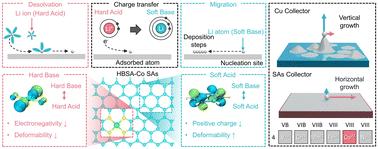
Regulating the surface structure of the collector to synergistically reduce the nucleation and lateral growth barrier of Li+ electrodeposition is key to long-cycle anode-free Li-metal batteries (AFLMB), but its adjusting mechanism and modulation remain a formidable challenge. Herein, a previously unreported heterogeneous collector with hard-base sites and soft-acid sites is proposed to enhance chemical interaction with hard-acid Li+ and soft-base Li atoms, respectively. Theoretical analysis demonstrates that the addition of Co single atoms into the N–C host improves the hardness of N bases and the softness of the carbon matrix. According to the results of operando microscopy and electrochemical measurement, the HBSA-Co SA collector with controlled local chemical softness substantially reduces nucleation/growth barriers without any dendrite morphology. The NCM811-based Li metal cells with a high cathode area capacity of 15 mA h cm−2 and limited lithium excess achieve a superior capacity retention rate of 98.8% after 150 cycles. This finding provides an avenue to rationally design a highly efficient collector for AFLMB.
期刊介绍:
Energy & Environmental Science, a peer-reviewed scientific journal, publishes original research and review articles covering interdisciplinary topics in the (bio)chemical and (bio)physical sciences, as well as chemical engineering disciplines. Published monthly by the Royal Society of Chemistry (RSC), a not-for-profit publisher, Energy & Environmental Science is recognized as a leading journal. It boasts an impressive impact factor of 8.500 as of 2009, ranking 8th among 140 journals in the category "Chemistry, Multidisciplinary," second among 71 journals in "Energy & Fuels," second among 128 journals in "Engineering, Chemical," and first among 181 scientific journals in "Environmental Sciences."
Energy & Environmental Science publishes various types of articles, including Research Papers (original scientific work), Review Articles, Perspectives, and Minireviews (feature review-type articles of broad interest), Communications (original scientific work of an urgent nature), Opinions (personal, often speculative viewpoints or hypotheses on current topics), and Analysis Articles (in-depth examination of energy-related issues).



 京公网安备 11010802042870号
京ICP备2023020795号-1
京公网安备 11010802042870号
京ICP备2023020795号-1

 分享
分享
 求助内容:
求助内容: 应助结果提醒方式:
 扫码关注我们
