Understanding and predicting the environmental dispersion of iron oxide nanoparticles: a comprehensive study on synthesis, characterisation, and modelling†
Maycon L. de Oliveira, Juliana Cancino-Bernardi and Márcia A. M. S. da Veiga
{"title":"Understanding and predicting the environmental dispersion of iron oxide nanoparticles: a comprehensive study on synthesis, characterisation, and modelling†","authors":"Maycon L. de Oliveira, Juliana Cancino-Bernardi and Márcia A. M. S. da Veiga","doi":"10.1039/D3EN00860F","DOIUrl":null,"url":null,"abstract":"<p >Iron oxide nanoparticles (IONPs) are among the most versatile and applied nanoparticles due to their unique properties. However, the distribution of these nanoparticles (NPs) in the environmental system presents a critical problem for understanding the generation of reactive oxygen species (ROS) and their unpredictable effect on micro and macro fauna/flora due to their chemical form. This study describes strategies to evaluate the dispersion of IONPs in environmental media under controlled conditions of pH (5–9), hardness (0–400 mg CaCO<small><sub>3</sub></small> per L), temperature (10–30 °C), and exposure time (0–48 h) in aquatic systems. For this purpose, iron-based nanoparticles (hematite, goethite, and magnetite) were synthesised and characterised using chemical and morphological analytical techniques. Subsequently, the effect of environmental parameters on the dispersion of NPs was investigated by developing a model using a central composite rotatable design (CCRD) with total Fe as the dependent variable. The three IONPs were synthesised with a size of less than 100 nm. It was observed that the nano-hematites and magnetites had spherical morphology, while goethite appeared as nanorods. The resulting models, integrating linear, quadratic, and combined effects, exhibited high predictive capacities of 76.4%, 93.6%, and an impressive 99.9% for nano-hematite, goethite, and magnetite, respectively. This research contributes to better understanding of nanoparticle behaviours in natural settings, providing essential insights to assess and potentially mitigate the adverse consequences of IONPs contamination in aquatic environments.</p>","PeriodicalId":73,"journal":{"name":"Environmental Science: Nano","volume":" 1","pages":" 791-804"},"PeriodicalIF":5.1000,"publicationDate":"2024-10-23","publicationTypes":"Journal Article","fieldsOfStudy":null,"isOpenAccess":false,"openAccessPdf":"","citationCount":"0","resultStr":null,"platform":"Semanticscholar","paperid":null,"PeriodicalName":"Environmental Science: Nano","FirstCategoryId":"6","ListUrlMain":"https://pubs.rsc.org/en/content/articlelanding/2025/en/d3en00860f","RegionNum":2,"RegionCategory":"环境科学与生态学","ArticlePicture":[],"TitleCN":null,"AbstractTextCN":null,"PMCID":null,"EPubDate":"","PubModel":"","JCR":"Q1","JCRName":"CHEMISTRY, MULTIDISCIPLINARY","Score":null,"Total":0}
引用次数: 0
Abstract
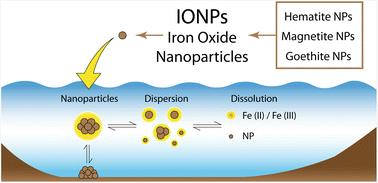
Iron oxide nanoparticles (IONPs) are among the most versatile and applied nanoparticles due to their unique properties. However, the distribution of these nanoparticles (NPs) in the environmental system presents a critical problem for understanding the generation of reactive oxygen species (ROS) and their unpredictable effect on micro and macro fauna/flora due to their chemical form. This study describes strategies to evaluate the dispersion of IONPs in environmental media under controlled conditions of pH (5–9), hardness (0–400 mg CaCO3 per L), temperature (10–30 °C), and exposure time (0–48 h) in aquatic systems. For this purpose, iron-based nanoparticles (hematite, goethite, and magnetite) were synthesised and characterised using chemical and morphological analytical techniques. Subsequently, the effect of environmental parameters on the dispersion of NPs was investigated by developing a model using a central composite rotatable design (CCRD) with total Fe as the dependent variable. The three IONPs were synthesised with a size of less than 100 nm. It was observed that the nano-hematites and magnetites had spherical morphology, while goethite appeared as nanorods. The resulting models, integrating linear, quadratic, and combined effects, exhibited high predictive capacities of 76.4%, 93.6%, and an impressive 99.9% for nano-hematite, goethite, and magnetite, respectively. This research contributes to better understanding of nanoparticle behaviours in natural settings, providing essential insights to assess and potentially mitigate the adverse consequences of IONPs contamination in aquatic environments.
期刊介绍:
Environmental Science: Nano serves as a comprehensive and high-impact peer-reviewed source of information on the design and demonstration of engineered nanomaterials for environment-based applications. It also covers the interactions between engineered, natural, and incidental nanomaterials with biological and environmental systems. This scope includes, but is not limited to, the following topic areas:
Novel nanomaterial-based applications for water, air, soil, food, and energy sustainability
Nanomaterial interactions with biological systems and nanotoxicology
Environmental fate, reactivity, and transformations of nanoscale materials
Nanoscale processes in the environment
Sustainable nanotechnology including rational nanomaterial design, life cycle assessment, risk/benefit analysis



 京公网安备 11010802042870号
京ICP备2023020795号-1
京公网安备 11010802042870号
京ICP备2023020795号-1

 分享
分享
 求助内容:
求助内容: 应助结果提醒方式:
 扫码关注我们
