Luca Pennisi, Gianluigi Ferri, Carlotta Lauteri, Daniele Di Clerico, Alberto Vergara
{"title":"Antibacterial Effects of Thermosonication Technology on <i>Salmonella typhimurium</i> Strains Identified from Swine Food Chain: An In Vitro Study.","authors":"Luca Pennisi, Gianluigi Ferri, Carlotta Lauteri, Daniele Di Clerico, Alberto Vergara","doi":"10.3390/foods13203259","DOIUrl":null,"url":null,"abstract":"<p><p>Among innovative food technologies, ultrasounds have demonstrated physical damages (provided by frequency and intensity factors) on bacterial structures while determining the microbiological stabilization of many foodstuffs. This study tested the efficacy of the thermosonication process on 16 <i>Salmonella typhimurium</i> strains belonging to the academic biobank (isolated from swine slaughterhouses). All strains were exposed to focused ultrasounds, generated by the Waveco<sup>®</sup> system (Milan, Italy), with the following settings: 40 KHz coupled with 80 W at different 5 min intervals starting from 5 to 15 ones, and focusing on two different temperatures: 40 °C and 50 °C. After each treatment, all strains were directly plated onto count agars immediately (t0) and after 24 h (t24) of storage at refrigerated temperature. The results showed bacterial reductions by prolonging the sonication treatments until 15 min (i.e., 50 °C for 15 min reduced of 2.16 log CFU/gr the initial loads). In the present in vitro study, the most considerable decrease was observed after 24 h. It meant that <i>Salmonella</i> strains were lethally damaged at the wall level, confirming the ultrasound bactericidal effect on loads. The present in vitro scientific investigation demonstrates the practical bactericidal effects of thermosonication, highlighting promising applications at the industry level for food microbial stabilization and shelf-life prolongation.</p>","PeriodicalId":12386,"journal":{"name":"Foods","volume":"13 20","pages":""},"PeriodicalIF":5.1000,"publicationDate":"2024-10-13","publicationTypes":"Journal Article","fieldsOfStudy":null,"isOpenAccess":false,"openAccessPdf":"https://www.ncbi.nlm.nih.gov/pmc/articles/PMC11507906/pdf/","citationCount":"0","resultStr":null,"platform":"Semanticscholar","paperid":null,"PeriodicalName":"Foods","FirstCategoryId":"97","ListUrlMain":"https://doi.org/10.3390/foods13203259","RegionNum":2,"RegionCategory":"农林科学","ArticlePicture":[],"TitleCN":null,"AbstractTextCN":null,"PMCID":null,"EPubDate":"","PubModel":"","JCR":"Q1","JCRName":"FOOD SCIENCE & TECHNOLOGY","Score":null,"Total":0}
引用次数: 0
Abstract
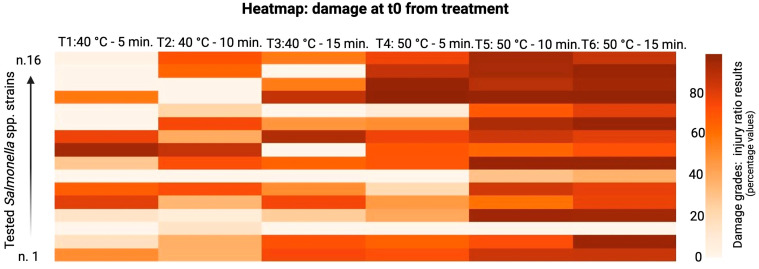
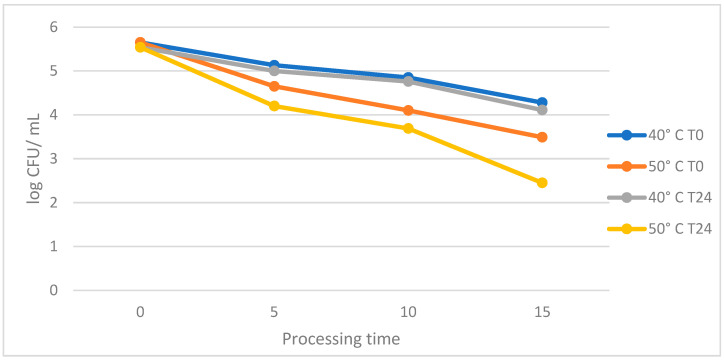
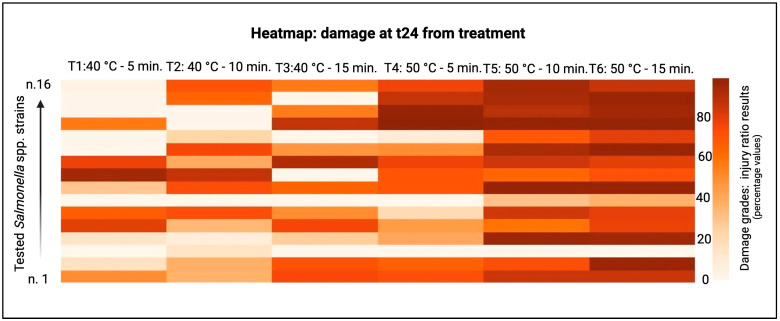
Among innovative food technologies, ultrasounds have demonstrated physical damages (provided by frequency and intensity factors) on bacterial structures while determining the microbiological stabilization of many foodstuffs. This study tested the efficacy of the thermosonication process on 16 Salmonella typhimurium strains belonging to the academic biobank (isolated from swine slaughterhouses). All strains were exposed to focused ultrasounds, generated by the Waveco® system (Milan, Italy), with the following settings: 40 KHz coupled with 80 W at different 5 min intervals starting from 5 to 15 ones, and focusing on two different temperatures: 40 °C and 50 °C. After each treatment, all strains were directly plated onto count agars immediately (t0) and after 24 h (t24) of storage at refrigerated temperature. The results showed bacterial reductions by prolonging the sonication treatments until 15 min (i.e., 50 °C for 15 min reduced of 2.16 log CFU/gr the initial loads). In the present in vitro study, the most considerable decrease was observed after 24 h. It meant that Salmonella strains were lethally damaged at the wall level, confirming the ultrasound bactericidal effect on loads. The present in vitro scientific investigation demonstrates the practical bactericidal effects of thermosonication, highlighting promising applications at the industry level for food microbial stabilization and shelf-life prolongation.
期刊介绍:
Foods (ISSN 2304-8158) is an international, peer-reviewed scientific open access journal which provides an advanced forum for studies related to all aspects of food research. It publishes reviews, regular research papers and short communications. Our aim is to encourage scientists, researchers, and other food professionals to publish their experimental and theoretical results in as much detail as possible or share their knowledge with as much readers unlimitedly as possible. There is no restriction on the length of the papers. The full experimental details must be provided so that the results can be reproduced. There are, in addition, unique features of this journal:
manuscripts regarding research proposals and research ideas will be particularly welcomed
electronic files or software regarding the full details of the calculation and experimental procedure, if unable to be published in a normal way, can be deposited as supplementary material
we also accept manuscripts communicating to a broader audience with regard to research projects financed with public funds



 京公网安备 11010802042870号
京ICP备2023020795号-1
京公网安备 11010802042870号
京ICP备2023020795号-1

 分享
分享
 求助内容:
求助内容: 应助结果提醒方式:
 扫码关注我们
