{"title":"[Systematic evaluation of the correlation between serum metabolites and tinnitus].","authors":"Y P Zuo, H Xie, T T Zhao, X Y Zhang, H Jiang","doi":"10.3760/cma.j.cn115330-20231224-00324","DOIUrl":null,"url":null,"abstract":"<p><p><b>Objective:</b> We performed a Mendelian randomisation (MR) analysis to explore the relationship between serum metabolites and tinnitus. <b>Methods:</b> In this study, 486 serum metabolites were considered as exposure factors, and single nucleotide polymorphisms (SNP) significantly associated with them were used as instrumental variables (IV). The serum metabolite data were obtained from a public database (http://metabolomips.org/gwas/index.php), while the genome-wide association study (GWAS) summary association statistics for tinnitus were obtained from a Finnish database (https://r10.finngen.fi/pheno/H8_TINNITUS). The inverse variance weighting (IVW) method was employed as the primary determination method for MR analysis, with corrections for multiple comparisons made using the false discovery rate (FDR). Sensitivity tests were conducted using the MR-Egger regression, Mendelian random polymorphism residuals and outliers (MR-PRESSO) methods. The identified serum metabolites were subjected to chained disequilibrium regression analysis (LDSC) and metabolic pathway analysis. Reverse MR analysis was performed to investigate the possibility of reverse causality. Analyses were performed in R software (version 4.3.1). <b>Results:</b> A total of 17 serum metabolites (including 10 known and 7 unknown metabolites) associated with tinnitus were identified. The known metabolites included protective metabolites such as acetylcarnitine, hydroxyisovaleryl carnitine, glycine, monounsaturated glycerol ester, and glycine-L-valine, and hazardous metabolites such as allantoin, glycerylphosphorylcholine 1-eicosatrienoate, myo-inositol, 15-methylpalmitate, and pseudouridine; the strongest causally protective metabolites were acetylcarnitine, the followed by hydroxyisopentanoyl carnitine and glycine; the hazardous metabolite with the strongest causal effect was pseudouridine, followed by inositol and 15-methylpalmitate; and only hydroxyisopentanoyl carnitine (<i>P</i><sub>FDR</sub>=0.04) and glycerol monooleate (<i>P</i><sub>FDR</sub>=0.04) reached significance values after FDR correction. The findings were free of heterogeneity, pleiotropy and reverse causal associations. The metabolic pathways were mainly enriched in pathways such as ascorbic acid and aldolac metabolism. <b>Conclusions:</b> The study suggests a causal relationship between serum metabolites and tinnitus risk. Serum metabolite levels may influence tinnitus-related metabolic pathways.</p>","PeriodicalId":23987,"journal":{"name":"Chinese journal of otorhinolaryngology head and neck surgery","volume":"59 10","pages":"1054-1063"},"PeriodicalIF":0.0000,"publicationDate":"2024-10-07","publicationTypes":"Journal Article","fieldsOfStudy":null,"isOpenAccess":false,"openAccessPdf":"","citationCount":"0","resultStr":null,"platform":"Semanticscholar","paperid":null,"PeriodicalName":"Chinese journal of otorhinolaryngology head and neck surgery","FirstCategoryId":"3","ListUrlMain":"https://doi.org/10.3760/cma.j.cn115330-20231224-00324","RegionNum":0,"RegionCategory":null,"ArticlePicture":[],"TitleCN":null,"AbstractTextCN":null,"PMCID":null,"EPubDate":"","PubModel":"","JCR":"Q4","JCRName":"Medicine","Score":null,"Total":0}
引用次数: 0
Abstract
Objective: We performed a Mendelian randomisation (MR) analysis to explore the relationship between serum metabolites and tinnitus. Methods: In this study, 486 serum metabolites were considered as exposure factors, and single nucleotide polymorphisms (SNP) significantly associated with them were used as instrumental variables (IV). The serum metabolite data were obtained from a public database (http://metabolomips.org/gwas/index.php), while the genome-wide association study (GWAS) summary association statistics for tinnitus were obtained from a Finnish database (https://r10.finngen.fi/pheno/H8_TINNITUS). The inverse variance weighting (IVW) method was employed as the primary determination method for MR analysis, with corrections for multiple comparisons made using the false discovery rate (FDR). Sensitivity tests were conducted using the MR-Egger regression, Mendelian random polymorphism residuals and outliers (MR-PRESSO) methods. The identified serum metabolites were subjected to chained disequilibrium regression analysis (LDSC) and metabolic pathway analysis. Reverse MR analysis was performed to investigate the possibility of reverse causality. Analyses were performed in R software (version 4.3.1). Results: A total of 17 serum metabolites (including 10 known and 7 unknown metabolites) associated with tinnitus were identified. The known metabolites included protective metabolites such as acetylcarnitine, hydroxyisovaleryl carnitine, glycine, monounsaturated glycerol ester, and glycine-L-valine, and hazardous metabolites such as allantoin, glycerylphosphorylcholine 1-eicosatrienoate, myo-inositol, 15-methylpalmitate, and pseudouridine; the strongest causally protective metabolites were acetylcarnitine, the followed by hydroxyisopentanoyl carnitine and glycine; the hazardous metabolite with the strongest causal effect was pseudouridine, followed by inositol and 15-methylpalmitate; and only hydroxyisopentanoyl carnitine (PFDR=0.04) and glycerol monooleate (PFDR=0.04) reached significance values after FDR correction. The findings were free of heterogeneity, pleiotropy and reverse causal associations. The metabolic pathways were mainly enriched in pathways such as ascorbic acid and aldolac metabolism. Conclusions: The study suggests a causal relationship between serum metabolites and tinnitus risk. Serum metabolite levels may influence tinnitus-related metabolic pathways.
期刊介绍:
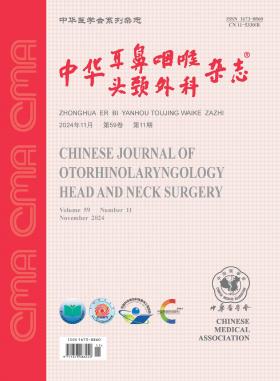
Chinese journal of otorhinolaryngology head and neck surgery is a high-level medical science and technology journal sponsored and published directly by the Chinese Medical Association, reflecting the significant research progress in the field of otorhinolaryngology head and neck surgery in China, and striving to promote the domestic and international academic exchanges for the purpose of running the journal.
Over the years, the journal has been ranked first in the total citation frequency list of national scientific and technical journals published by the Documentation and Intelligence Center of the Chinese Academy of Sciences and the China Science Citation Database, and has always ranked first among the scientific and technical journals in the related fields.
Chinese journal of otorhinolaryngology head and neck surgery has been included in the authoritative databases PubMed, Chinese core journals, CSCD.




 京公网安备 11010802042870号
京ICP备2023020795号-1
京公网安备 11010802042870号
京ICP备2023020795号-1

 分享
分享
 求助内容:
求助内容: 应助结果提醒方式:
 扫码关注我们
