Guo Peng, Guo-Xing Zhou, Xiang-Tao Dong, Yong-Bo Peng, Rong-Yan Zhang, Ying-Zhao Ma and Xiao-Ming Ren
{"title":"Multifunctional chiral metal hydrogen-bonded organic frameworks constructed from lanthanide ions with a trigonal prismatic coordination environment†","authors":"Guo Peng, Guo-Xing Zhou, Xiang-Tao Dong, Yong-Bo Peng, Rong-Yan Zhang, Ying-Zhao Ma and Xiao-Ming Ren","doi":"10.1039/D4DT02131B","DOIUrl":null,"url":null,"abstract":"<p >Two pairs of chiral enantiomers D/L-Dy(PMP)<small><sub>3</sub></small>·2H<small><sub>2</sub></small>O (<strong>D-1</strong>/<strong>L-1</strong>) and D/L-Yb(PMP)<small><sub>3</sub></small>·2H<small><sub>2</sub></small>O (<strong>D-2</strong>/<strong>L-2</strong>) were synthesized by the introduction of enantiomerically pure D/L-PMP (PMP = (phosphonomethyl)proline) ligands into lanthanide coordination chemistry. The chiral characteristics of these products were confirmed by single crystal X-ray diffraction, second harmonic generation (SHG) measurements and circular dichroism (CD) spectroscopy. These complexes are composed of 1D chains constructed from lanthanide ions with a trigonal prismatic coordination geometry and PMP ligands. The assembly of the 1D chains led to the formation of a lanthanide hydrogen-bonded organic framework with 1D water chains filled in the channels. Zero-field slow relaxation of magnetization was detected in <strong>L-1</strong>, whereas <strong>L-2</strong> showed field-induced single-molecule magnet (SMM) behavior. Complexes <strong>D-1</strong>, <strong>L-1</strong> and <strong>L-2</strong> show proton conductive ability and their conductivity values reach the order of 10<small><sup>−5</sup></small> S cm<small><sup>−1</sup></small> at 90 °C and 98% relative humidity.</p>","PeriodicalId":71,"journal":{"name":"Dalton Transactions","volume":" 1","pages":" 152-158"},"PeriodicalIF":3.3000,"publicationDate":"2024-11-05","publicationTypes":"Journal Article","fieldsOfStudy":null,"isOpenAccess":false,"openAccessPdf":"","citationCount":"0","resultStr":null,"platform":"Semanticscholar","paperid":null,"PeriodicalName":"Dalton Transactions","FirstCategoryId":"92","ListUrlMain":"https://pubs.rsc.org/en/content/articlelanding/2025/dt/d4dt02131b","RegionNum":3,"RegionCategory":"化学","ArticlePicture":[],"TitleCN":null,"AbstractTextCN":null,"PMCID":null,"EPubDate":"","PubModel":"","JCR":"Q2","JCRName":"CHEMISTRY, INORGANIC & NUCLEAR","Score":null,"Total":0}
引用次数: 0
Abstract
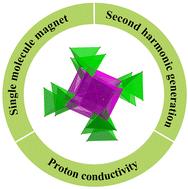
Two pairs of chiral enantiomers D/L-Dy(PMP)3·2H2O (D-1/L-1) and D/L-Yb(PMP)3·2H2O (D-2/L-2) were synthesized by the introduction of enantiomerically pure D/L-PMP (PMP = (phosphonomethyl)proline) ligands into lanthanide coordination chemistry. The chiral characteristics of these products were confirmed by single crystal X-ray diffraction, second harmonic generation (SHG) measurements and circular dichroism (CD) spectroscopy. These complexes are composed of 1D chains constructed from lanthanide ions with a trigonal prismatic coordination geometry and PMP ligands. The assembly of the 1D chains led to the formation of a lanthanide hydrogen-bonded organic framework with 1D water chains filled in the channels. Zero-field slow relaxation of magnetization was detected in L-1, whereas L-2 showed field-induced single-molecule magnet (SMM) behavior. Complexes D-1, L-1 and L-2 show proton conductive ability and their conductivity values reach the order of 10−5 S cm−1 at 90 °C and 98% relative humidity.
期刊介绍:
Dalton Transactions is a journal for all areas of inorganic chemistry, which encompasses the organometallic, bioinorganic and materials chemistry of the elements, with applications including synthesis, catalysis, energy conversion/storage, electrical devices and medicine. Dalton Transactions welcomes high-quality, original submissions in all of these areas and more, where the advancement of knowledge in inorganic chemistry is significant.




 京公网安备 11010802042870号
京ICP备2023020795号-1
京公网安备 11010802042870号
京ICP备2023020795号-1

 分享
分享
 求助内容:
求助内容: 应助结果提醒方式:
 扫码关注我们
