John D. Langhout, Elizabeth Gager, Talianna Ulloa, Shane Shepard, Juan C. Nino and Megan M. Butala
{"title":"Isovalent substitution modulates average and short-range structure in disordered rocksalt oxides†","authors":"John D. Langhout, Elizabeth Gager, Talianna Ulloa, Shane Shepard, Juan C. Nino and Megan M. Butala","doi":"10.1039/D4TA05971A","DOIUrl":null,"url":null,"abstract":"<p >Li-excess disordered rocksalt oxides are promising candidate materials for high-energy density Li-ion battery cathodes. Their disordered cation sublattice provides opportunity to design compositions that balance performance and sustainability, especially enabling the use of abundant and inexpensive elements. However, relationships between composition, short-range cation ordering, and their effects on performance are not well-understood. Here, we use a compositional series of the form Li<small><sub>1.2</sub></small>Mn<small><sub>0.4</sub></small>Ti<small><sub>0.4−<em>x</em></sub></small>Zr<small><sub><em>x</em></sub></small>O<small><sub>2</sub></small>, in which Ti<small><sup>4+</sup></small> is gradually replaced with Zr<small><sup>4+</sup></small>, to study the effect of Zr content on average- and short-range structure using synchrotron X-ray diffraction and pair distribution function analysis. We report the coexistence of multiple modes of short-range order, which have a major impact on battery capacity. However, the effects of Zr on degree of short-range ordering, lattice parameter, and chemical segregation also influence battery capacity, reflecting the complex dependencies of composition on structure across length scales in these disordered materials.</p>","PeriodicalId":82,"journal":{"name":"Journal of Materials Chemistry A","volume":" 46","pages":" 32140-32153"},"PeriodicalIF":9.5000,"publicationDate":"2024-11-05","publicationTypes":"Journal Article","fieldsOfStudy":null,"isOpenAccess":false,"openAccessPdf":"","citationCount":"0","resultStr":null,"platform":"Semanticscholar","paperid":null,"PeriodicalName":"Journal of Materials Chemistry A","FirstCategoryId":"88","ListUrlMain":"https://pubs.rsc.org/en/content/articlelanding/2024/ta/d4ta05971a","RegionNum":2,"RegionCategory":"材料科学","ArticlePicture":[],"TitleCN":null,"AbstractTextCN":null,"PMCID":null,"EPubDate":"","PubModel":"","JCR":"Q1","JCRName":"CHEMISTRY, PHYSICAL","Score":null,"Total":0}
引用次数: 0
Abstract
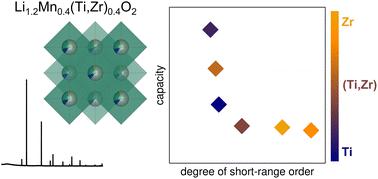
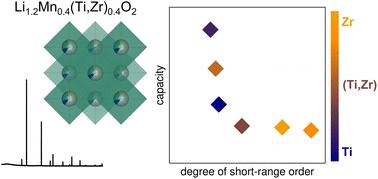
Li-excess disordered rocksalt oxides are promising candidate materials for high-energy density Li-ion battery cathodes. Their disordered cation sublattice provides opportunity to design compositions that balance performance and sustainability, especially enabling the use of abundant and inexpensive elements. However, relationships between composition, short-range cation ordering, and their effects on performance are not well-understood. Here, we use a compositional series of the form Li1.2Mn0.4Ti0.4−xZrxO2, in which Ti4+ is gradually replaced with Zr4+, to study the effect of Zr content on average- and short-range structure using synchrotron X-ray diffraction and pair distribution function analysis. We report the coexistence of multiple modes of short-range order, which have a major impact on battery capacity. However, the effects of Zr on degree of short-range ordering, lattice parameter, and chemical segregation also influence battery capacity, reflecting the complex dependencies of composition on structure across length scales in these disordered materials.
期刊介绍:
The Journal of Materials Chemistry A, B & C covers a wide range of high-quality studies in the field of materials chemistry, with each section focusing on specific applications of the materials studied. Journal of Materials Chemistry A emphasizes applications in energy and sustainability, including topics such as artificial photosynthesis, batteries, and fuel cells. Journal of Materials Chemistry B focuses on applications in biology and medicine, while Journal of Materials Chemistry C covers applications in optical, magnetic, and electronic devices. Example topic areas within the scope of Journal of Materials Chemistry A include catalysis, green/sustainable materials, sensors, and water treatment, among others.



 京公网安备 11010802042870号
京ICP备2023020795号-1
京公网安备 11010802042870号
京ICP备2023020795号-1

 分享
分享
 求助内容:
求助内容: 应助结果提醒方式:
 扫码关注我们
