Yuchen Zhang, Yuehan Jia, Yanjie Li, Hongquan Xu, Jingsu Wang, Maobin Wei, Yong Zhang, Hui Yuan and Ming Gao
{"title":"Doping-induced band-gap shrinkage to modify the electronic structure of MoS2 for organic wastewater management†","authors":"Yuchen Zhang, Yuehan Jia, Yanjie Li, Hongquan Xu, Jingsu Wang, Maobin Wei, Yong Zhang, Hui Yuan and Ming Gao","doi":"10.1039/D4DT00523F","DOIUrl":null,"url":null,"abstract":"<p >MoS<small><sub>2</sub></small>, with its high specific surface area and tunable electronic structure, has received much interest in the fields of sensing and environmental remediation. Nevertheless, pure MoS<small><sub>2</sub></small> has the disadvantages of easy aggregation and high electron–hole pair complexity, which affect its SERS and photocatalytic performance. In this work, a band-gap shrinkage strategy was used to improve MoS<small><sub>2</sub></small> performance for SERS and photocatalytic applications. It exhibited high SERS activity (enhancement factor (EF) = 3.61 × 10<small><sup>8</sup></small>), great stability (4 mth), broad applicability (CV, CR and R6G), and excellent reusability (with a recovery of 95% after 5 cycles). In addition, the interfacial dipole–dipole interaction and charge transfer (CT) process caused by doping Ru together enhanced the SERS sensitivity, reducing the limit of detection of CV to 10<small><sup>11</sup></small> M. The degradation rate of 10<small><sup>−5</sup></small> M CV was up to 99% after 60 min of Ru-MoS<small><sub>2</sub></small> photocatalytic degradation under visible light. This study investigated the effect of doping-induced bandgap shrinkage on charge transfer (CT), providing new insights into improving the sensitivity of semiconductor SERS substrates for efficient low-concentration SERS detection and low-cost sustainable wastewater remediation.</p>","PeriodicalId":71,"journal":{"name":"Dalton Transactions","volume":" 1","pages":" 318-327"},"PeriodicalIF":3.3000,"publicationDate":"2024-11-05","publicationTypes":"Journal Article","fieldsOfStudy":null,"isOpenAccess":false,"openAccessPdf":"","citationCount":"0","resultStr":null,"platform":"Semanticscholar","paperid":null,"PeriodicalName":"Dalton Transactions","FirstCategoryId":"92","ListUrlMain":"https://pubs.rsc.org/en/content/articlelanding/2025/dt/d4dt00523f","RegionNum":3,"RegionCategory":"化学","ArticlePicture":[],"TitleCN":null,"AbstractTextCN":null,"PMCID":null,"EPubDate":"","PubModel":"","JCR":"Q2","JCRName":"CHEMISTRY, INORGANIC & NUCLEAR","Score":null,"Total":0}
引用次数: 0
Abstract
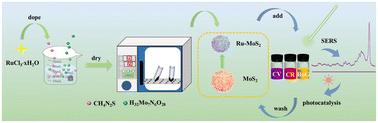
MoS2, with its high specific surface area and tunable electronic structure, has received much interest in the fields of sensing and environmental remediation. Nevertheless, pure MoS2 has the disadvantages of easy aggregation and high electron–hole pair complexity, which affect its SERS and photocatalytic performance. In this work, a band-gap shrinkage strategy was used to improve MoS2 performance for SERS and photocatalytic applications. It exhibited high SERS activity (enhancement factor (EF) = 3.61 × 10⁸), great stability (4 mth), broad applicability (CV, CR and R6G), and excellent reusability (with a recovery of 95% after 5 cycles). In addition, the interfacial dipole–dipole interaction and charge transfer (CT) process caused by doping Ru together enhanced the SERS sensitivity, reducing the limit of detection of CV to 1011 M. The degradation rate of 10−5 M CV was up to 99% after 60 min of Ru-MoS2 photocatalytic degradation under visible light. This study investigated the effect of doping-induced bandgap shrinkage on charge transfer (CT), providing new insights into improving the sensitivity of semiconductor SERS substrates for efficient low-concentration SERS detection and low-cost sustainable wastewater remediation.
期刊介绍:
Dalton Transactions is a journal for all areas of inorganic chemistry, which encompasses the organometallic, bioinorganic and materials chemistry of the elements, with applications including synthesis, catalysis, energy conversion/storage, electrical devices and medicine. Dalton Transactions welcomes high-quality, original submissions in all of these areas and more, where the advancement of knowledge in inorganic chemistry is significant.



 京公网安备 11010802042870号
京ICP备2023020795号-1
京公网安备 11010802042870号
京ICP备2023020795号-1

 分享
分享
 求助内容:
求助内容: 应助结果提醒方式:
 扫码关注我们
