{"title":"Evolution of small molecules as photocatalysts towards production of green hydrogen","authors":"Tumpa Gorai and Surya Prakash Singh","doi":"10.1039/D4TA05353B","DOIUrl":null,"url":null,"abstract":"<p >With the increased demand for green and sustainable sources of fuels, photocatalytic hydrogen gas production using semiconductor catalysts is attracting tremendous attention. In this perspective article, we will discuss the state-of-the-art development of small molecule-based semiconductors for photocatalytic green hydrogen production. Organic small molecules have the benefits of easy structural engineering allowing fine modulation of optical and electronic properties for the development of efficient photocatalysts. Small molecule-based photocatalyst development is advantageous compared to that of their polymer counterparts due to various reasons including less tedious synthesis, easily tunable optical and electronic properties, improved water dispersibility, <em>etc</em>. Conjugated donor–acceptor, porphyrin, perylene, and organic heterojunction nanoparticles are discussed in this article for their photocatalytic activity in the hydrogen evolution reaction. We have highlighted literature reports emphasizing the impact of heteroatom substitution, conjugation, band gap, exciton diffusion length, planarity, crystallinity, molecular packing, water solubility, <em>etc.</em> on photocatalytic performance.</p>","PeriodicalId":82,"journal":{"name":"Journal of Materials Chemistry A","volume":" 48","pages":" 33470-33487"},"PeriodicalIF":9.5000,"publicationDate":"2024-11-06","publicationTypes":"Journal Article","fieldsOfStudy":null,"isOpenAccess":false,"openAccessPdf":"","citationCount":"0","resultStr":null,"platform":"Semanticscholar","paperid":null,"PeriodicalName":"Journal of Materials Chemistry A","FirstCategoryId":"88","ListUrlMain":"https://pubs.rsc.org/en/content/articlelanding/2024/ta/d4ta05353b","RegionNum":2,"RegionCategory":"材料科学","ArticlePicture":[],"TitleCN":null,"AbstractTextCN":null,"PMCID":null,"EPubDate":"","PubModel":"","JCR":"Q1","JCRName":"CHEMISTRY, PHYSICAL","Score":null,"Total":0}
引用次数: 0
Abstract
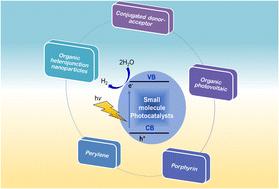
With the increased demand for green and sustainable sources of fuels, photocatalytic hydrogen gas production using semiconductor catalysts is attracting tremendous attention. In this perspective article, we will discuss the state-of-the-art development of small molecule-based semiconductors for photocatalytic green hydrogen production. Organic small molecules have the benefits of easy structural engineering allowing fine modulation of optical and electronic properties for the development of efficient photocatalysts. Small molecule-based photocatalyst development is advantageous compared to that of their polymer counterparts due to various reasons including less tedious synthesis, easily tunable optical and electronic properties, improved water dispersibility, etc. Conjugated donor–acceptor, porphyrin, perylene, and organic heterojunction nanoparticles are discussed in this article for their photocatalytic activity in the hydrogen evolution reaction. We have highlighted literature reports emphasizing the impact of heteroatom substitution, conjugation, band gap, exciton diffusion length, planarity, crystallinity, molecular packing, water solubility, etc. on photocatalytic performance.
期刊介绍:
The Journal of Materials Chemistry A, B & C covers a wide range of high-quality studies in the field of materials chemistry, with each section focusing on specific applications of the materials studied. Journal of Materials Chemistry A emphasizes applications in energy and sustainability, including topics such as artificial photosynthesis, batteries, and fuel cells. Journal of Materials Chemistry B focuses on applications in biology and medicine, while Journal of Materials Chemistry C covers applications in optical, magnetic, and electronic devices. Example topic areas within the scope of Journal of Materials Chemistry A include catalysis, green/sustainable materials, sensors, and water treatment, among others.




 京公网安备 11010802042870号
京ICP备2023020795号-1
京公网安备 11010802042870号
京ICP备2023020795号-1

 分享
分享
 求助内容:
求助内容: 应助结果提醒方式:
 扫码关注我们
