Chao Wei, Ming Lu, Jing-Jing Li, Ze-Jiu Diao, Guoliang Liu, Xiao-Qin Liu and Lin-Bing Sun
{"title":"A doubly interpenetrated perylene diimide-based zirconium metal–organic framework for selective oxidation of sulfides powered by blue light†","authors":"Chao Wei, Ming Lu, Jing-Jing Li, Ze-Jiu Diao, Guoliang Liu, Xiao-Qin Liu and Lin-Bing Sun","doi":"10.1039/D4TA06294A","DOIUrl":null,"url":null,"abstract":"<p >Perylene diimide (PDI) with its unique photoactive properties can be employed as an effective building block for synthesizing vigorous metal–organic frameworks (MOFs) and photocatalytic performance can be anticipated. Specifically, we introduce the fabrication of a zirconium-based MOF, Zr-PDI-Me, which is deliberately constructed using PDI units <em>via</em> a solvothermal process. The resulting Zr-PDI-Me exhibits a double interpenetrated topological structure and boasts a considerable specific surface area of up to 634 m<small><sup>2</sup></small> g<small><sup>−1</sup></small>. Furthermore, its photoelectric response is satisfactory as evidenced by electrochemical characterization. Consequently, Zr-PDI-Me has served as a photocatalyst to selectively oxidize sulfides, demonstrating its excellent versatility. Importantly, it retains initial catalytic activity even after 5 cycles. Studies on the mechanism revealed that both superoxide radicals (O<small><sub>2</sub></small>˙<small><sup>−</sup></small>) and singlet oxygen (<small><sup>1</sup></small>O<small><sub>2</sub></small>) promote the selective oxidation process to produce sulfoxides over Zr-PDI-Me. This work underscores the potential of incorporating photoresponsive organic functional groups into MOFs to create photoactive heterogeneous catalysts.</p>","PeriodicalId":82,"journal":{"name":"Journal of Materials Chemistry A","volume":" 47","pages":" 33142-33149"},"PeriodicalIF":9.5000,"publicationDate":"2024-11-06","publicationTypes":"Journal Article","fieldsOfStudy":null,"isOpenAccess":false,"openAccessPdf":"","citationCount":"0","resultStr":null,"platform":"Semanticscholar","paperid":null,"PeriodicalName":"Journal of Materials Chemistry A","FirstCategoryId":"88","ListUrlMain":"https://pubs.rsc.org/en/content/articlelanding/2024/ta/d4ta06294a","RegionNum":2,"RegionCategory":"材料科学","ArticlePicture":[],"TitleCN":null,"AbstractTextCN":null,"PMCID":null,"EPubDate":"","PubModel":"","JCR":"Q1","JCRName":"CHEMISTRY, PHYSICAL","Score":null,"Total":0}
引用次数: 0
Abstract
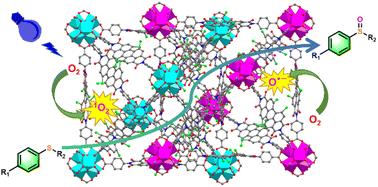
Perylene diimide (PDI) with its unique photoactive properties can be employed as an effective building block for synthesizing vigorous metal–organic frameworks (MOFs) and photocatalytic performance can be anticipated. Specifically, we introduce the fabrication of a zirconium-based MOF, Zr-PDI-Me, which is deliberately constructed using PDI units via a solvothermal process. The resulting Zr-PDI-Me exhibits a double interpenetrated topological structure and boasts a considerable specific surface area of up to 634 m2 g−1. Furthermore, its photoelectric response is satisfactory as evidenced by electrochemical characterization. Consequently, Zr-PDI-Me has served as a photocatalyst to selectively oxidize sulfides, demonstrating its excellent versatility. Importantly, it retains initial catalytic activity even after 5 cycles. Studies on the mechanism revealed that both superoxide radicals (O2˙−) and singlet oxygen (1O2) promote the selective oxidation process to produce sulfoxides over Zr-PDI-Me. This work underscores the potential of incorporating photoresponsive organic functional groups into MOFs to create photoactive heterogeneous catalysts.
期刊介绍:
The Journal of Materials Chemistry A, B & C covers a wide range of high-quality studies in the field of materials chemistry, with each section focusing on specific applications of the materials studied. Journal of Materials Chemistry A emphasizes applications in energy and sustainability, including topics such as artificial photosynthesis, batteries, and fuel cells. Journal of Materials Chemistry B focuses on applications in biology and medicine, while Journal of Materials Chemistry C covers applications in optical, magnetic, and electronic devices. Example topic areas within the scope of Journal of Materials Chemistry A include catalysis, green/sustainable materials, sensors, and water treatment, among others.




 京公网安备 11010802042870号
京ICP备2023020795号-1
京公网安备 11010802042870号
京ICP备2023020795号-1

 分享
分享
 求助内容:
求助内容: 应助结果提醒方式:
 扫码关注我们
