Yixing Shen, Jipeng Xu, Yana Li, Shuzhi Zhao, Haiying Che, Jabeen Maher, Xuan Wang, Yunlong Zhang, Jiafang Wu, Jingkun Li, Cheng Lian and Zi-Feng Ma
{"title":"Adjusting anion–solvent dipole interactions in ether-based electrolytes for wide temperature range applications of sodium-ion batteries†","authors":"Yixing Shen, Jipeng Xu, Yana Li, Shuzhi Zhao, Haiying Che, Jabeen Maher, Xuan Wang, Yunlong Zhang, Jiafang Wu, Jingkun Li, Cheng Lian and Zi-Feng Ma","doi":"10.1039/D4TA06873D","DOIUrl":null,"url":null,"abstract":"<p >Ether-based electrolytes have superior low-temperature performance, however, their instability at high temperatures hinders their commercial application. Therefore, it is crucial to conduct further studies to enable their use in practical batteries. In this work, we demonstrate that the coordination of anion–solvent dipole interactions with weak solvation improves interface transmission and reduces the kinetic barrier for Na<small><sup>+</sup></small> desolvation, leading to a significant improvement in the rate capability and cycling stability of batteries over a wide temperature range (−50–55 °C). The Na‖Na symmetrical cell demonstrates outstanding stripping/plating cycling durability for over 4000 h at −20 °C and 0.5 mA cm<small><sup>−2</sup></small>. The Na<small><sub>4</sub></small>Fe<small><sub>3</sub></small>(PO<small><sub>4</sub></small>)<small><sub>2</sub></small>P<small><sub>2</sub></small>O<small><sub>7</sub></small> ‖Na half cells present an ultra-high capacity retention of 99.9% after 1000 cycles at −20 °C and 0.3C, with an average coulombic efficiency (CE) of 99.8%. Additionally, the Na<small><sub>4</sub></small>Fe<small><sub>3</sub></small>(PO<small><sub>4</sub></small>)<small><sub>2</sub></small>P<small><sub>2</sub></small>O<small><sub>7</sub></small>‖hard carbon pouch batteries exhibit superior high-temperature cycling performance with a capacity retention of 87.8% after 1000 cycles and excellent low-temperature stability compared to commercial electrolytes with a capacity retention of 98.3% after 500 cycles. Our strategy in expanding the working temperature range of sodium-ion batteries accelerates the practical application of ether-based electrolytes.</p>","PeriodicalId":82,"journal":{"name":"Journal of Materials Chemistry A","volume":" 48","pages":" 33559-33571"},"PeriodicalIF":9.5000,"publicationDate":"2024-11-06","publicationTypes":"Journal Article","fieldsOfStudy":null,"isOpenAccess":false,"openAccessPdf":"","citationCount":"0","resultStr":null,"platform":"Semanticscholar","paperid":null,"PeriodicalName":"Journal of Materials Chemistry A","FirstCategoryId":"88","ListUrlMain":"https://pubs.rsc.org/en/content/articlelanding/2024/ta/d4ta06873d","RegionNum":2,"RegionCategory":"材料科学","ArticlePicture":[],"TitleCN":null,"AbstractTextCN":null,"PMCID":null,"EPubDate":"","PubModel":"","JCR":"Q1","JCRName":"CHEMISTRY, PHYSICAL","Score":null,"Total":0}
引用次数: 0
Abstract
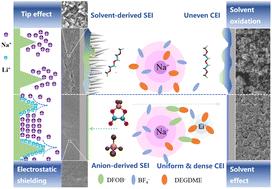
Ether-based electrolytes have superior low-temperature performance, however, their instability at high temperatures hinders their commercial application. Therefore, it is crucial to conduct further studies to enable their use in practical batteries. In this work, we demonstrate that the coordination of anion–solvent dipole interactions with weak solvation improves interface transmission and reduces the kinetic barrier for Na+ desolvation, leading to a significant improvement in the rate capability and cycling stability of batteries over a wide temperature range (−50–55 °C). The Na‖Na symmetrical cell demonstrates outstanding stripping/plating cycling durability for over 4000 h at −20 °C and 0.5 mA cm−2. The Na4Fe3(PO4)2P2O7 ‖Na half cells present an ultra-high capacity retention of 99.9% after 1000 cycles at −20 °C and 0.3C, with an average coulombic efficiency (CE) of 99.8%. Additionally, the Na4Fe3(PO4)2P2O7‖hard carbon pouch batteries exhibit superior high-temperature cycling performance with a capacity retention of 87.8% after 1000 cycles and excellent low-temperature stability compared to commercial electrolytes with a capacity retention of 98.3% after 500 cycles. Our strategy in expanding the working temperature range of sodium-ion batteries accelerates the practical application of ether-based electrolytes.
期刊介绍:
The Journal of Materials Chemistry A, B & C covers a wide range of high-quality studies in the field of materials chemistry, with each section focusing on specific applications of the materials studied. Journal of Materials Chemistry A emphasizes applications in energy and sustainability, including topics such as artificial photosynthesis, batteries, and fuel cells. Journal of Materials Chemistry B focuses on applications in biology and medicine, while Journal of Materials Chemistry C covers applications in optical, magnetic, and electronic devices. Example topic areas within the scope of Journal of Materials Chemistry A include catalysis, green/sustainable materials, sensors, and water treatment, among others.



 京公网安备 11010802042870号
京ICP备2023020795号-1
京公网安备 11010802042870号
京ICP备2023020795号-1

 分享
分享
 求助内容:
求助内容: 应助结果提醒方式:
 扫码关注我们
