{"title":"Surface-deprotonated ultra-small SnO2 quantum dots for high-performance perovskite solar cells†","authors":"Wuchen Xiang, Yiheng Gao, Bobo Yuan, Shuping Xiao, Rui Wu, Yiran Wan, Zhiqiang Liu, Liang Ma, Xiangbai Chen, Weijun Ke, Guojia Fang and Pingli Qin","doi":"10.1039/D4EE03193H","DOIUrl":null,"url":null,"abstract":"<p >SnO<small><sub>2</sub></small> electron transport layers (ETLs) have significantly boosted the recent record efficiencies in perovskite solar cells (PSCs). However, solution-processed SnO<small><sub>2</sub></small> ETLs often suffer from surface protonation with interface/surface defects, leading to substantial energy loss and interface instability. Herein, we investigated the surface properties of SnO<small><sub>2</sub></small> quantum dots (QDs) on device performance and then developed surface-deprotonated ultra-small SnO<small><sub>2</sub></small> QD ETLs. Our findings revealed that traditional SnO<small><sub>2</sub></small> QDs with thiourea doping introduced surface positive-charge protonation to recombine transferred electrons and lengthen their migration path, thereby reducing the electron-transfer efficiency and increasing the surface photocatalytic activity. In contrast, our surface-deprotonated ultra-small SnO<small><sub>2</sub></small> QDs (2.5 nm average size) exhibited effective coordination between PbI<small><sub>2</sub></small> and SnO<small><sub>2</sub></small>, lowering the interface barrier and suppressing carrier accumulation for rapid electron transfer and extraction. Consequently, PSCs with non-protonated SnO<small><sub>2</sub></small> QDs as ETLs achieved a significantly improved champion PCE of 25.55% and enhanced stability, outperforming those with the protonated SnO<small><sub>2</sub></small> QD ETLs. The corresponding X-ray detector devices also demonstrate broad applicability for superior detection performance.</p>","PeriodicalId":72,"journal":{"name":"Energy & Environmental Science","volume":" 1","pages":" 406-417"},"PeriodicalIF":30.8000,"publicationDate":"2024-11-12","publicationTypes":"Journal Article","fieldsOfStudy":null,"isOpenAccess":false,"openAccessPdf":"","citationCount":"0","resultStr":null,"platform":"Semanticscholar","paperid":null,"PeriodicalName":"Energy & Environmental Science","FirstCategoryId":"88","ListUrlMain":"https://pubs.rsc.org/en/content/articlelanding/2025/ee/d4ee03193h","RegionNum":1,"RegionCategory":"材料科学","ArticlePicture":[],"TitleCN":null,"AbstractTextCN":null,"PMCID":null,"EPubDate":"","PubModel":"","JCR":"Q1","JCRName":"CHEMISTRY, MULTIDISCIPLINARY","Score":null,"Total":0}
引用次数: 0
Abstract
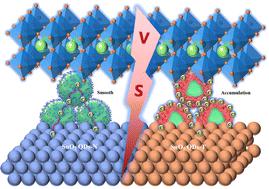
SnO2 electron transport layers (ETLs) have significantly boosted the recent record efficiencies in perovskite solar cells (PSCs). However, solution-processed SnO2 ETLs often suffer from surface protonation with interface/surface defects, leading to substantial energy loss and interface instability. Herein, we investigated the surface properties of SnO2 quantum dots (QDs) on device performance and then developed surface-deprotonated ultra-small SnO2 QD ETLs. Our findings revealed that traditional SnO2 QDs with thiourea doping introduced surface positive-charge protonation to recombine transferred electrons and lengthen their migration path, thereby reducing the electron-transfer efficiency and increasing the surface photocatalytic activity. In contrast, our surface-deprotonated ultra-small SnO2 QDs (2.5 nm average size) exhibited effective coordination between PbI2 and SnO2, lowering the interface barrier and suppressing carrier accumulation for rapid electron transfer and extraction. Consequently, PSCs with non-protonated SnO2 QDs as ETLs achieved a significantly improved champion PCE of 25.55% and enhanced stability, outperforming those with the protonated SnO2 QD ETLs. The corresponding X-ray detector devices also demonstrate broad applicability for superior detection performance.
期刊介绍:
Energy & Environmental Science, a peer-reviewed scientific journal, publishes original research and review articles covering interdisciplinary topics in the (bio)chemical and (bio)physical sciences, as well as chemical engineering disciplines. Published monthly by the Royal Society of Chemistry (RSC), a not-for-profit publisher, Energy & Environmental Science is recognized as a leading journal. It boasts an impressive impact factor of 8.500 as of 2009, ranking 8th among 140 journals in the category "Chemistry, Multidisciplinary," second among 71 journals in "Energy & Fuels," second among 128 journals in "Engineering, Chemical," and first among 181 scientific journals in "Environmental Sciences."
Energy & Environmental Science publishes various types of articles, including Research Papers (original scientific work), Review Articles, Perspectives, and Minireviews (feature review-type articles of broad interest), Communications (original scientific work of an urgent nature), Opinions (personal, often speculative viewpoints or hypotheses on current topics), and Analysis Articles (in-depth examination of energy-related issues).



 京公网安备 11010802042870号
京ICP备2023020795号-1
京公网安备 11010802042870号
京ICP备2023020795号-1

 分享
分享
 求助内容:
求助内容: 应助结果提醒方式:
 扫码关注我们
