{"title":"Formation of Chlorinated Carbohydrate Degradation Products and Amino Acids during Heating of Sucralose in Model Systems and Food.","authors":"Michael Hellwig","doi":"10.1021/acs.jafc.4c08059","DOIUrl":null,"url":null,"abstract":"<p><p>Sucralose is an artificial sweetener whose stability during the thermal treatment of food is controversially discussed. In the present work, sucralose was subjected to different kinds of heat treatment either as such, in the presence of protein, or as an ingredient of food. Compared with sucrose, sucralose showed remarkable instability and discoloration after heating at 85-90 °C for 1 h. A chlorinated furan-3-one and different chlorinated dicarbonyl compounds were identified by High-performance liquid chromatography-time-of-flight mass spectrometry (HPLC-TOF-MS) for the first time, indicating that both the 4-chlorogalactosyl residue and the 1,6-dichlorofructosyl residue give rise to novel chlorinated sugar degradation products. When sucralose was heated in the presence of protein, the formation of 3-chlorotyrosine was detected, indicating that sucralose can invoke chlorination of other biomolecules. The influence of the addition of sucralose (0.03-0.1%) to dough on pH value, color development, and HMF formation was tested in baking experiments (muffins, coconut macaroons, cookies). A significantly higher HMF concentration was observed in bakery products, including sucralose, and a chlorinated 1,2-dicarbonyl compound was detected qualitatively in baked cookies. This work shows that sucralose is not stable during baking processes at high temperatures and low moisture contents, thereby confirming recommendations from the German Institute of Risk Assessment not to use sucralose for baking.</p>","PeriodicalId":41,"journal":{"name":"Journal of Agricultural and Food Chemistry","volume":" ","pages":"26441-26450"},"PeriodicalIF":6.2000,"publicationDate":"2024-11-27","publicationTypes":"Journal Article","fieldsOfStudy":null,"isOpenAccess":false,"openAccessPdf":"https://www.ncbi.nlm.nih.gov/pmc/articles/PMC11613498/pdf/","citationCount":"0","resultStr":null,"platform":"Semanticscholar","paperid":null,"PeriodicalName":"Journal of Agricultural and Food Chemistry","FirstCategoryId":"97","ListUrlMain":"https://doi.org/10.1021/acs.jafc.4c08059","RegionNum":1,"RegionCategory":"农林科学","ArticlePicture":[],"TitleCN":null,"AbstractTextCN":null,"PMCID":null,"EPubDate":"2024/11/18 0:00:00","PubModel":"Epub","JCR":"Q1","JCRName":"AGRICULTURE, MULTIDISCIPLINARY","Score":null,"Total":0}
引用次数: 0
Abstract
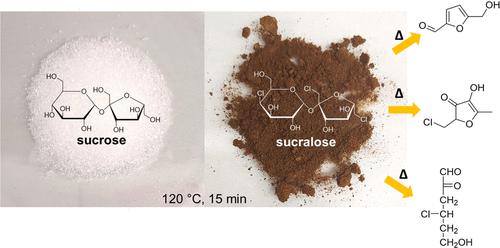
Sucralose is an artificial sweetener whose stability during the thermal treatment of food is controversially discussed. In the present work, sucralose was subjected to different kinds of heat treatment either as such, in the presence of protein, or as an ingredient of food. Compared with sucrose, sucralose showed remarkable instability and discoloration after heating at 85-90 °C for 1 h. A chlorinated furan-3-one and different chlorinated dicarbonyl compounds were identified by High-performance liquid chromatography-time-of-flight mass spectrometry (HPLC-TOF-MS) for the first time, indicating that both the 4-chlorogalactosyl residue and the 1,6-dichlorofructosyl residue give rise to novel chlorinated sugar degradation products. When sucralose was heated in the presence of protein, the formation of 3-chlorotyrosine was detected, indicating that sucralose can invoke chlorination of other biomolecules. The influence of the addition of sucralose (0.03-0.1%) to dough on pH value, color development, and HMF formation was tested in baking experiments (muffins, coconut macaroons, cookies). A significantly higher HMF concentration was observed in bakery products, including sucralose, and a chlorinated 1,2-dicarbonyl compound was detected qualitatively in baked cookies. This work shows that sucralose is not stable during baking processes at high temperatures and low moisture contents, thereby confirming recommendations from the German Institute of Risk Assessment not to use sucralose for baking.
期刊介绍:
The Journal of Agricultural and Food Chemistry publishes high-quality, cutting edge original research representing complete studies and research advances dealing with the chemistry and biochemistry of agriculture and food. The Journal also encourages papers with chemistry and/or biochemistry as a major component combined with biological/sensory/nutritional/toxicological evaluation related to agriculture and/or food.




 京公网安备 11010802042870号
京ICP备2023020795号-1
京公网安备 11010802042870号
京ICP备2023020795号-1

 分享
分享
 求助内容:
求助内容: 应助结果提醒方式:
 扫码关注我们
