Dongyue Gao, Li Ma, Yongli Yang, Zhe Liu, Yadong Yu, Yi Fang, Yang Huang, Chengchun Tang, Zhonglu Guo
{"title":"Breaking the linear scaling relationship in BN-supported metal catalysts for efficient CO2RR towards C1 and C2 products","authors":"Dongyue Gao, Li Ma, Yongli Yang, Zhe Liu, Yadong Yu, Yi Fang, Yang Huang, Chengchun Tang, Zhonglu Guo","doi":"10.1016/j.jmst.2024.11.008","DOIUrl":null,"url":null,"abstract":"The catalytic activity and selectivity of CO<sub>2</sub> reduction reaction (CO<sub>2</sub>RR) towards C1 and C2 products are fundamentally restricted by the inherent linear scaling relationship among the adsorption-free energies of intermediates. To face this challenge, we have proposed a novel multifunctional M<sub>1</sub>M<sub>2</sub>@BN electrocatalysts to break the linear scaling relationships in CO<sub>2</sub>RR and efficiently obtain C1 and C2 products. Our results reveal that the optimal limiting potential is increased from −0.58 V for M@BN to −0.39 V for M<sub>1</sub>M<sub>2</sub>@BN, which achieves ultrahigh activity of CO<sub>2</sub>RR. Further mechanism analysis illuminates that M<sub>1</sub>M<sub>2</sub>@BN can selectivity modulate the adsorption strength of OCHO* and OCH<sub>2</sub>O*/OCHOH*, breaking the linear scaling relationship of adsorption-free energies of key intermediates to achieve the enhanced catalytic activity. Notably, the sufficient active sites on M<sub>1</sub>M<sub>2</sub>@BN electrocatalysts can promote the sluggish C–C coupling by capturing two CO intermediates simultaneously, further generating high-value multi-carbon (CH<sub>2</sub>CH<sub>2</sub>OH) products. Meanwhile, the thermodynamic stability of M<sub>1</sub>M<sub>2</sub>@BN has been demonstrated by ab initio molecular dynamics (AIMD) simulations, which shows the feasibility of commercial application in CO<sub>2</sub>RR. Our findings provide a novel strategy to modulate the binding strength of intermediates and develop the design of efficient multi-active-site CO<sub>2</sub>RR electrocatalysts.","PeriodicalId":16154,"journal":{"name":"Journal of Materials Science & Technology","volume":"198 1","pages":""},"PeriodicalIF":14.3000,"publicationDate":"2024-11-30","publicationTypes":"Journal Article","fieldsOfStudy":null,"isOpenAccess":false,"openAccessPdf":"","citationCount":"0","resultStr":null,"platform":"Semanticscholar","paperid":null,"PeriodicalName":"Journal of Materials Science & Technology","FirstCategoryId":"88","ListUrlMain":"https://doi.org/10.1016/j.jmst.2024.11.008","RegionNum":1,"RegionCategory":"材料科学","ArticlePicture":[],"TitleCN":null,"AbstractTextCN":null,"PMCID":null,"EPubDate":"","PubModel":"","JCR":"Q1","JCRName":"MATERIALS SCIENCE, MULTIDISCIPLINARY","Score":null,"Total":0}
引用次数: 0
Abstract
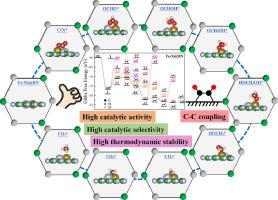
The catalytic activity and selectivity of CO2 reduction reaction (CO2RR) towards C1 and C2 products are fundamentally restricted by the inherent linear scaling relationship among the adsorption-free energies of intermediates. To face this challenge, we have proposed a novel multifunctional M1M2@BN electrocatalysts to break the linear scaling relationships in CO2RR and efficiently obtain C1 and C2 products. Our results reveal that the optimal limiting potential is increased from −0.58 V for M@BN to −0.39 V for M1M2@BN, which achieves ultrahigh activity of CO2RR. Further mechanism analysis illuminates that M1M2@BN can selectivity modulate the adsorption strength of OCHO* and OCH2O*/OCHOH*, breaking the linear scaling relationship of adsorption-free energies of key intermediates to achieve the enhanced catalytic activity. Notably, the sufficient active sites on M1M2@BN electrocatalysts can promote the sluggish C–C coupling by capturing two CO intermediates simultaneously, further generating high-value multi-carbon (CH2CH2OH) products. Meanwhile, the thermodynamic stability of M1M2@BN has been demonstrated by ab initio molecular dynamics (AIMD) simulations, which shows the feasibility of commercial application in CO2RR. Our findings provide a novel strategy to modulate the binding strength of intermediates and develop the design of efficient multi-active-site CO2RR electrocatalysts.
期刊介绍:
Journal of Materials Science & Technology strives to promote global collaboration in the field of materials science and technology. It primarily publishes original research papers, invited review articles, letters, research notes, and summaries of scientific achievements. The journal covers a wide range of materials science and technology topics, including metallic materials, inorganic nonmetallic materials, and composite materials.




 京公网安备 11010802042870号
京ICP备2023020795号-1
京公网安备 11010802042870号
京ICP备2023020795号-1

 分享
分享
 求助内容:
求助内容: 应助结果提醒方式:
 扫码关注我们
