In situ grown Na+-doped NH4V4O10 nano-arrays on carbon cloth with ultra-high specific capacity for high-performance aqueous ammonium ion hybrid supercapacitors†
Yangwang Zhou, Fei Long, Yixin Hou, Xinying Lin, Li Sun, Shuyi Mo, Fei Long and Yihua Gao
{"title":"In situ grown Na+-doped NH4V4O10 nano-arrays on carbon cloth with ultra-high specific capacity for high-performance aqueous ammonium ion hybrid supercapacitors†","authors":"Yangwang Zhou, Fei Long, Yixin Hou, Xinying Lin, Li Sun, Shuyi Mo, Fei Long and Yihua Gao","doi":"10.1039/D4TA06326K","DOIUrl":null,"url":null,"abstract":"<p >Aqueous ammonium ion hybrid supercapacitors (A-HSCs) have sparked significant interest due to their safety, sustainability, and low cost. However, the quest for superior electrode materials for storing ammonium ions still encounters many challenges. Since layered vanadium-based materials usually have a high theoretical capacity and open crystal structure, and the introduction of sodium ions can enhance ionic bonds and cycle stability, this work reports a Na<small><sup>+</sup></small>-doped NH<small><sub>4</sub></small>V<small><sub>4</sub></small>O<small><sub>10</sub></small> nano-array grown <em>in situ</em> on carbon cloth through a hydrothermal approach (NaNVO@CC), which serves as a novel cathode material for A-HSCs. The irreversible deammoniation reaction of NH<small><sub>4</sub></small>V<small><sub>4</sub></small>O<small><sub>10</sub></small> was effectively inhibited due to the growth on the carbon cloth and the synergistic effect of Na<small><sup>+</sup></small>. Thanks to these advantages, the NaNVO@CC cathode demonstrates outstanding electrochemical performance, achieving an ultra-high specific capacity of 712 F g<small><sup>−1</sup></small> at 0.50 A g<small><sup>−1</sup></small> and exceptional cycle stability, retaining 71.1% of its capacitance at 5.00 A g<small><sup>−1</sup></small> over 20 000 cycles. The built A-HSC exhibits significant power density (8556.6 W kg<small><sup>−1</sup></small>), energy density (77.7 W h kg<small><sup>−1</sup></small>) and superior cycle life. This work proves the enormous potential of doping in enhancing electrode performance, which will offer insights for the creation of high-performance A-HSCs.</p>","PeriodicalId":82,"journal":{"name":"Journal of Materials Chemistry A","volume":" 2","pages":" 1023-1033"},"PeriodicalIF":9.5000,"publicationDate":"2024-12-03","publicationTypes":"Journal Article","fieldsOfStudy":null,"isOpenAccess":false,"openAccessPdf":"","citationCount":"0","resultStr":null,"platform":"Semanticscholar","paperid":null,"PeriodicalName":"Journal of Materials Chemistry A","FirstCategoryId":"88","ListUrlMain":"https://pubs.rsc.org/en/content/articlelanding/2025/ta/d4ta06326k","RegionNum":2,"RegionCategory":"材料科学","ArticlePicture":[],"TitleCN":null,"AbstractTextCN":null,"PMCID":null,"EPubDate":"","PubModel":"","JCR":"Q1","JCRName":"CHEMISTRY, PHYSICAL","Score":null,"Total":0}
引用次数: 0
Abstract
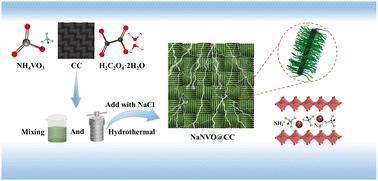
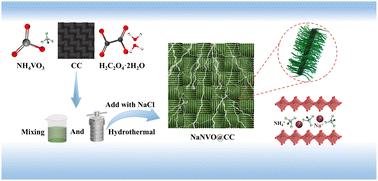
Aqueous ammonium ion hybrid supercapacitors (A-HSCs) have sparked significant interest due to their safety, sustainability, and low cost. However, the quest for superior electrode materials for storing ammonium ions still encounters many challenges. Since layered vanadium-based materials usually have a high theoretical capacity and open crystal structure, and the introduction of sodium ions can enhance ionic bonds and cycle stability, this work reports a Na+-doped NH4V4O10 nano-array grown in situ on carbon cloth through a hydrothermal approach (NaNVO@CC), which serves as a novel cathode material for A-HSCs. The irreversible deammoniation reaction of NH4V4O10 was effectively inhibited due to the growth on the carbon cloth and the synergistic effect of Na+. Thanks to these advantages, the NaNVO@CC cathode demonstrates outstanding electrochemical performance, achieving an ultra-high specific capacity of 712 F g−1 at 0.50 A g−1 and exceptional cycle stability, retaining 71.1% of its capacitance at 5.00 A g−1 over 20 000 cycles. The built A-HSC exhibits significant power density (8556.6 W kg−1), energy density (77.7 W h kg−1) and superior cycle life. This work proves the enormous potential of doping in enhancing electrode performance, which will offer insights for the creation of high-performance A-HSCs.
水铵离子混合超级电容器(a - hsc)因其安全性、可持续性和低成本而引起了人们的极大兴趣。然而,寻找储存铵离子的优良电极材料仍然面临许多挑战。由于层状钒基材料通常具有较高的理论容量和开放的晶体结构,并且钠离子的引入可以增强离子键和循环稳定性,本工作报道了通过水热方法在碳布上原位生长的Na+掺杂NH4V4O10纳米阵列(NaNVO@CC),作为a - hsc的新型正极材料。由于碳布上的生长和Na+的协同作用,NH4V4O10的不可逆脱氨反应被有效抑制。由于这些优点,NaNVO@CC阴极表现出出色的电化学性能,在0.50 A g−1下实现了712 F g−1的超高比容量和出色的循环稳定性,在5.00 A g−1下超过20,000次循环保持了71.1%的电容。构建的A-HSC具有显著的功率密度(8556.6 W kg−1)、能量密度(77.7 W h kg−1)和优良的循环寿命。这项工作证明了掺杂在提高电极性能方面的巨大潜力,这将为高性能a - hsc的创建提供见解。
期刊介绍:
The Journal of Materials Chemistry A, B & C covers a wide range of high-quality studies in the field of materials chemistry, with each section focusing on specific applications of the materials studied. Journal of Materials Chemistry A emphasizes applications in energy and sustainability, including topics such as artificial photosynthesis, batteries, and fuel cells. Journal of Materials Chemistry B focuses on applications in biology and medicine, while Journal of Materials Chemistry C covers applications in optical, magnetic, and electronic devices. Example topic areas within the scope of Journal of Materials Chemistry A include catalysis, green/sustainable materials, sensors, and water treatment, among others.




 京公网安备 11010802042870号
京ICP备2023020795号-1
京公网安备 11010802042870号
京ICP备2023020795号-1

 分享
分享
 求助内容:
求助内容: 应助结果提醒方式:
 扫码关注我们
