Yong-Kang Zhang, Lan Zhao, Alexander O. Terent'ev and Liang-Nian He
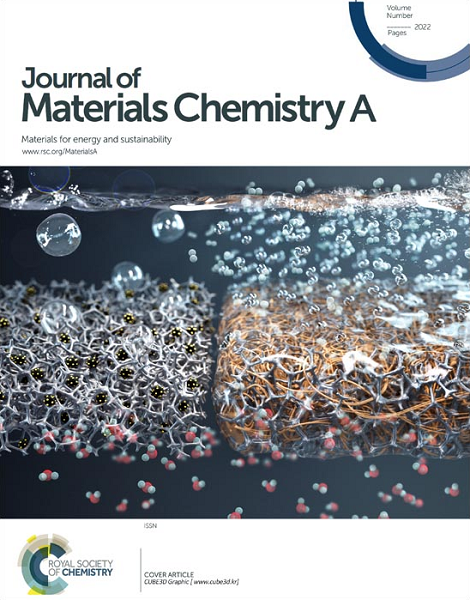
{"title":"Dynamic pyridinethiol ligand shuttling within iron-anchored covalent organic frameworks boosts CO2 photoreduction†","authors":"Yong-Kang Zhang, Lan Zhao, Alexander O. Terent'ev and Liang-Nian He","doi":"10.1039/D4TA07403C","DOIUrl":null,"url":null,"abstract":"<p >A covalent organic framework (COF), as a porous crystalline material, provides a versatile platform for the photocatalytic CO<small><sub>2</sub></small> reduction reaction (PCO<small><sub>2</sub></small>RR). However, the lack of surface redox active sites and rapid photogenerated charge recombination are the major barriers limiting further enhancement of PCO<small><sub>2</sub></small>RR activity. Herein, we designed a novel photocatalytic system constructed from a dynamic D⋯M–A structure COF. Earth-abundant metal iron sites were embedded into a triazinyl COF structure containing bipyridine units (Fe-bpy-COF), and the subsequent supplementation of pyridinethiol to the system allowed efficient CO<small><sub>2</sub></small> photoreduction without additional photosensitizers. Remarkably, the Fe-bpy-COF system achieved an impressive formate yield of 4052 μmol g<small><sup>−1</sup></small> h<small><sup>−1</sup></small> and CO yield of 2123 μmol g<small><sup>−1</sup></small> h<small><sup>−1</sup></small>, being over approximately 8.2-fold higher than that of the previously reported Re-COF under visible light irradiation. On the basis of <small><sup>1</sup></small>H NMR titration experiments and steady-state tests of the absorption spectra, the superior photocatalytic performance is accordingly attributed to the dynamic coordination interaction between the pyridinethiol ligands and Fe-bpy-COF host, thus facilitating continuous double-electron transfer from the pyridinethiol ligands to the iron center under visible light and inhibiting photogenerated charge recombination in Fe-bpy-COF. Finally, the reaction pathways of CO<small><sub>2</sub></small> conversion catalyzed by the reductive iron active species are elucidated by combining experimental results and density functional theory studies. This provides unprecedented insights into the design of earth abundant metal-derived COF photocatalysts for efficient and selective CO<small><sub>2</sub></small> reduction under visible light.</p>","PeriodicalId":82,"journal":{"name":"Journal of Materials Chemistry A","volume":" 2","pages":" 1407-1419"},"PeriodicalIF":9.5000,"publicationDate":"2024-12-03","publicationTypes":"Journal Article","fieldsOfStudy":null,"isOpenAccess":false,"openAccessPdf":"","citationCount":"0","resultStr":null,"platform":"Semanticscholar","paperid":null,"PeriodicalName":"Journal of Materials Chemistry A","FirstCategoryId":"88","ListUrlMain":"https://pubs.rsc.org/en/content/articlelanding/2025/ta/d4ta07403c","RegionNum":2,"RegionCategory":"材料科学","ArticlePicture":[],"TitleCN":null,"AbstractTextCN":null,"PMCID":null,"EPubDate":"","PubModel":"","JCR":"Q1","JCRName":"CHEMISTRY, PHYSICAL","Score":null,"Total":0}
引用次数: 0
Abstract
A covalent organic framework (COF), as a porous crystalline material, provides a versatile platform for the photocatalytic CO2 reduction reaction (PCO2RR). However, the lack of surface redox active sites and rapid photogenerated charge recombination are the major barriers limiting further enhancement of PCO2RR activity. Herein, we designed a novel photocatalytic system constructed from a dynamic D⋯M–A structure COF. Earth-abundant metal iron sites were embedded into a triazinyl COF structure containing bipyridine units (Fe-bpy-COF), and the subsequent supplementation of pyridinethiol to the system allowed efficient CO2 photoreduction without additional photosensitizers. Remarkably, the Fe-bpy-COF system achieved an impressive formate yield of 4052 μmol g−1 h−1 and CO yield of 2123 μmol g−1 h−1, being over approximately 8.2-fold higher than that of the previously reported Re-COF under visible light irradiation. On the basis of 1H NMR titration experiments and steady-state tests of the absorption spectra, the superior photocatalytic performance is accordingly attributed to the dynamic coordination interaction between the pyridinethiol ligands and Fe-bpy-COF host, thus facilitating continuous double-electron transfer from the pyridinethiol ligands to the iron center under visible light and inhibiting photogenerated charge recombination in Fe-bpy-COF. Finally, the reaction pathways of CO2 conversion catalyzed by the reductive iron active species are elucidated by combining experimental results and density functional theory studies. This provides unprecedented insights into the design of earth abundant metal-derived COF photocatalysts for efficient and selective CO2 reduction under visible light.
期刊介绍:
The Journal of Materials Chemistry A, B & C covers a wide range of high-quality studies in the field of materials chemistry, with each section focusing on specific applications of the materials studied. Journal of Materials Chemistry A emphasizes applications in energy and sustainability, including topics such as artificial photosynthesis, batteries, and fuel cells. Journal of Materials Chemistry B focuses on applications in biology and medicine, while Journal of Materials Chemistry C covers applications in optical, magnetic, and electronic devices. Example topic areas within the scope of Journal of Materials Chemistry A include catalysis, green/sustainable materials, sensors, and water treatment, among others.





 京公网安备 11010802042870号
京ICP备2023020795号-1
京公网安备 11010802042870号
京ICP备2023020795号-1

 分享
分享
 求助内容:
求助内容: 应助结果提醒方式:
 扫码关注我们
