Beibei Zhang , Mengnan Zeng , Qimei Tie , Ru Wang , Mengya Wang , Yuanyuan Wu , Xiaoke Zheng , Weisheng Feng
{"title":"(−)-Epigallocatechin-3-gallate (EGCG) ameliorates ovalbumin-induced asthma by inhibiting inflammation via the TNF-α/TNF-R1/NLRP3 signaling pathway","authors":"Beibei Zhang , Mengnan Zeng , Qimei Tie , Ru Wang , Mengya Wang , Yuanyuan Wu , Xiaoke Zheng , Weisheng Feng","doi":"10.1016/j.intimp.2024.113708","DOIUrl":null,"url":null,"abstract":"<div><div>(−)-Epigallocatechin-3-gallate (EGCG) is a polyphenol in green tea with potential lung-protective effects. However, the effects of EGCG on airway inflammation in asthma remain unclear. The aim of this study was to investigate the effect and mechanism of EGCG on asthmatic airway inflammation. In this study, the therapeutic effects of EGCG on ovalbumin (OVA)-induced asthmatic mice were tested first. Second, the effects of EGCG on airway inflammation, airway hyperresponsiveness (AHR), airway mucus hypersecretion, cell apoptosis and differential genes were investigated. Finally, the relationships between the effects of EGCG on airway inflammation and the TNF-α/TNF-R1/NLRP3 signaling pathway in asthmatic mice were explored. The results showed that EGCG could attenuate AHR, alleviate the symptoms of alveolar wall thickening and inflammatory cell infiltration, decrease the levels of inflammatory cytokines and airway mucus markers, reduce apoptosis and reactive oxygen species (ROS) and increase the mitochondrial membrane potential (MMP) in primary lung cells in asthmatic mice. Additionally, EGCG significantly inhibited the activation of the TNF-α/TNF-R1/NLRP3 signaling pathway in the lung tissues of asthmatic mice. The lowest binding free energies of EGCG with TNF-α, TNF-R1 and NLRP3 were −11.6, −11.6 and −8.2 kcal/mol, respectively. Moreover, the equilibrium dissociation constant (KD) of EGCG and TNF-R1was 26.05 μmol/L. EGCG-mediated inhibition of TNF-α/TNF-R1/NLRP3 signaling pathway activation was blocked in LPS-induced BEAS-2B and RAW264.7 cells overexpressing TNF-α. Consequently, EGCG effectively attenuated AHR and inhibited airway inflammation and airway mucus hypersecretion in asthmatic mice, and these effects may be closely related to the TNF-α/TNF-R1/NLRP3 signaling pathway.</div></div>","PeriodicalId":13859,"journal":{"name":"International immunopharmacology","volume":"144 ","pages":"Article 113708"},"PeriodicalIF":4.7000,"publicationDate":"2025-01-10","publicationTypes":"Journal Article","fieldsOfStudy":null,"isOpenAccess":false,"openAccessPdf":"","citationCount":"0","resultStr":null,"platform":"Semanticscholar","paperid":null,"PeriodicalName":"International immunopharmacology","FirstCategoryId":"3","ListUrlMain":"https://www.sciencedirect.com/science/article/pii/S1567576924022306","RegionNum":2,"RegionCategory":"医学","ArticlePicture":[],"TitleCN":null,"AbstractTextCN":null,"PMCID":null,"EPubDate":"2024/12/3 0:00:00","PubModel":"Epub","JCR":"Q2","JCRName":"IMMUNOLOGY","Score":null,"Total":0}
引用次数: 0
Abstract
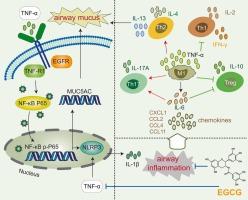
(−)-Epigallocatechin-3-gallate (EGCG) is a polyphenol in green tea with potential lung-protective effects. However, the effects of EGCG on airway inflammation in asthma remain unclear. The aim of this study was to investigate the effect and mechanism of EGCG on asthmatic airway inflammation. In this study, the therapeutic effects of EGCG on ovalbumin (OVA)-induced asthmatic mice were tested first. Second, the effects of EGCG on airway inflammation, airway hyperresponsiveness (AHR), airway mucus hypersecretion, cell apoptosis and differential genes were investigated. Finally, the relationships between the effects of EGCG on airway inflammation and the TNF-α/TNF-R1/NLRP3 signaling pathway in asthmatic mice were explored. The results showed that EGCG could attenuate AHR, alleviate the symptoms of alveolar wall thickening and inflammatory cell infiltration, decrease the levels of inflammatory cytokines and airway mucus markers, reduce apoptosis and reactive oxygen species (ROS) and increase the mitochondrial membrane potential (MMP) in primary lung cells in asthmatic mice. Additionally, EGCG significantly inhibited the activation of the TNF-α/TNF-R1/NLRP3 signaling pathway in the lung tissues of asthmatic mice. The lowest binding free energies of EGCG with TNF-α, TNF-R1 and NLRP3 were −11.6, −11.6 and −8.2 kcal/mol, respectively. Moreover, the equilibrium dissociation constant (KD) of EGCG and TNF-R1was 26.05 μmol/L. EGCG-mediated inhibition of TNF-α/TNF-R1/NLRP3 signaling pathway activation was blocked in LPS-induced BEAS-2B and RAW264.7 cells overexpressing TNF-α. Consequently, EGCG effectively attenuated AHR and inhibited airway inflammation and airway mucus hypersecretion in asthmatic mice, and these effects may be closely related to the TNF-α/TNF-R1/NLRP3 signaling pathway.
期刊介绍:
International Immunopharmacology is the primary vehicle for the publication of original research papers pertinent to the overlapping areas of immunology, pharmacology, cytokine biology, immunotherapy, immunopathology and immunotoxicology. Review articles that encompass these subjects are also welcome.
The subject material appropriate for submission includes:
• Clinical studies employing immunotherapy of any type including the use of: bacterial and chemical agents; thymic hormones, interferon, lymphokines, etc., in transplantation and diseases such as cancer, immunodeficiency, chronic infection and allergic, inflammatory or autoimmune disorders.
• Studies on the mechanisms of action of these agents for specific parameters of immune competence as well as the overall clinical state.
• Pre-clinical animal studies and in vitro studies on mechanisms of action with immunopotentiators, immunomodulators, immunoadjuvants and other pharmacological agents active on cells participating in immune or allergic responses.
• Pharmacological compounds, microbial products and toxicological agents that affect the lymphoid system, and their mechanisms of action.
• Agents that activate genes or modify transcription and translation within the immune response.
• Substances activated, generated, or released through immunologic or related pathways that are pharmacologically active.
• Production, function and regulation of cytokines and their receptors.
• Classical pharmacological studies on the effects of chemokines and bioactive factors released during immunological reactions.



 京公网安备 11010802042870号
京ICP备2023020795号-1
京公网安备 11010802042870号
京ICP备2023020795号-1

 分享
分享
 求助内容:
求助内容: 应助结果提醒方式:
 扫码关注我们
