Danielle R Shayani, Elizabeth Alpert, J Ben Barnes, Denise M Sloan, Adele M Hayes
{"title":"Identifying predictors of long-term treatment outcomes using narratives from written exposure therapy and cognitive processing therapy for PTSD.","authors":"Danielle R Shayani, Elizabeth Alpert, J Ben Barnes, Denise M Sloan, Adele M Hayes","doi":"10.1037/tra0001813","DOIUrl":null,"url":null,"abstract":"<p><strong>Objective: </strong>Cognitive processing therapy (CPT), a 12-session, gold-standard treatment for posttraumatic stress disorder (PTSD), and written exposure therapy (WET), a brief, five-session treatment, have similar treatment efficacy. The aim of the present study was to identify predictors of long-term treatment outcomes of WET and CPT using clients' written narratives.</p><p><strong>Method: </strong>Narratives from both treatments were coded with the Change and Growth Experiences Scale coding system to identify predictors of long-term PTSD symptom outcomes. Participants were 113 adults with PTSD randomly assigned to receive WET (<i>n</i> = 60) or CPT (<i>n</i> = 53).</p><p><strong>Results: </strong>In WET, higher average levels of accommodated (balanced, healthy) beliefs predicted lower PTSD symptoms at the 60-week endpoint, as well as a decrease in symptoms over the follow-up symptom slope. In CPT, higher average negative emotions and positive view of self predicted better 60-week PTSD symptom outcomes, as did lower hopelessness, which also predicted a decrease in PTSD symptoms over the follow-up period.</p><p><strong>Conclusions: </strong>Even without direct cognitive change techniques, adaptive processing of traumatic experiences occurred in WET and predicted PTSD long-term symptom improvement. Both emotional engagement and cognitive change might help to sustain treatment gains in CPT. (PsycInfo Database Record (c) 2025 APA, all rights reserved).</p>","PeriodicalId":20982,"journal":{"name":"Psychological trauma : theory, research, practice and policy","volume":" ","pages":"1808-1817"},"PeriodicalIF":2.3000,"publicationDate":"2025-11-01","publicationTypes":"Journal Article","fieldsOfStudy":null,"isOpenAccess":false,"openAccessPdf":"https://www.ncbi.nlm.nih.gov/pmc/articles/PMC12159258/pdf/","citationCount":"0","resultStr":null,"platform":"Semanticscholar","paperid":null,"PeriodicalName":"Psychological trauma : theory, research, practice and policy","FirstCategoryId":"102","ListUrlMain":"https://doi.org/10.1037/tra0001813","RegionNum":2,"RegionCategory":"心理学","ArticlePicture":[],"TitleCN":null,"AbstractTextCN":null,"PMCID":null,"EPubDate":"2024/12/12 0:00:00","PubModel":"Epub","JCR":"Q2","JCRName":"PSYCHIATRY","Score":null,"Total":0}
引用次数: 0
Abstract
Objective: Cognitive processing therapy (CPT), a 12-session, gold-standard treatment for posttraumatic stress disorder (PTSD), and written exposure therapy (WET), a brief, five-session treatment, have similar treatment efficacy. The aim of the present study was to identify predictors of long-term treatment outcomes of WET and CPT using clients' written narratives.
Method: Narratives from both treatments were coded with the Change and Growth Experiences Scale coding system to identify predictors of long-term PTSD symptom outcomes. Participants were 113 adults with PTSD randomly assigned to receive WET (n = 60) or CPT (n = 53).
Results: In WET, higher average levels of accommodated (balanced, healthy) beliefs predicted lower PTSD symptoms at the 60-week endpoint, as well as a decrease in symptoms over the follow-up symptom slope. In CPT, higher average negative emotions and positive view of self predicted better 60-week PTSD symptom outcomes, as did lower hopelessness, which also predicted a decrease in PTSD symptoms over the follow-up period.
Conclusions: Even without direct cognitive change techniques, adaptive processing of traumatic experiences occurred in WET and predicted PTSD long-term symptom improvement. Both emotional engagement and cognitive change might help to sustain treatment gains in CPT. (PsycInfo Database Record (c) 2025 APA, all rights reserved).
期刊介绍:
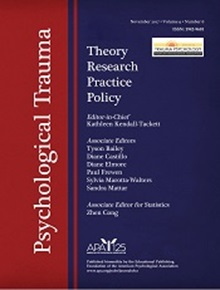
Psychological Trauma: Theory, Research, Practice, and Policy publishes empirical research on the psychological effects of trauma. The journal is intended to be a forum for an interdisciplinary discussion on trauma, blending science, theory, practice, and policy.
The journal publishes empirical research on a wide range of trauma-related topics, including:
-Psychological treatments and effects
-Promotion of education about effects of and treatment for trauma
-Assessment and diagnosis of trauma
-Pathophysiology of trauma reactions
-Health services (delivery of services to trauma populations)
-Epidemiological studies and risk factor studies
-Neuroimaging studies
-Trauma and cultural competence



 京公网安备 11010802042870号
京ICP备2023020795号-1
京公网安备 11010802042870号
京ICP备2023020795号-1

 分享
分享
 求助内容:
求助内容: 应助结果提醒方式:
 扫码关注我们
