{"title":"Friction Behaviors and Wear Mechanisms of Carbon Fiber Reinforced Composites for Bridge Cable.","authors":"Guijun Xian, Xiao Qi, Rui Guo, Jingwei Tian, Huigang Xiao, Chenggao Li","doi":"10.3390/polym16233446","DOIUrl":null,"url":null,"abstract":"<p><p>Carbon fiber reinforced epoxy resin composites (CFRP) demonstrate superior wear resistance and fatigue durability, which are anticipated to markedly enhance the service life of structures under complex conditions. In the present paper, the friction behaviors and wear mechanisms of CFRP under different applied loads, sliding speeds, service temperatures, and water lubrication were studied and analyzed in detail. The results indicated that the tribological properties of CFRP were predominantly influenced by the applied loads, as the tangential displacement generated significant shear stress at the interface of the friction pair. Serviced temperature was the next most impactful factor, while the influence of water lubrication remained minimal. Moreover, when subjected to a load of 2000 g, the wear rate and scratch width of the samples exhibited increases of 158% and 113%, respectively, compared to those loaded with 500 g. This observed escalation in wear characteristics can be attributed to irreversible debonding damage at the fiber/resin interface, leading to severe delamination wear. At elevated temperatures of 100 °C and 120 °C, the wear rate of CFRP increased by 75% and 112% compared to that at room temperature. This augmentation in wear was attributed to the transition of the epoxy resin from a glassy to an elastic state, which facilitated enhanced fatigue wear. Furthermore, both sliding speed and water lubrication displayed a negligible influence on the friction coefficient of CFRP, particularly under water lubrication conditions at 60 °C, where the friction coefficient was only 15%. This was because the lubricant properties and thermal management provided by the water molecules, which mitigated the frictional interactions, led to only minor abrasive wear. In contrast, the wear rate of CFRP at a sliding speed of 120 mm/s was found to be 74% greater than that observed at 60 mm/s. This significant increase can be attributed to the disparity in sliding rates, which induced uncoordinated deformation in the surface and subsurface of the CFRP, resulting in adhesive wear.</p>","PeriodicalId":20416,"journal":{"name":"Polymers","volume":"16 23","pages":""},"PeriodicalIF":4.9000,"publicationDate":"2024-12-09","publicationTypes":"Journal Article","fieldsOfStudy":null,"isOpenAccess":false,"openAccessPdf":"https://www.ncbi.nlm.nih.gov/pmc/articles/PMC11644159/pdf/","citationCount":"0","resultStr":null,"platform":"Semanticscholar","paperid":null,"PeriodicalName":"Polymers","FirstCategoryId":"5","ListUrlMain":"https://doi.org/10.3390/polym16233446","RegionNum":3,"RegionCategory":"工程技术","ArticlePicture":[],"TitleCN":null,"AbstractTextCN":null,"PMCID":null,"EPubDate":"","PubModel":"","JCR":"Q1","JCRName":"POLYMER SCIENCE","Score":null,"Total":0}
引用次数: 0
Abstract
Carbon fiber reinforced epoxy resin composites (CFRP) demonstrate superior wear resistance and fatigue durability, which are anticipated to markedly enhance the service life of structures under complex conditions. In the present paper, the friction behaviors and wear mechanisms of CFRP under different applied loads, sliding speeds, service temperatures, and water lubrication were studied and analyzed in detail. The results indicated that the tribological properties of CFRP were predominantly influenced by the applied loads, as the tangential displacement generated significant shear stress at the interface of the friction pair. Serviced temperature was the next most impactful factor, while the influence of water lubrication remained minimal. Moreover, when subjected to a load of 2000 g, the wear rate and scratch width of the samples exhibited increases of 158% and 113%, respectively, compared to those loaded with 500 g. This observed escalation in wear characteristics can be attributed to irreversible debonding damage at the fiber/resin interface, leading to severe delamination wear. At elevated temperatures of 100 °C and 120 °C, the wear rate of CFRP increased by 75% and 112% compared to that at room temperature. This augmentation in wear was attributed to the transition of the epoxy resin from a glassy to an elastic state, which facilitated enhanced fatigue wear. Furthermore, both sliding speed and water lubrication displayed a negligible influence on the friction coefficient of CFRP, particularly under water lubrication conditions at 60 °C, where the friction coefficient was only 15%. This was because the lubricant properties and thermal management provided by the water molecules, which mitigated the frictional interactions, led to only minor abrasive wear. In contrast, the wear rate of CFRP at a sliding speed of 120 mm/s was found to be 74% greater than that observed at 60 mm/s. This significant increase can be attributed to the disparity in sliding rates, which induced uncoordinated deformation in the surface and subsurface of the CFRP, resulting in adhesive wear.
期刊介绍:
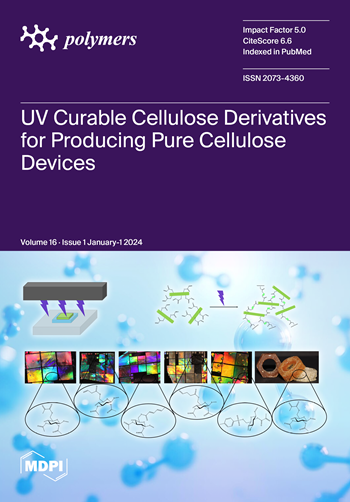
Polymers (ISSN 2073-4360) is an international, open access journal of polymer science. It publishes research papers, short communications and review papers. Our aim is to encourage scientists to publish their experimental and theoretical results in as much detail as possible. Therefore, there is no restriction on the length of the papers. The full experimental details must be provided so that the results can be reproduced. Polymers provides an interdisciplinary forum for publishing papers which advance the fields of (i) polymerization methods, (ii) theory, simulation, and modeling, (iii) understanding of new physical phenomena, (iv) advances in characterization techniques, and (v) harnessing of self-assembly and biological strategies for producing complex multifunctional structures.





 京公网安备 11010802042870号
京ICP备2023020795号-1
京公网安备 11010802042870号
京ICP备2023020795号-1

 分享
分享
 求助内容:
求助内容: 应助结果提醒方式:
 扫码关注我们
