A. Adaka, P. Guragain, K. Perera, P. Nepal, R. J. Twieg and A. Jákli
{"title":"Low field electrocaloric effect at isotropic–ferroelectric nematic phase transition†","authors":"A. Adaka, P. Guragain, K. Perera, P. Nepal, R. J. Twieg and A. Jákli","doi":"10.1039/D4SM00979G","DOIUrl":null,"url":null,"abstract":"<p >Electrocaloric effects (ECE) in solid state materials, such as ferroelectric ceramics and ferroelectric polymers, have a great impact in developing cooling systems. Herein, we describe the ECE of a newly synthesized ferroelectric nematic liquid crystal compound at the isotropic–ferroelectric nematic (I–N<small><sub>F</sub></small>) phase transition. While the Joule heat completely suppressed the ECE in a DC field, in an AC field with <em>E</em> < 1.2 V μm<small><sup>−1</sup></small> and <em>f</em> ≥ 40 Hz, an increase in optical transmittance was observed, which in comparison with a zero-field transmittance <em>versus</em> temperature plot indicated a shift in the transition temperature. These findings implied that one can induce the desired phase transition using an electric field <em>via</em> ECE with an EC responsivity of ∼1.7 × 10<small><sup>−6</sup></small> km V<small><sup>−1</sup></small>. Notably, the required electric field was two orders of magnitude smaller than the typical fields for other EC materials. EC effects observed under such low fields is a unique property of ferroelectric nematic liquid crystals. Furthermore, the specific EC energy could be increased considerably by reducing the ionic content, thus suppressing the Joule heat.</p>","PeriodicalId":103,"journal":{"name":"Soft Matter","volume":" 3","pages":" 458-462"},"PeriodicalIF":2.8000,"publicationDate":"2024-12-11","publicationTypes":"Journal Article","fieldsOfStudy":null,"isOpenAccess":false,"openAccessPdf":"","citationCount":"0","resultStr":null,"platform":"Semanticscholar","paperid":null,"PeriodicalName":"Soft Matter","FirstCategoryId":"92","ListUrlMain":"https://pubs.rsc.org/en/content/articlelanding/2025/sm/d4sm00979g","RegionNum":3,"RegionCategory":"化学","ArticlePicture":[],"TitleCN":null,"AbstractTextCN":null,"PMCID":null,"EPubDate":"","PubModel":"","JCR":"Q3","JCRName":"CHEMISTRY, PHYSICAL","Score":null,"Total":0}
引用次数: 0
Abstract
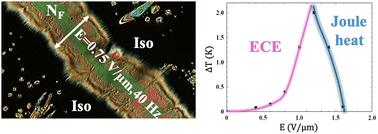
Electrocaloric effects (ECE) in solid state materials, such as ferroelectric ceramics and ferroelectric polymers, have a great impact in developing cooling systems. Herein, we describe the ECE of a newly synthesized ferroelectric nematic liquid crystal compound at the isotropic–ferroelectric nematic (I–NF) phase transition. While the Joule heat completely suppressed the ECE in a DC field, in an AC field with E < 1.2 V μm−1 and f ≥ 40 Hz, an increase in optical transmittance was observed, which in comparison with a zero-field transmittance versus temperature plot indicated a shift in the transition temperature. These findings implied that one can induce the desired phase transition using an electric field via ECE with an EC responsivity of ∼1.7 × 10⁻⁶ km V−1. Notably, the required electric field was two orders of magnitude smaller than the typical fields for other EC materials. EC effects observed under such low fields is a unique property of ferroelectric nematic liquid crystals. Furthermore, the specific EC energy could be increased considerably by reducing the ionic content, thus suppressing the Joule heat.
期刊介绍:
Soft Matter is an international journal published by the Royal Society of Chemistry using Engineering-Materials Science: A Synthesis as its research focus. It publishes original research articles, review articles, and synthesis articles related to this field, reporting the latest discoveries in the relevant theoretical, practical, and applied disciplines in a timely manner, and aims to promote the rapid exchange of scientific information in this subject area. The journal is an open access journal. The journal is an open access journal and has not been placed on the alert list in the last three years.




 京公网安备 11010802042870号
京ICP备2023020795号-1
京公网安备 11010802042870号
京ICP备2023020795号-1

 分享
分享
 求助内容:
求助内容: 应助结果提醒方式:
 扫码关注我们
