Mateusz Dyksik, Michal Baranowski, Joshua J. P. Thompson, Zhuo Yang, Martha Rivera Medina, Maria Antonietta Loi, Ermin Malic, Paulina Plochocka
{"title":"Steric Engineering of Exciton Fine Structure in 2D Perovskites","authors":"Mateusz Dyksik, Michal Baranowski, Joshua J. P. Thompson, Zhuo Yang, Martha Rivera Medina, Maria Antonietta Loi, Ermin Malic, Paulina Plochocka","doi":"10.1002/aenm.202404769","DOIUrl":null,"url":null,"abstract":"<p>A comprehensive study of excitonic properties of 2D layered perovskites is provided, with an emphasis on understanding and controlling the exciton fine structure. First, an overview of the optical properties is presented, discussing the challenges in determining the bandgap and exciton binding energies. Through magneto-optical spectroscopic measurements (up to <i>B</i> = 140 T), scaling laws are established for exciton binding energy as a function of the band gap and the diamagnetic coefficient. Using an in-plane magnetic field, the exciton fine structure for various 2D perovskites is examined to measure the energy splitting between the excitonic levels. The exciton fine structure and exchange interaction are correlated with structural parameters, employing an effective mass model, to highlight the role of steric effect on the exchange interaction. These findings reveal that lattice distortions, introduced by organic spacers, significantly influence the exchange interaction, driving a tunable energy spacing between dark and bright excitons. This unique feature of 2D perovskites, not present in other semiconductors, offers a novel tuning mechanism for exciton control, making these materials highly promising for efficient light emitters and advanced quantum technologies.</p>","PeriodicalId":111,"journal":{"name":"Advanced Energy Materials","volume":"15 9","pages":""},"PeriodicalIF":26.0000,"publicationDate":"2024-12-23","publicationTypes":"Journal Article","fieldsOfStudy":null,"isOpenAccess":false,"openAccessPdf":"https://onlinelibrary.wiley.com/doi/epdf/10.1002/aenm.202404769","citationCount":"0","resultStr":null,"platform":"Semanticscholar","paperid":null,"PeriodicalName":"Advanced Energy Materials","FirstCategoryId":"88","ListUrlMain":"https://advanced.onlinelibrary.wiley.com/doi/10.1002/aenm.202404769","RegionNum":1,"RegionCategory":"材料科学","ArticlePicture":[],"TitleCN":null,"AbstractTextCN":null,"PMCID":null,"EPubDate":"","PubModel":"","JCR":"Q1","JCRName":"CHEMISTRY, PHYSICAL","Score":null,"Total":0}
引用次数: 0
Abstract
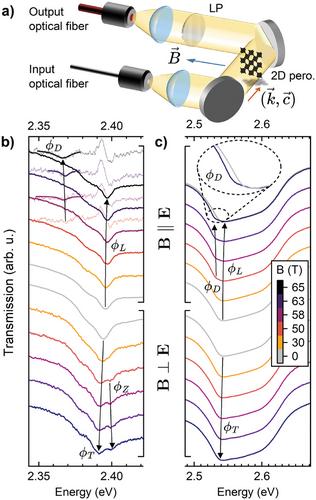
A comprehensive study of excitonic properties of 2D layered perovskites is provided, with an emphasis on understanding and controlling the exciton fine structure. First, an overview of the optical properties is presented, discussing the challenges in determining the bandgap and exciton binding energies. Through magneto-optical spectroscopic measurements (up to B = 140 T), scaling laws are established for exciton binding energy as a function of the band gap and the diamagnetic coefficient. Using an in-plane magnetic field, the exciton fine structure for various 2D perovskites is examined to measure the energy splitting between the excitonic levels. The exciton fine structure and exchange interaction are correlated with structural parameters, employing an effective mass model, to highlight the role of steric effect on the exchange interaction. These findings reveal that lattice distortions, introduced by organic spacers, significantly influence the exchange interaction, driving a tunable energy spacing between dark and bright excitons. This unique feature of 2D perovskites, not present in other semiconductors, offers a novel tuning mechanism for exciton control, making these materials highly promising for efficient light emitters and advanced quantum technologies.
期刊介绍:
Established in 2011, Advanced Energy Materials is an international, interdisciplinary, English-language journal that focuses on materials used in energy harvesting, conversion, and storage. It is regarded as a top-quality journal alongside Advanced Materials, Advanced Functional Materials, and Small.
With a 2022 Impact Factor of 27.8, Advanced Energy Materials is considered a prime source for the best energy-related research. The journal covers a wide range of topics in energy-related research, including organic and inorganic photovoltaics, batteries and supercapacitors, fuel cells, hydrogen generation and storage, thermoelectrics, water splitting and photocatalysis, solar fuels and thermosolar power, magnetocalorics, and piezoelectronics.
The readership of Advanced Energy Materials includes materials scientists, chemists, physicists, and engineers in both academia and industry. The journal is indexed in various databases and collections, such as Advanced Technologies & Aerospace Database, FIZ Karlsruhe, INSPEC (IET), Science Citation Index Expanded, Technology Collection, and Web of Science, among others.





 京公网安备 11010802042870号
京ICP备2023020795号-1
京公网安备 11010802042870号
京ICP备2023020795号-1

 分享
分享
 求助内容:
求助内容: 应助结果提醒方式:
 扫码关注我们
