An Niza El Aisnada, Kajjana Boonpalit, Robin van der Kruit, Koen M. Draijer, Jon López-Zorrilla, Masahiro Miyauchi, Akira Yamaguchi, Nongnuch Artrith
{"title":"Cost-Effective Strategy of Enhancing Machine Learning Potentials by Transfer Learning from a Multicomponent Data Set on ænet-PyTorch","authors":"An Niza El Aisnada, Kajjana Boonpalit, Robin van der Kruit, Koen M. Draijer, Jon López-Zorrilla, Masahiro Miyauchi, Akira Yamaguchi, Nongnuch Artrith","doi":"10.1021/acs.jpcc.4c06235","DOIUrl":null,"url":null,"abstract":"Machine learning potentials (MLPs) offer efficient and accurate material simulations, but constructing the reference ab initio database remains a significant challenge, particularly for catalyst-adsorbate systems. Training an MLP with a small data set can lead to overfitting, thus limiting its practical applications. This study explores the feasibility of developing computationally cost-effective and accurate MLPs for catalyst-adsorbate systems with a limited number of ab initio references by leveraging a transfer learning strategy from subsets of a comprehensive public database. Using the Open Catalyst Project 2020 (OC20)─a data set closely related to our system of interest─we pretrained MLP models on OC20 subsets using the ænet-PyTorch framework. We compared several strategies for database subset selection. Our findings indicate that MLPs constructed via transfer learning exhibit better generalizability than those constructed from scratch, as demonstrated by the consistency in the dynamics simulations. Remarkably, transfer learning enhances the stability and accuracy of MLPs for the CuAu/H<sub>2</sub>O system with approximately 600 reference data points. This approach achieved excellent extrapolation performance in molecular dynamics simulations for the larger CuAu/6H<sub>2</sub>O system, maintaining stable and accurate predictions for up to 250 ps, whereas MLPs without transfer learning become unstable before reaching 50 ps. We also examine the potential limitations of this strategy. This work proposes an alternative, cost-effective approach for constructing MLPs for the challenging simulation of catalytic systems. Finally, we anticipate that this methodology will pave the way for broader applications in materials science and catalysis research, facilitating more efficient and accurate simulations across various systems.","PeriodicalId":61,"journal":{"name":"The Journal of Physical Chemistry C","volume":"224 1","pages":""},"PeriodicalIF":3.2000,"publicationDate":"2024-12-27","publicationTypes":"Journal Article","fieldsOfStudy":null,"isOpenAccess":false,"openAccessPdf":"","citationCount":"0","resultStr":null,"platform":"Semanticscholar","paperid":null,"PeriodicalName":"The Journal of Physical Chemistry C","FirstCategoryId":"1","ListUrlMain":"https://doi.org/10.1021/acs.jpcc.4c06235","RegionNum":3,"RegionCategory":"化学","ArticlePicture":[],"TitleCN":null,"AbstractTextCN":null,"PMCID":null,"EPubDate":"","PubModel":"","JCR":"Q2","JCRName":"CHEMISTRY, PHYSICAL","Score":null,"Total":0}
引用次数: 0
Abstract
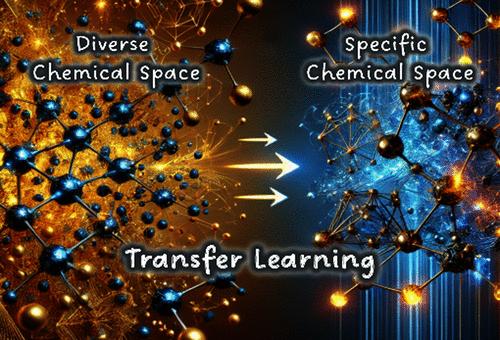
Machine learning potentials (MLPs) offer efficient and accurate material simulations, but constructing the reference ab initio database remains a significant challenge, particularly for catalyst-adsorbate systems. Training an MLP with a small data set can lead to overfitting, thus limiting its practical applications. This study explores the feasibility of developing computationally cost-effective and accurate MLPs for catalyst-adsorbate systems with a limited number of ab initio references by leveraging a transfer learning strategy from subsets of a comprehensive public database. Using the Open Catalyst Project 2020 (OC20)─a data set closely related to our system of interest─we pretrained MLP models on OC20 subsets using the ænet-PyTorch framework. We compared several strategies for database subset selection. Our findings indicate that MLPs constructed via transfer learning exhibit better generalizability than those constructed from scratch, as demonstrated by the consistency in the dynamics simulations. Remarkably, transfer learning enhances the stability and accuracy of MLPs for the CuAu/H2O system with approximately 600 reference data points. This approach achieved excellent extrapolation performance in molecular dynamics simulations for the larger CuAu/6H2O system, maintaining stable and accurate predictions for up to 250 ps, whereas MLPs without transfer learning become unstable before reaching 50 ps. We also examine the potential limitations of this strategy. This work proposes an alternative, cost-effective approach for constructing MLPs for the challenging simulation of catalytic systems. Finally, we anticipate that this methodology will pave the way for broader applications in materials science and catalysis research, facilitating more efficient and accurate simulations across various systems.
期刊介绍:
The Journal of Physical Chemistry A/B/C is devoted to reporting new and original experimental and theoretical basic research of interest to physical chemists, biophysical chemists, and chemical physicists.



 京公网安备 11010802042870号
京ICP备2023020795号-1
京公网安备 11010802042870号
京ICP备2023020795号-1

 分享
分享
 求助内容:
求助内容: 应助结果提醒方式:
 扫码关注我们
