Data-driven criteria for DNA testing were implemented in routine care of Alzheimer Center Amsterdam. We aimed to explore patients’ perspectives and considerations regarding their decision to (not) be tested for a monogenic cause of their disease.
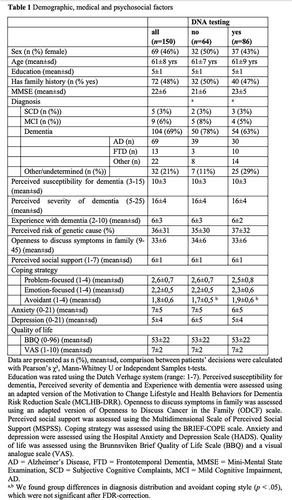
In this mixed method study, 150 of 519 new patients visiting Alzheimer Center Amsterdam who fulfilled the criteria were offered DNA-diagnostics: 86(57%) accepted, 64(43%) did not. In 65/86(76%) cases results were negative, in 14/86(16%) a monogenic cause and in 7/86 (8%) variants of uncertain significance were found (Figure 1). Sex, age, education, family history of dementia, MMSE and diagnosis were retrieved. Before discussing DNA testing, patients completed a questionnaire assessing perceived risk of a genetic cause, susceptibility for, severity of, and experience with dementia, social support, coping strategies, anxiety, depression, and quality of life. Differences between those who did and did not consent to DNA testing were calculated using Pearson’s χ², Mann-Whitney U or Independent Samples t-tests; p-values were FDR-adjusted. A subset of 22 patients and/or relatives participated in semi-structured interviews on motivations and considerations regarding their decision. Verbatim transcripts were analyzed inductively using MAXQDA-software.
Participants (n = 150) were 46% female and aged 61±8 (MMSE = 22±6, 5 Subjective Cognitive Decline, 9 MCI, 104 dementia [69 AD, 13 FTD, 22 other], 32 other/undetermined). Adjusted for multiple testing, no demographic, medical or psychosocial factors were associated with the decision on DNA testing (all p>0.05). Twenty-one interviewees who agreed to DNA testing were generally motivated by obtaining information on heredity for their relatives, contributing to scientific research into a treatment, and gaining insight in the cause of their disease. One patient had blood stored, allowing their children to test it when opportune. The majority decided quickly, mostly on intuitions (e.g., responsibility towards relatives) rather than facts (e.g., information on risk and consequences). They expected to feel reassured or relieved by negative test results, and sad or worried if a genetic cause was found.
Over half of memory clinic patients eligible for DNA-testing wanted to be tested. This decision was unrelated to demographic, medical or psychosocial characteristics, and mostly based on intuition and considerations regarding family.





 京公网安备 11010802042870号
京ICP备2023020795号-1
京公网安备 11010802042870号
京ICP备2023020795号-1

 分享
分享
 求助内容:
求助内容: 应助结果提醒方式:
 扫码关注我们
