Zhenqi Li, Yuping Wang, Dongrui Liu, Tao Hong, Bingchao Qin, Xiang Gao and Li-Dong Zhao
{"title":"Attempts to realize promising thermoelectric performance in n-type polycrystalline SnSe with a cubic structure†","authors":"Zhenqi Li, Yuping Wang, Dongrui Liu, Tao Hong, Bingchao Qin, Xiang Gao and Li-Dong Zhao","doi":"10.1039/D4TA08632E","DOIUrl":null,"url":null,"abstract":"<p >Both crystalline and polycrystalline p-type SnSe have been investigated with promising thermoelectric capabilities across a broad temperature range, garnering significant attention recently. However, the inferior electrical transport of n-type polycrystalline SnSe, especially at low temperatures, has seriously restricted the advancement of thermoelectric devices based on SnSe. In the study, we attempted to attain promising thermoelectric properties of n-type polycrystalline SnSe through modulating the lattice structure by AgBiSe<small><sub>2</sub></small> alloying. After subsequent Br doping and Pb alloying, n-type polycrystalline SnSe with a cubic structure exhibited completely reversed electrical transport, especially at low temperatures (300–600 K). Resultantly, the polycrystalline (Sn<small><sub>0.6</sub></small>Pb<small><sub>0.4</sub></small>Se<small><sub>0.97</sub></small>Br<small><sub>0.03</sub></small>)<small><sub>0.6</sub></small>(AgBiSe<small><sub>2</sub></small>)<small><sub>0.4</sub></small> demonstrated promising thermoelectric properties, achieving a maximum <em>ZT</em> value of roughly 0.3 at 600 K, surpassing the performance of most other current n-type SnSe polycrystals. Our research presents a systematic method for obtaining n-type SnSe with a cubic-phase structure and promising performance, laying a basic foundation for constructing high-efficiency all-SnSe-based homogeneous thermoelectric devices.</p>","PeriodicalId":82,"journal":{"name":"Journal of Materials Chemistry A","volume":" 7","pages":" 4899-4907"},"PeriodicalIF":9.5000,"publicationDate":"2025-01-09","publicationTypes":"Journal Article","fieldsOfStudy":null,"isOpenAccess":false,"openAccessPdf":"","citationCount":"0","resultStr":null,"platform":"Semanticscholar","paperid":null,"PeriodicalName":"Journal of Materials Chemistry A","FirstCategoryId":"88","ListUrlMain":"https://pubs.rsc.org/en/content/articlelanding/2025/ta/d4ta08632e","RegionNum":2,"RegionCategory":"材料科学","ArticlePicture":[],"TitleCN":null,"AbstractTextCN":null,"PMCID":null,"EPubDate":"","PubModel":"","JCR":"Q1","JCRName":"CHEMISTRY, PHYSICAL","Score":null,"Total":0}
引用次数: 0
Abstract
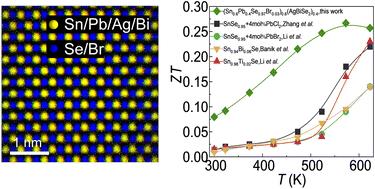
Both crystalline and polycrystalline p-type SnSe have been investigated with promising thermoelectric capabilities across a broad temperature range, garnering significant attention recently. However, the inferior electrical transport of n-type polycrystalline SnSe, especially at low temperatures, has seriously restricted the advancement of thermoelectric devices based on SnSe. In the study, we attempted to attain promising thermoelectric properties of n-type polycrystalline SnSe through modulating the lattice structure by AgBiSe2 alloying. After subsequent Br doping and Pb alloying, n-type polycrystalline SnSe with a cubic structure exhibited completely reversed electrical transport, especially at low temperatures (300–600 K). Resultantly, the polycrystalline (Sn0.6Pb0.4Se0.97Br0.03)0.6(AgBiSe2)0.4 demonstrated promising thermoelectric properties, achieving a maximum ZT value of roughly 0.3 at 600 K, surpassing the performance of most other current n-type SnSe polycrystals. Our research presents a systematic method for obtaining n-type SnSe with a cubic-phase structure and promising performance, laying a basic foundation for constructing high-efficiency all-SnSe-based homogeneous thermoelectric devices.
期刊介绍:
The Journal of Materials Chemistry A, B & C covers a wide range of high-quality studies in the field of materials chemistry, with each section focusing on specific applications of the materials studied. Journal of Materials Chemistry A emphasizes applications in energy and sustainability, including topics such as artificial photosynthesis, batteries, and fuel cells. Journal of Materials Chemistry B focuses on applications in biology and medicine, while Journal of Materials Chemistry C covers applications in optical, magnetic, and electronic devices. Example topic areas within the scope of Journal of Materials Chemistry A include catalysis, green/sustainable materials, sensors, and water treatment, among others.



 京公网安备 11010802042870号
京ICP备2023020795号-1
京公网安备 11010802042870号
京ICP备2023020795号-1

 分享
分享
 求助内容:
求助内容: 应助结果提醒方式:
 扫码关注我们
