Xi Jin, Jun Li, Siyuan Zhu, Wenyan Tan, Jiahong Tang, Xueyuan Gong, Xingyu Liu, Yu Zhang, Chao Zhou, Zhaoheng Tang, Vincent O. Nyamori, Bice S. Martincigh, Matthew L. Davies, Minghua Li, Tongsheng Chen, Qi Chen, Jinsong Hu, Qijie Liang, Weiqiang Chen and Yan Jiang
{"title":"pH-Independent lead sequestration and light management enable sustainable and efficient perovskite photovoltaics†","authors":"Xi Jin, Jun Li, Siyuan Zhu, Wenyan Tan, Jiahong Tang, Xueyuan Gong, Xingyu Liu, Yu Zhang, Chao Zhou, Zhaoheng Tang, Vincent O. Nyamori, Bice S. Martincigh, Matthew L. Davies, Minghua Li, Tongsheng Chen, Qi Chen, Jinsong Hu, Qijie Liang, Weiqiang Chen and Yan Jiang","doi":"10.1039/D4EE03820G","DOIUrl":null,"url":null,"abstract":"<p >The illumination side of perovskite solar cells is more vulnerable to external impacts (such as hail, flying rocks, snow, hurricanes, <em>etc.</em>) than the rear side, leading to more likelihood of Pb<small><sup>2+</sup></small> leakage. They also suffer from severe optical loss at the air/solid interface, deteriorating the solar cell performance. In this study, large-area textured phosphate-buffered functionalized polymer films (PFPFs) with self-healing characteristics, up to 16 × 16 cm<small><sup>2</sup></small> in size, are deliberately designed and employed on the illumination side of PSCs. The PFPF immobilizes Pb<small><sup>2+</sup></small> mainly through phosphate precipitation with an ultrafast Pb<small><sup>2+</sup></small> sequestration rate (200.9 m<small><sup>2</sup></small> min<small><sup>−1</sup></small> g<small><sup>−1</sup></small>) and sequestration capacity equaling 24 times the theoretical Pb amount in typical 500-nm-thick PSCs. The pH-independent lead sequestration capability results in a Pb<small><sup>2+</sup></small> leakage concentration well below the US drinking water safety level (15 μg L<small><sup>−1</sup></small>) even under extreme environmental condition scenarios. The pyramidal-structured surface of the PFPF also reduces reflective losses over broadband wavelengths and increases the optical path of the incident light. We have utilized this in both rigid and flexible devices, improving the efficiencies by over 7% (relative gain). The PFPF is of low cost and can be easily applied to both rigid and flexible devices, demonstrating its universal applicability and promising commercialization potential.</p>","PeriodicalId":72,"journal":{"name":"Energy & Environmental Science","volume":" 4","pages":" 1901-1910"},"PeriodicalIF":30.8000,"publicationDate":"2025-01-09","publicationTypes":"Journal Article","fieldsOfStudy":null,"isOpenAccess":false,"openAccessPdf":"","citationCount":"0","resultStr":null,"platform":"Semanticscholar","paperid":null,"PeriodicalName":"Energy & Environmental Science","FirstCategoryId":"88","ListUrlMain":"https://pubs.rsc.org/en/content/articlelanding/2025/ee/d4ee03820g","RegionNum":1,"RegionCategory":"材料科学","ArticlePicture":[],"TitleCN":null,"AbstractTextCN":null,"PMCID":null,"EPubDate":"","PubModel":"","JCR":"Q1","JCRName":"CHEMISTRY, MULTIDISCIPLINARY","Score":null,"Total":0}
引用次数: 0
Abstract
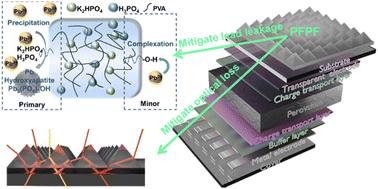
The illumination side of perovskite solar cells is more vulnerable to external impacts (such as hail, flying rocks, snow, hurricanes, etc.) than the rear side, leading to more likelihood of Pb2+ leakage. They also suffer from severe optical loss at the air/solid interface, deteriorating the solar cell performance. In this study, large-area textured phosphate-buffered functionalized polymer films (PFPFs) with self-healing characteristics, up to 16 × 16 cm2 in size, are deliberately designed and employed on the illumination side of PSCs. The PFPF immobilizes Pb2+ mainly through phosphate precipitation with an ultrafast Pb2+ sequestration rate (200.9 m2 min−1 g−1) and sequestration capacity equaling 24 times the theoretical Pb amount in typical 500-nm-thick PSCs. The pH-independent lead sequestration capability results in a Pb2+ leakage concentration well below the US drinking water safety level (15 μg L−1) even under extreme environmental condition scenarios. The pyramidal-structured surface of the PFPF also reduces reflective losses over broadband wavelengths and increases the optical path of the incident light. We have utilized this in both rigid and flexible devices, improving the efficiencies by over 7% (relative gain). The PFPF is of low cost and can be easily applied to both rigid and flexible devices, demonstrating its universal applicability and promising commercialization potential.
期刊介绍:
Energy & Environmental Science, a peer-reviewed scientific journal, publishes original research and review articles covering interdisciplinary topics in the (bio)chemical and (bio)physical sciences, as well as chemical engineering disciplines. Published monthly by the Royal Society of Chemistry (RSC), a not-for-profit publisher, Energy & Environmental Science is recognized as a leading journal. It boasts an impressive impact factor of 8.500 as of 2009, ranking 8th among 140 journals in the category "Chemistry, Multidisciplinary," second among 71 journals in "Energy & Fuels," second among 128 journals in "Engineering, Chemical," and first among 181 scientific journals in "Environmental Sciences."
Energy & Environmental Science publishes various types of articles, including Research Papers (original scientific work), Review Articles, Perspectives, and Minireviews (feature review-type articles of broad interest), Communications (original scientific work of an urgent nature), Opinions (personal, often speculative viewpoints or hypotheses on current topics), and Analysis Articles (in-depth examination of energy-related issues).



 京公网安备 11010802042870号
京ICP备2023020795号-1
京公网安备 11010802042870号
京ICP备2023020795号-1

 分享
分享
 求助内容:
求助内容: 应助结果提醒方式:
 扫码关注我们
