Tao Sun, Tong Yang, Wenjie Zang, Jing Li, Xiaoyu Sheng, Enzhou Liu, Jiali Li, Xiao Hai, Huihui Lin, Cheng-Hao Chuang, Chenliang Su, Maohong Fan, Ming Yang, Ming Lin, Shibo Xi, Ruqiang Zou, Jiong Lu
{"title":"Atomic Gap-State Engineering of MoS2 for Alkaline Water and Seawater Splitting","authors":"Tao Sun, Tong Yang, Wenjie Zang, Jing Li, Xiaoyu Sheng, Enzhou Liu, Jiali Li, Xiao Hai, Huihui Lin, Cheng-Hao Chuang, Chenliang Su, Maohong Fan, Ming Yang, Ming Lin, Shibo Xi, Ruqiang Zou, Jiong Lu","doi":"10.1021/acsnano.4c13736","DOIUrl":null,"url":null,"abstract":"Transition-metal dichalcogenides (TMDs), such as molybdenum disulfide (MoS<sub>2</sub>), have emerged as a generation of nonprecious catalysts for the hydrogen evolution reaction (HER), largely due to their theoretical hydrogen adsorption energy close to that of platinum. However, efforts to activate the basal planes of TMDs have primarily centered around strategies such as introducing numerous atomic vacancies, creating vacancy–heteroatom complexes, or applying significant strain, especially for acidic media. These approaches, while potentially effective, present substantial challenges in practical large-scale deployment. Here, we report a gap-state engineering strategy for the controlled activation of S atom in MoS<sub>2</sub> basal planes through metal single-atom doping, effectively tackling both efficiency and stability challenges in alkaline water and seawater splitting. A versatile synthetic methodology allows for the fabrication of a series of single-metal atom-doped MoS<sub>2</sub> materials (M<sub>1</sub>/MoS<sub>2</sub>), featuring widely tunable densities with each dopant replacing a Mo site. Among these (Mn<sub>1</sub>, Fe<sub>1</sub>, Co<sub>1</sub>, and Ni<sub>1</sub>), Co<sub>1</sub>/MoS<sub>2</sub> demonstrates outstanding HER performance in both alkaline and seawater alkaline media, with overpotentials at a mere 159 and 164 mV at 100 mA cm<sup>–2</sup>, and Tafel slopes at 41 and 45 mV dec<sup>–1</sup>, respectively, which surpasses all reported TMD-based nonprecious materials and benchmark Pt/C catalysts in HER efficiency and stability during seawater splitting, which can be attributed to an optimal gap-state modulation associated with sulfur atoms. Experimental data correlating doping density and dopant identity with HER performance, in conjunction with theoretical calculations, also reveal a descriptor linked to near-Fermi gap state modulation, corroborated by the observed increase in unoccupied S 3p states.","PeriodicalId":21,"journal":{"name":"ACS Nano","volume":"8 1","pages":""},"PeriodicalIF":16.0000,"publicationDate":"2025-01-11","publicationTypes":"Journal Article","fieldsOfStudy":null,"isOpenAccess":false,"openAccessPdf":"","citationCount":"0","resultStr":null,"platform":"Semanticscholar","paperid":null,"PeriodicalName":"ACS Nano","FirstCategoryId":"88","ListUrlMain":"https://doi.org/10.1021/acsnano.4c13736","RegionNum":1,"RegionCategory":"材料科学","ArticlePicture":[],"TitleCN":null,"AbstractTextCN":null,"PMCID":null,"EPubDate":"","PubModel":"","JCR":"Q1","JCRName":"CHEMISTRY, MULTIDISCIPLINARY","Score":null,"Total":0}
引用次数: 0
Abstract
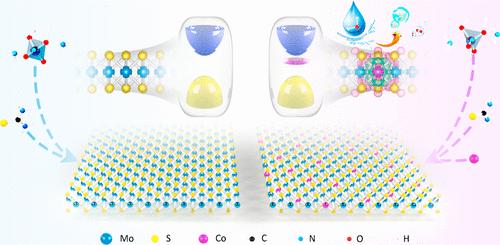
Transition-metal dichalcogenides (TMDs), such as molybdenum disulfide (MoS2), have emerged as a generation of nonprecious catalysts for the hydrogen evolution reaction (HER), largely due to their theoretical hydrogen adsorption energy close to that of platinum. However, efforts to activate the basal planes of TMDs have primarily centered around strategies such as introducing numerous atomic vacancies, creating vacancy–heteroatom complexes, or applying significant strain, especially for acidic media. These approaches, while potentially effective, present substantial challenges in practical large-scale deployment. Here, we report a gap-state engineering strategy for the controlled activation of S atom in MoS2 basal planes through metal single-atom doping, effectively tackling both efficiency and stability challenges in alkaline water and seawater splitting. A versatile synthetic methodology allows for the fabrication of a series of single-metal atom-doped MoS2 materials (M1/MoS2), featuring widely tunable densities with each dopant replacing a Mo site. Among these (Mn1, Fe1, Co1, and Ni1), Co1/MoS2 demonstrates outstanding HER performance in both alkaline and seawater alkaline media, with overpotentials at a mere 159 and 164 mV at 100 mA cm–2, and Tafel slopes at 41 and 45 mV dec–1, respectively, which surpasses all reported TMD-based nonprecious materials and benchmark Pt/C catalysts in HER efficiency and stability during seawater splitting, which can be attributed to an optimal gap-state modulation associated with sulfur atoms. Experimental data correlating doping density and dopant identity with HER performance, in conjunction with theoretical calculations, also reveal a descriptor linked to near-Fermi gap state modulation, corroborated by the observed increase in unoccupied S 3p states.
期刊介绍:
ACS Nano, published monthly, serves as an international forum for comprehensive articles on nanoscience and nanotechnology research at the intersections of chemistry, biology, materials science, physics, and engineering. The journal fosters communication among scientists in these communities, facilitating collaboration, new research opportunities, and advancements through discoveries. ACS Nano covers synthesis, assembly, characterization, theory, and simulation of nanostructures, nanobiotechnology, nanofabrication, methods and tools for nanoscience and nanotechnology, and self- and directed-assembly. Alongside original research articles, it offers thorough reviews, perspectives on cutting-edge research, and discussions envisioning the future of nanoscience and nanotechnology.



 京公网安备 11010802042870号
京ICP备2023020795号-1
京公网安备 11010802042870号
京ICP备2023020795号-1

 分享
分享
 求助内容:
求助内容: 应助结果提醒方式:
 扫码关注我们
