{"title":"Modeling the growth and dynamics of uropathogenic Escherichia coli in sugarcane juice for shelf life predictions","authors":"Liu-Yean Goh , Ching-Wen Chang , Kuan-Hung Lu","doi":"10.1016/j.foodres.2024.115603","DOIUrl":null,"url":null,"abstract":"<div><div>In this study, we assessed the effects of temperature and dilution on uropathogenic <em>Escherichia coli</em> (UPEC) growth in sugarcane juice and modeled the kinetics for shelf life simulation. Diluted and undiluted sugarcane juice samples inoculated with a four-strain UPEC cocktail were stored at 4, 10, 15, 20, 30, and 40 °C to evaluate their growth during storage. Changes in UPEC growth were fitted using three primary models (Baranyi, Huang, and reparameterized Gompertz models), and two secondary models (Huang square-root and Ratkowsky square-root models) were selected to evaluate the effect of temperature on specific growth rates. The best-fitted models (reparameterized Gompertz and Huang square-root models) were validated by an additional experiment under isothermal storage (35 °C). Combining differential forms of the Baranyi model, the prediction performances of these models were further validated under storage at dynamic temperature profiles (15 to 37 °C in 4-h cycles). Results revealed that UPEC growth was observed in diluted and undiluted juice samples at storage temperatures of 15 to 40 °C. No growth of UPEC was found in either type of juice at storage temperatures below 10 °C. The estimated minimum growth temperatures (<em>T</em><sub>min</sub>) of UPEC in sugarcane juice and diluted juice were 10.7 and 11.2 °C, respectively. Validation results showed that the model perfectly estimated UPEC growth under isothermal conditions in both types of sugarcane juice (proportion of prediction error (pPE) = 1.00). Predictions of dynamic conditions in sugarcane juice (pPE = 0.73) and diluted juice (pPE = 0.91) were acceptable, at pPE > 0.7. Using the model, shelf life charts were derived based on the time to reach a certain microbial concentration. In conclusion, these results together with shelf life charts provide valuable information for the food industry to enhance sugarcane juice safety.</div></div>","PeriodicalId":323,"journal":{"name":"Food Research International","volume":"201 ","pages":"Article 115603"},"PeriodicalIF":8.0000,"publicationDate":"2025-02-01","publicationTypes":"Journal Article","fieldsOfStudy":null,"isOpenAccess":false,"openAccessPdf":"","citationCount":"0","resultStr":null,"platform":"Semanticscholar","paperid":null,"PeriodicalName":"Food Research International","FirstCategoryId":"97","ListUrlMain":"https://www.sciencedirect.com/science/article/pii/S0963996924016740","RegionNum":1,"RegionCategory":"农林科学","ArticlePicture":[],"TitleCN":null,"AbstractTextCN":null,"PMCID":null,"EPubDate":"2024/12/30 0:00:00","PubModel":"Epub","JCR":"Q1","JCRName":"FOOD SCIENCE & TECHNOLOGY","Score":null,"Total":0}
引用次数: 0
Abstract
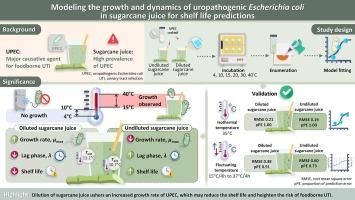
In this study, we assessed the effects of temperature and dilution on uropathogenic Escherichia coli (UPEC) growth in sugarcane juice and modeled the kinetics for shelf life simulation. Diluted and undiluted sugarcane juice samples inoculated with a four-strain UPEC cocktail were stored at 4, 10, 15, 20, 30, and 40 °C to evaluate their growth during storage. Changes in UPEC growth were fitted using three primary models (Baranyi, Huang, and reparameterized Gompertz models), and two secondary models (Huang square-root and Ratkowsky square-root models) were selected to evaluate the effect of temperature on specific growth rates. The best-fitted models (reparameterized Gompertz and Huang square-root models) were validated by an additional experiment under isothermal storage (35 °C). Combining differential forms of the Baranyi model, the prediction performances of these models were further validated under storage at dynamic temperature profiles (15 to 37 °C in 4-h cycles). Results revealed that UPEC growth was observed in diluted and undiluted juice samples at storage temperatures of 15 to 40 °C. No growth of UPEC was found in either type of juice at storage temperatures below 10 °C. The estimated minimum growth temperatures (Tmin) of UPEC in sugarcane juice and diluted juice were 10.7 and 11.2 °C, respectively. Validation results showed that the model perfectly estimated UPEC growth under isothermal conditions in both types of sugarcane juice (proportion of prediction error (pPE) = 1.00). Predictions of dynamic conditions in sugarcane juice (pPE = 0.73) and diluted juice (pPE = 0.91) were acceptable, at pPE > 0.7. Using the model, shelf life charts were derived based on the time to reach a certain microbial concentration. In conclusion, these results together with shelf life charts provide valuable information for the food industry to enhance sugarcane juice safety.
期刊介绍:
Food Research International serves as a rapid dissemination platform for significant and impactful research in food science, technology, engineering, and nutrition. The journal focuses on publishing novel, high-quality, and high-impact review papers, original research papers, and letters to the editors across various disciplines in the science and technology of food. Additionally, it follows a policy of publishing special issues on topical and emergent subjects in food research or related areas. Selected, peer-reviewed papers from scientific meetings, workshops, and conferences on the science, technology, and engineering of foods are also featured in special issues.



 京公网安备 11010802042870号
京ICP备2023020795号-1
京公网安备 11010802042870号
京ICP备2023020795号-1

 分享
分享
 求助内容:
求助内容: 应助结果提醒方式:
 扫码关注我们
