Xylooligosaccharide and Akkermansia muciniphila synergistically ameliorate insulin resistance by reshaping gut microbiota, improving intestinal barrier and regulating NKG2D/NKG2DL signaling in gestational diabetes mellitus mice
Jiexian Wang , Yanhua Wu , Junyi Yang , Shihao Ying , Huiyu Luo , Longying Zha , Qing Li
{"title":"Xylooligosaccharide and Akkermansia muciniphila synergistically ameliorate insulin resistance by reshaping gut microbiota, improving intestinal barrier and regulating NKG2D/NKG2DL signaling in gestational diabetes mellitus mice","authors":"Jiexian Wang , Yanhua Wu , Junyi Yang , Shihao Ying , Huiyu Luo , Longying Zha , Qing Li","doi":"10.1016/j.foodres.2024.115634","DOIUrl":null,"url":null,"abstract":"<div><div>Xylooligosaccharides (XOS) ameliorate insulin resistance (IR) in gestational diabetes mellitus (GDM) probably by propagating <em>Akkermansia muciniphila</em> (<em>Akk</em>). This study aimed to investigate the effects and mechanisms of XOS, <em>Akk</em> and combination on IR in GDM mice/pseudo-germ-free (PGF) mice. Female mice were fed with AIN-93 (n = 19) and high fat diet (HFD) (n = 206). After 4 weeks, HFD-fed mice were further allotted to HFD, GDM, GDM + XOS, GDM + <em>Akk</em>, GDM + XOS + <em>Akk</em>, GDM + PGF, GDM + PGF + XOS, GDM + PGF + <em>Akk</em>, and GDM + PGF + XOS + <em>Akk</em> groups (n ≥ 19). GDM was induced by intraperitoneally injecting streptozotocin and PGF was established by intragastrically administrating antibiotic cocktails. XOS (500 mg/kg·BW) or/and <em>Akk</em> (4 × 10<sup>8</sup> CFU) were gavaged once a day for 10 days. Fasting blood glucose (FBG), insulin, oral glucose tolerance test (OGTT) and insulin signaling pathway were determined. Gut microbiota were detected by 16S rRNA sequencing and absolute quantities of <em>Akk</em> by qRT-PCR. Intestinal tissues were stained by Hematoxylin-Eosin and Periodic acid-Schiff-Alcian blue staining. Occludin and Zonula occludens-1 (ZO-1) in intestine, Natural killer group 2 member D (NKG2D) on intestinal epithelial lymphocytes (IELs) and NKG2D ligands (NKG2DL) on intestinal epithelial cells (IECs) were detected by Western blotting. In GDM mice, XOS, <em>Akk</em> and XOS + <em>Akk</em> reduced (<em>p</em> < 0.05) the area under the curve of OGTT (AUC), insulin and homeostasis model assessment of insulin resistance (HOMA-IR), and increased (<em>p</em> < 0.05) protein kinase B (Akt) phosphorylation in liver and insulin receptor substrate 1 (IRS-1) phosphorylation in muscle. Furthermore, XOS + <em>Akk</em> reduced (<em>p</em> < 0.05) FBG and increased (<em>p</em> < 0.05) Akt phosphorylation in muscle and IRS-1 phosphorylation in liver. XOS, <em>Akk</em> and XOS + <em>Akk</em> reshaped gut microbiota with XOS + <em>Akk</em> exhibiting the greatest effectiveness. XOS increased (<em>p</em> < 0.05) <em>Akk</em> and clearance of gut microbiota abolished such effect. XOS, <em>Akk</em> and XOS + <em>Akk</em> reduced (<em>p</em> < 0.05) the small intestine Chiu’s score and the colon Dieleman’s scores, increased (<em>p</em> < 0.05) ZO-1 and Occludin, and reduced (<em>p</em> < 0.05) NKG2D on IELs and NKG2DLs (H60, MULT-1, Rae-1ε) on IECs. Moreover, XOS + <em>Akk</em> reduced (<em>p</em> < 0.05) MULT-1 in duodenum. Collectively, XOS and <em>Akk</em> synergistically ameliorate IR by reshaping gut microbiota, improving intestinal barrier and regulating NKG2D/NKG2DL signaling in GDM mice.</div></div>","PeriodicalId":323,"journal":{"name":"Food Research International","volume":"201 ","pages":"Article 115634"},"PeriodicalIF":8.0000,"publicationDate":"2025-02-01","publicationTypes":"Journal Article","fieldsOfStudy":null,"isOpenAccess":false,"openAccessPdf":"","citationCount":"0","resultStr":null,"platform":"Semanticscholar","paperid":null,"PeriodicalName":"Food Research International","FirstCategoryId":"97","ListUrlMain":"https://www.sciencedirect.com/science/article/pii/S0963996924017058","RegionNum":1,"RegionCategory":"农林科学","ArticlePicture":[],"TitleCN":null,"AbstractTextCN":null,"PMCID":null,"EPubDate":"","PubModel":"","JCR":"Q1","JCRName":"FOOD SCIENCE & TECHNOLOGY","Score":null,"Total":0}
引用次数: 0
Abstract
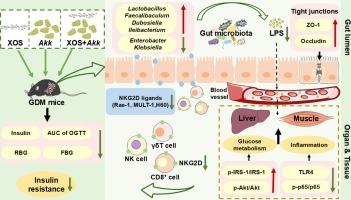
Xylooligosaccharides (XOS) ameliorate insulin resistance (IR) in gestational diabetes mellitus (GDM) probably by propagating Akkermansia muciniphila (Akk). This study aimed to investigate the effects and mechanisms of XOS, Akk and combination on IR in GDM mice/pseudo-germ-free (PGF) mice. Female mice were fed with AIN-93 (n = 19) and high fat diet (HFD) (n = 206). After 4 weeks, HFD-fed mice were further allotted to HFD, GDM, GDM + XOS, GDM + Akk, GDM + XOS + Akk, GDM + PGF, GDM + PGF + XOS, GDM + PGF + Akk, and GDM + PGF + XOS + Akk groups (n ≥ 19). GDM was induced by intraperitoneally injecting streptozotocin and PGF was established by intragastrically administrating antibiotic cocktails. XOS (500 mg/kg·BW) or/and Akk (4 × 10⁸ CFU) were gavaged once a day for 10 days. Fasting blood glucose (FBG), insulin, oral glucose tolerance test (OGTT) and insulin signaling pathway were determined. Gut microbiota were detected by 16S rRNA sequencing and absolute quantities of Akk by qRT-PCR. Intestinal tissues were stained by Hematoxylin-Eosin and Periodic acid-Schiff-Alcian blue staining. Occludin and Zonula occludens-1 (ZO-1) in intestine, Natural killer group 2 member D (NKG2D) on intestinal epithelial lymphocytes (IELs) and NKG2D ligands (NKG2DL) on intestinal epithelial cells (IECs) were detected by Western blotting. In GDM mice, XOS, Akk and XOS + Akk reduced (p < 0.05) the area under the curve of OGTT (AUC), insulin and homeostasis model assessment of insulin resistance (HOMA-IR), and increased (p < 0.05) protein kinase B (Akt) phosphorylation in liver and insulin receptor substrate 1 (IRS-1) phosphorylation in muscle. Furthermore, XOS + Akk reduced (p < 0.05) FBG and increased (p < 0.05) Akt phosphorylation in muscle and IRS-1 phosphorylation in liver. XOS, Akk and XOS + Akk reshaped gut microbiota with XOS + Akk exhibiting the greatest effectiveness. XOS increased (p < 0.05) Akk and clearance of gut microbiota abolished such effect. XOS, Akk and XOS + Akk reduced (p < 0.05) the small intestine Chiu’s score and the colon Dieleman’s scores, increased (p < 0.05) ZO-1 and Occludin, and reduced (p < 0.05) NKG2D on IELs and NKG2DLs (H60, MULT-1, Rae-1ε) on IECs. Moreover, XOS + Akk reduced (p < 0.05) MULT-1 in duodenum. Collectively, XOS and Akk synergistically ameliorate IR by reshaping gut microbiota, improving intestinal barrier and regulating NKG2D/NKG2DL signaling in GDM mice.
期刊介绍:
Food Research International serves as a rapid dissemination platform for significant and impactful research in food science, technology, engineering, and nutrition. The journal focuses on publishing novel, high-quality, and high-impact review papers, original research papers, and letters to the editors across various disciplines in the science and technology of food. Additionally, it follows a policy of publishing special issues on topical and emergent subjects in food research or related areas. Selected, peer-reviewed papers from scientific meetings, workshops, and conferences on the science, technology, and engineering of foods are also featured in special issues.



 京公网安备 11010802042870号
京ICP备2023020795号-1
京公网安备 11010802042870号
京ICP备2023020795号-1

 分享
分享
 求助内容:
求助内容: 应助结果提醒方式:
 扫码关注我们
