{"title":"Molecular Hydrogen Modulates T Cell Differentiation and Enhances Neuro-Regeneration in a Vascular Dementia Mouse Model.","authors":"Dain Lee, Hyunjun Jo, Jong-Il Choi","doi":"10.3390/antiox14010111","DOIUrl":null,"url":null,"abstract":"<p><p>This study explores whether molecular hydrogen (H<sub>2</sub>) administration can alleviate cognitive and immunological disturbances in a mouse model of vascular dementia (VaD). Adult male C57BL/6 mice underwent bilateral common carotid artery stenosis to induce VaD and were subsequently assigned to three groups: VaD, VaD with hydrogen-rich water treatment (VaD + H<sub>2</sub>), and Sham controls. Behavioral assessments using open field and novel object recognition tests revealed that VaD mice exhibited anxiety-deficient behavior and memory impairment, both of which were reversed by H<sub>2</sub> treatment. Histological examinations showed pyknotic neuronal morphologies and elevated reactive oxygen species (ROS) in the VaD hippocampus, whereas H<sub>2</sub> administration mitigated these alterations. Furthermore, VaD-induced downregulation of BCL2 was reversed in the VaD + H<sub>2</sub> group, in parallel with increased IL-4 expression. Flow cytometric analyses revealed that VaD disrupted T regulatory cell homeostasis by significantly increasing their proportion, an effect reversed by H<sub>2</sub> treatment, thereby restoring immunological balance. Transcriptomic evaluations confirmed that VaD suppressed key neuroprotective and anti-inflammatory genes, while H<sub>2</sub> treatment restored or enhanced their expression. Collectively, these findings highlight the neuroprotective and immuno-modulatory potential of molecular hydrogen, suggesting that H<sub>2</sub> supplementation may promote neuronal resilience, modulate T cell differentiation, and support cognitive recovery in vascular dementia.</p>","PeriodicalId":7984,"journal":{"name":"Antioxidants","volume":"14 1","pages":""},"PeriodicalIF":6.6000,"publicationDate":"2025-01-20","publicationTypes":"Journal Article","fieldsOfStudy":null,"isOpenAccess":false,"openAccessPdf":"https://www.ncbi.nlm.nih.gov/pmc/articles/PMC11761578/pdf/","citationCount":"0","resultStr":null,"platform":"Semanticscholar","paperid":null,"PeriodicalName":"Antioxidants","FirstCategoryId":"3","ListUrlMain":"https://doi.org/10.3390/antiox14010111","RegionNum":2,"RegionCategory":"医学","ArticlePicture":[],"TitleCN":null,"AbstractTextCN":null,"PMCID":null,"EPubDate":"","PubModel":"","JCR":"Q1","JCRName":"BIOCHEMISTRY & MOLECULAR BIOLOGY","Score":null,"Total":0}
引用次数: 0
Abstract
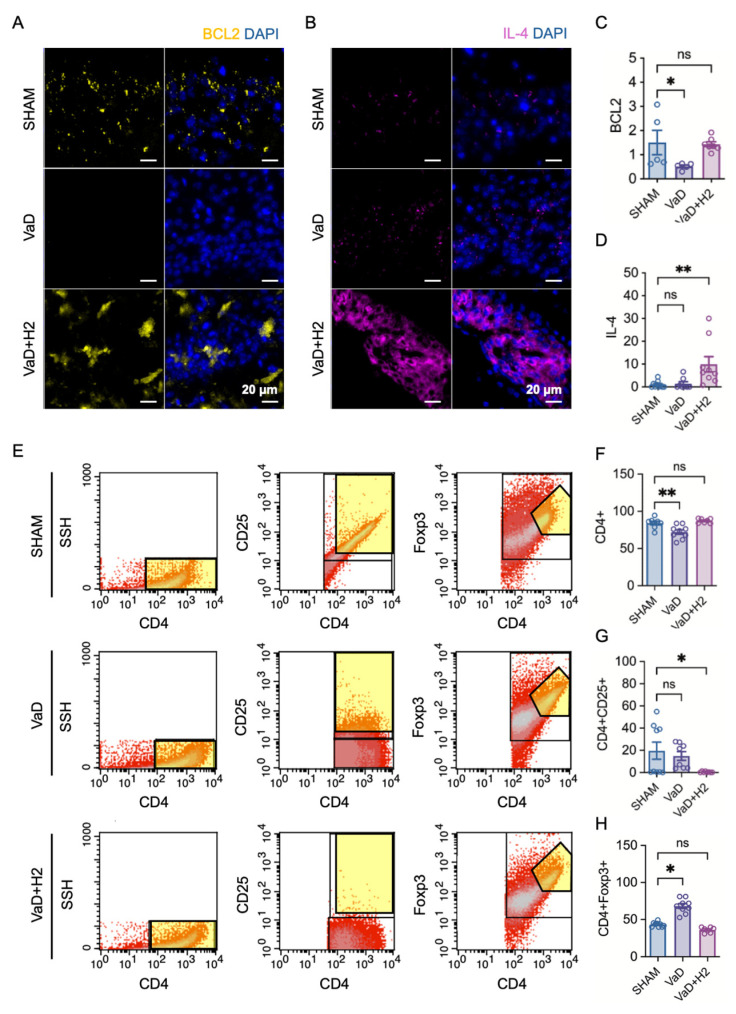
This study explores whether molecular hydrogen (H2) administration can alleviate cognitive and immunological disturbances in a mouse model of vascular dementia (VaD). Adult male C57BL/6 mice underwent bilateral common carotid artery stenosis to induce VaD and were subsequently assigned to three groups: VaD, VaD with hydrogen-rich water treatment (VaD + H2), and Sham controls. Behavioral assessments using open field and novel object recognition tests revealed that VaD mice exhibited anxiety-deficient behavior and memory impairment, both of which were reversed by H2 treatment. Histological examinations showed pyknotic neuronal morphologies and elevated reactive oxygen species (ROS) in the VaD hippocampus, whereas H2 administration mitigated these alterations. Furthermore, VaD-induced downregulation of BCL2 was reversed in the VaD + H2 group, in parallel with increased IL-4 expression. Flow cytometric analyses revealed that VaD disrupted T regulatory cell homeostasis by significantly increasing their proportion, an effect reversed by H2 treatment, thereby restoring immunological balance. Transcriptomic evaluations confirmed that VaD suppressed key neuroprotective and anti-inflammatory genes, while H2 treatment restored or enhanced their expression. Collectively, these findings highlight the neuroprotective and immuno-modulatory potential of molecular hydrogen, suggesting that H2 supplementation may promote neuronal resilience, modulate T cell differentiation, and support cognitive recovery in vascular dementia.
AntioxidantsBiochemistry, Genetics and Molecular Biology-Physiology
CiteScore
10.60
自引率
11.40%
发文量
2123
审稿时长
16.3 days
期刊介绍:
Antioxidants (ISSN 2076-3921), provides an advanced forum for studies related to the science and technology of antioxidants. It publishes research papers, reviews and communications. Our aim is to encourage scientists to publish their experimental and theoretical results in as much detail as possible. There is no restriction on the length of the papers. The full experimental details must be provided so that the results can be reproduced. Electronic files and software regarding the full details of the calculation or experimental procedure, if unable to be published in a normal way, can be deposited as supplementary electronic material.





 京公网安备 11010802042870号
京ICP备2023020795号-1
京公网安备 11010802042870号
京ICP备2023020795号-1

 分享
分享
 求助内容:
求助内容: 应助结果提醒方式:
 扫码关注我们
