Matthias Forkel, Christine Wessollek, Vincent Huijnen, Niels Andela, Adrianus de Laat, Daniel Kinalczyk, Christopher Marrs, Dave van Wees, Ana Bastos, Philippe Ciais, Dominic Fawcett, Johannes W. Kaiser, Carine Klauberg, Erico Kutchartt, Rodrigo Leite, Wei Li, Carlos Silva, Stephen Sitch, Jefferson Goncalves De Souza, Sönke Zaehle, Stephen Plummer
{"title":"Burning of woody debris dominates fire emissions in the Amazon and Cerrado","authors":"Matthias Forkel, Christine Wessollek, Vincent Huijnen, Niels Andela, Adrianus de Laat, Daniel Kinalczyk, Christopher Marrs, Dave van Wees, Ana Bastos, Philippe Ciais, Dominic Fawcett, Johannes W. Kaiser, Carine Klauberg, Erico Kutchartt, Rodrigo Leite, Wei Li, Carlos Silva, Stephen Sitch, Jefferson Goncalves De Souza, Sönke Zaehle, Stephen Plummer","doi":"10.1038/s41561-024-01637-5","DOIUrl":null,"url":null,"abstract":"The Amazon forest is fire sensitive, but, where fires were uncommon as a natural disturbance, deforestation and drought are accelerating fire occurrences, which threaten the integrity of the tropical forest, the carbon cycle and air quality. Fire emissions depend on fuel amount and type, moisture conditions and burning behaviour. Higher-resolution satellite data have helped more accurately map global burnt areas; however, the effects of fuels on the combustion process and on the composition of fire emissions remain uncertain in current fire emissions inventories. By using multiple Earth observation-based approaches, here we show that total fire emissions in the Amazon and Cerrado biomes are dominated by smouldering combustion of woody debris. The representation of woody debris and surface litter presents a critical uncertainty in fire emissions inventories and global vegetation models. For the fire season 1 August to 31 October 2020, for which all approaches are available, we found $$372^{605}_{277}\\,\\mathrm{Tg}$$ (median and range across approaches) of dry matter burnt, corresponding to carbon monoxide emissions of $$39.1^{59}_{27}\\,\\mathrm{Tg}$$ . Our results emphasize how Earth observation approaches for fuel and fire dynamics and of atmospheric trace gases reduce uncertainties of fire emission estimates. The findings enable diagnosing the representation of fuels, wildfire combustion and its effects on atmospheric composition and the carbon cycle in global vegetation–fire models. Fire emissions in the Amazon and Cerrado biomes are mainly produced from smouldering combustion of woody debris, according to observationally constrained fire emissions inventories.","PeriodicalId":19053,"journal":{"name":"Nature Geoscience","volume":"18 2","pages":"140-147"},"PeriodicalIF":16.1000,"publicationDate":"2025-01-27","publicationTypes":"Journal Article","fieldsOfStudy":null,"isOpenAccess":false,"openAccessPdf":"","citationCount":"0","resultStr":null,"platform":"Semanticscholar","paperid":null,"PeriodicalName":"Nature Geoscience","FirstCategoryId":"89","ListUrlMain":"https://www.nature.com/articles/s41561-024-01637-5","RegionNum":1,"RegionCategory":"地球科学","ArticlePicture":[],"TitleCN":null,"AbstractTextCN":null,"PMCID":null,"EPubDate":"","PubModel":"","JCR":"Q1","JCRName":"GEOSCIENCES, MULTIDISCIPLINARY","Score":null,"Total":0}
引用次数: 0
Abstract
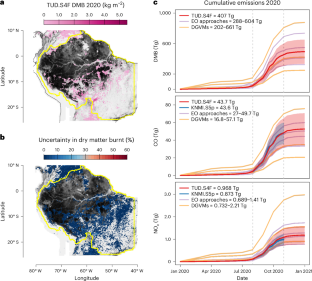
The Amazon forest is fire sensitive, but, where fires were uncommon as a natural disturbance, deforestation and drought are accelerating fire occurrences, which threaten the integrity of the tropical forest, the carbon cycle and air quality. Fire emissions depend on fuel amount and type, moisture conditions and burning behaviour. Higher-resolution satellite data have helped more accurately map global burnt areas; however, the effects of fuels on the combustion process and on the composition of fire emissions remain uncertain in current fire emissions inventories. By using multiple Earth observation-based approaches, here we show that total fire emissions in the Amazon and Cerrado biomes are dominated by smouldering combustion of woody debris. The representation of woody debris and surface litter presents a critical uncertainty in fire emissions inventories and global vegetation models. For the fire season 1 August to 31 October 2020, for which all approaches are available, we found $$372^{605}_{277}\,\mathrm{Tg}$$ (median and range across approaches) of dry matter burnt, corresponding to carbon monoxide emissions of $$39.1^{59}_{27}\,\mathrm{Tg}$$ . Our results emphasize how Earth observation approaches for fuel and fire dynamics and of atmospheric trace gases reduce uncertainties of fire emission estimates. The findings enable diagnosing the representation of fuels, wildfire combustion and its effects on atmospheric composition and the carbon cycle in global vegetation–fire models. Fire emissions in the Amazon and Cerrado biomes are mainly produced from smouldering combustion of woody debris, according to observationally constrained fire emissions inventories.
期刊介绍:
Nature Geoscience is a monthly interdisciplinary journal that gathers top-tier research spanning Earth Sciences and related fields.
The journal covers all geoscience disciplines, including fieldwork, modeling, and theoretical studies.
Topics include atmospheric science, biogeochemistry, climate science, geobiology, geochemistry, geoinformatics, remote sensing, geology, geomagnetism, paleomagnetism, geomorphology, geophysics, glaciology, hydrology, limnology, mineralogy, oceanography, paleontology, paleoclimatology, paleoceanography, petrology, planetary science, seismology, space physics, tectonics, and volcanology.
Nature Geoscience upholds its commitment to publishing significant, high-quality Earth Sciences research through fair, rapid, and rigorous peer review, overseen by a team of full-time professional editors.





 京公网安备 11010802042870号
京ICP备2023020795号-1
京公网安备 11010802042870号
京ICP备2023020795号-1

 分享
分享
 求助内容:
求助内容: 应助结果提醒方式:
 扫码关注我们
