Shifting Lithium Amide Reactivity to the Radical Domain: Regioselective Radical C−H Functionalization of 3-Iodooxetane for the Synthesis of 1,5-Dioxaspiro[2.3]hexanes
Dr. Philipp Natho, Dr. Marco Colella, Annarita Vicenti, Prof. Giuseppe Romanazzi, Dr. Faizan Ullah, Prof. Dr. Nadeem S. Sheikh, Dr. Andrew J. P. White, Francesco Pasca, Prof. Renzo Luisi
{"title":"Shifting Lithium Amide Reactivity to the Radical Domain: Regioselective Radical C−H Functionalization of 3-Iodooxetane for the Synthesis of 1,5-Dioxaspiro[2.3]hexanes","authors":"Dr. Philipp Natho, Dr. Marco Colella, Annarita Vicenti, Prof. Giuseppe Romanazzi, Dr. Faizan Ullah, Prof. Dr. Nadeem S. Sheikh, Dr. Andrew J. P. White, Francesco Pasca, Prof. Renzo Luisi","doi":"10.1002/anie.202424346","DOIUrl":null,"url":null,"abstract":"<p>Strained spiro-heterocycles (SSHs) have gained significant attention within the medicinal chemistry community as promising <i>sp</i><sup><i>3</i></sup>-rich bioisosteres for their aromatic and non-spirocyclic counterparts. We herein report access to an unprecedented spiro-heterocycle—1,5-dioxaspiro[2.3]hexane. Our synthetic approach leverages a lithium-amide induced single-electron transfer to benzophenones generating an <i>N</i>-centered radical and a ketyl radical anion—reminiscent of a frustrated radical pair. This pair works synergistically to selectively abstract the β-hydrogen from 3-iodooxetane, initiating an exergonic radical-radical coupling reaction. This process enables the formation of the desired bond between the oxetane core and benzophenone derivatives, ultimately yielding the novel 1,5-dioxaspiro[2.3]hexane core. The stability and synthetic utility of the novel 1,5-dioxaspiro[2.3]hexane motif are showcased. An in-depth mechanistic investigation is presented, including cyclic voltammetry studies, as well as computational calculations and experiments to support the mechanism of this new single electron synthetic tactic.</p>","PeriodicalId":125,"journal":{"name":"Angewandte Chemie International Edition","volume":"64 15","pages":""},"PeriodicalIF":16.9000,"publicationDate":"2025-01-27","publicationTypes":"Journal Article","fieldsOfStudy":null,"isOpenAccess":false,"openAccessPdf":"https://onlinelibrary.wiley.com/doi/epdf/10.1002/anie.202424346","citationCount":"0","resultStr":null,"platform":"Semanticscholar","paperid":null,"PeriodicalName":"Angewandte Chemie International Edition","FirstCategoryId":"92","ListUrlMain":"https://onlinelibrary.wiley.com/doi/10.1002/anie.202424346","RegionNum":1,"RegionCategory":"化学","ArticlePicture":[],"TitleCN":null,"AbstractTextCN":null,"PMCID":null,"EPubDate":"","PubModel":"","JCR":"Q1","JCRName":"CHEMISTRY, MULTIDISCIPLINARY","Score":null,"Total":0}
引用次数: 0
Abstract
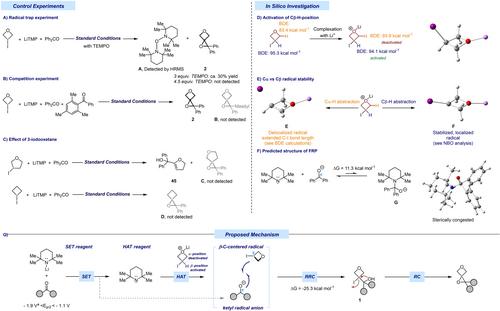
Strained spiro-heterocycles (SSHs) have gained significant attention within the medicinal chemistry community as promising sp3-rich bioisosteres for their aromatic and non-spirocyclic counterparts. We herein report access to an unprecedented spiro-heterocycle—1,5-dioxaspiro[2.3]hexane. Our synthetic approach leverages a lithium-amide induced single-electron transfer to benzophenones generating an N-centered radical and a ketyl radical anion—reminiscent of a frustrated radical pair. This pair works synergistically to selectively abstract the β-hydrogen from 3-iodooxetane, initiating an exergonic radical-radical coupling reaction. This process enables the formation of the desired bond between the oxetane core and benzophenone derivatives, ultimately yielding the novel 1,5-dioxaspiro[2.3]hexane core. The stability and synthetic utility of the novel 1,5-dioxaspiro[2.3]hexane motif are showcased. An in-depth mechanistic investigation is presented, including cyclic voltammetry studies, as well as computational calculations and experiments to support the mechanism of this new single electron synthetic tactic.
期刊介绍:
Angewandte Chemie, a journal of the German Chemical Society (GDCh), maintains a leading position among scholarly journals in general chemistry with an impressive Impact Factor of 16.6 (2022 Journal Citation Reports, Clarivate, 2023). Published weekly in a reader-friendly format, it features new articles almost every day. Established in 1887, Angewandte Chemie is a prominent chemistry journal, offering a dynamic blend of Review-type articles, Highlights, Communications, and Research Articles on a weekly basis, making it unique in the field.



 京公网安备 11010802042870号
京ICP备2023020795号-1
京公网安备 11010802042870号
京ICP备2023020795号-1

 分享
分享
 求助内容:
求助内容: 应助结果提醒方式:
 扫码关注我们
