Jun Wu , Jing Liang , Sichen Li , Jinjin Lu , Yi Li , Bin Zhang , Min Gao , Juan Zhou , Yan Zhang , Jinghua Chen
{"title":"Cancer vaccine designed from homologous ferritin-based fusion protein with enhanced DC-T cell crosstalk for durable adaptive immunity against tumors","authors":"Jun Wu , Jing Liang , Sichen Li , Jinjin Lu , Yi Li , Bin Zhang , Min Gao , Juan Zhou , Yan Zhang , Jinghua Chen","doi":"10.1016/j.bioactmat.2024.12.029","DOIUrl":null,"url":null,"abstract":"<div><div>Peptide vaccines based on tumor antigens face the challenges of rapid clearance of peptides, low immunogenicity, and immune suppressive tumor microenvironment. However, the traditional solution mainly uses exogenous substances as adjuvants or carriers to enhance innate immune responses, but excessive inflammation can damage adaptive immunity. In the current study, we propose a straightforward novel nanovaccine strategy by employing homologous human ferritin light chain for minimized innate immunity and dendritic cell (DC) targeting, the cationic KALA peptide for enhanced cellular uptake, and suppressor of cytokine signaling 1 (SOCS1) siRNA for modulating DC activity. Upon fusing with the KALA peptide, this nanovaccine presents as a novel 40-mer cage structure, with highly enriched antigen peptides of proper size (25 nm) for targeted delivery to lymph nodes. The loading of SOCS1 siRNA onto the KALA peptide promoted DC maturation in tumor environment, leading to a 3-fold increase in antigen presentation compared to alum adjuvant. Moreover, it demonstrates remarkable efficacy in suppressing tumor progression and metastasis, together with prolonged survival. In addition, the nanovaccine stimulates up to 40 % memory T cells, thereby achieving sustained protection against tumor re-challenge. This unprecedented nanovaccine platform can ignite fresh interdisciplinary discussions on interactive strategies for future peptide vaccine development.</div></div>","PeriodicalId":8762,"journal":{"name":"Bioactive Materials","volume":"46 ","pages":"Pages 516-530"},"PeriodicalIF":18.0000,"publicationDate":"2025-04-01","publicationTypes":"Journal Article","fieldsOfStudy":null,"isOpenAccess":false,"openAccessPdf":"https://www.ncbi.nlm.nih.gov/pmc/articles/PMC11764028/pdf/","citationCount":"0","resultStr":null,"platform":"Semanticscholar","paperid":null,"PeriodicalName":"Bioactive Materials","FirstCategoryId":"5","ListUrlMain":"https://www.sciencedirect.com/science/article/pii/S2452199X24005668","RegionNum":1,"RegionCategory":"医学","ArticlePicture":[],"TitleCN":null,"AbstractTextCN":null,"PMCID":null,"EPubDate":"2025/1/8 0:00:00","PubModel":"Epub","JCR":"Q1","JCRName":"ENGINEERING, BIOMEDICAL","Score":null,"Total":0}
引用次数: 0
Abstract
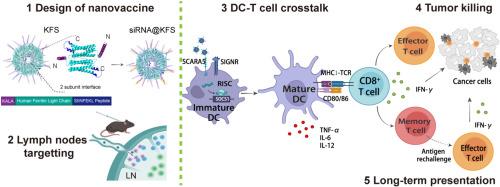
Peptide vaccines based on tumor antigens face the challenges of rapid clearance of peptides, low immunogenicity, and immune suppressive tumor microenvironment. However, the traditional solution mainly uses exogenous substances as adjuvants or carriers to enhance innate immune responses, but excessive inflammation can damage adaptive immunity. In the current study, we propose a straightforward novel nanovaccine strategy by employing homologous human ferritin light chain for minimized innate immunity and dendritic cell (DC) targeting, the cationic KALA peptide for enhanced cellular uptake, and suppressor of cytokine signaling 1 (SOCS1) siRNA for modulating DC activity. Upon fusing with the KALA peptide, this nanovaccine presents as a novel 40-mer cage structure, with highly enriched antigen peptides of proper size (25 nm) for targeted delivery to lymph nodes. The loading of SOCS1 siRNA onto the KALA peptide promoted DC maturation in tumor environment, leading to a 3-fold increase in antigen presentation compared to alum adjuvant. Moreover, it demonstrates remarkable efficacy in suppressing tumor progression and metastasis, together with prolonged survival. In addition, the nanovaccine stimulates up to 40 % memory T cells, thereby achieving sustained protection against tumor re-challenge. This unprecedented nanovaccine platform can ignite fresh interdisciplinary discussions on interactive strategies for future peptide vaccine development.
Bioactive MaterialsBiochemistry, Genetics and Molecular Biology-Biotechnology
CiteScore
28.00
自引率
6.30%
发文量
436
审稿时长
20 days
期刊介绍:
Bioactive Materials is a peer-reviewed research publication that focuses on advancements in bioactive materials. The journal accepts research papers, reviews, and rapid communications in the field of next-generation biomaterials that interact with cells, tissues, and organs in various living organisms.
The primary goal of Bioactive Materials is to promote the science and engineering of biomaterials that exhibit adaptiveness to the biological environment. These materials are specifically designed to stimulate or direct appropriate cell and tissue responses or regulate interactions with microorganisms.
The journal covers a wide range of bioactive materials, including those that are engineered or designed in terms of their physical form (e.g. particulate, fiber), topology (e.g. porosity, surface roughness), or dimensions (ranging from macro to nano-scales). Contributions are sought from the following categories of bioactive materials:
Bioactive metals and alloys
Bioactive inorganics: ceramics, glasses, and carbon-based materials
Bioactive polymers and gels
Bioactive materials derived from natural sources
Bioactive composites
These materials find applications in human and veterinary medicine, such as implants, tissue engineering scaffolds, cell/drug/gene carriers, as well as imaging and sensing devices.




 京公网安备 11010802042870号
京ICP备2023020795号-1
京公网安备 11010802042870号
京ICP备2023020795号-1

 分享
分享
 求助内容:
求助内容: 应助结果提醒方式:
 扫码关注我们
