{"title":"Effect of internal pancreatic duct stent on reducing long-term pancreaticojejunostomy stenosis following pancreaticoduodenectomy.","authors":"Wei-Hsun Lu, Ying-Jui Chao, Ting-Kai Liao, Ping-Jui Su, Chih-Jung Wang, Yan-Shen Shan","doi":"10.1007/s00423-025-03622-x","DOIUrl":null,"url":null,"abstract":"<p><strong>Background: </strong>As survival following PD improved, long-term complications have emerged as an issue in current era. Pancreaticojejunostomy stenosis is the common long-term sequel after PD but rarely addressed. This study aimed to investigate the benefit of pancreatic duct stent in reducing PJ stenosis after PD.</p><p><strong>Methods: </strong>Between July 2006 and July 2019, patients undergoing PD with follow-up more than 1 year were recruited. Patients were divided into internal stent, external stent, and no stent groups. We reviewed the Computed tomography (CT) to measure the diameter of pancreatic duct and stent migration at 3 months and 1 year after PD. PJ stenosis was defined as pancreatic duct diameter > 3 mm. Perioperative variables were collected for analysis.</p><p><strong>Results: </strong>Totally, 506 patients were included 349 patients in internal stent group, 84 patients in the external stent, and 73 patients in no stent group. There was no difference in preoperative P-duct size between the IS and ES group (3.39 ± 1.78 mm vs 3.26 ± 1.89 mm, p = 0.481), while the P-duct size was larger in ES group compared to the IS group (3.22 ± 2.44 mm vs. 1.94 ± 2.08 mm, p < 0.001) one year after PD. In the internal stent group, the rate of stent migration was 22.1% at 3 months and 67.9% at 1 year post-operatively. CR-POPF (OR 2.24, p = 0.015) and P-duct stent retention at PJ > 3 months (OR 0.45, p < 0.001) were the independent factors for 1-year PJ stenosis in multivariate analysis.</p><p><strong>Conclusion: </strong>Retention of internal pancreatic duct stents at the anastomosis for more than 3 months can reduce post-PD PJ stenosis. Extended retention of internal pancreatic duct stents reduces PJ stenosis, highlighting its critical role in preventing long-term complications.</p>","PeriodicalId":17983,"journal":{"name":"Langenbeck's Archives of Surgery","volume":"410 1","pages":"51"},"PeriodicalIF":1.8000,"publicationDate":"2025-01-27","publicationTypes":"Journal Article","fieldsOfStudy":null,"isOpenAccess":false,"openAccessPdf":"https://www.ncbi.nlm.nih.gov/pmc/articles/PMC11772507/pdf/","citationCount":"0","resultStr":null,"platform":"Semanticscholar","paperid":null,"PeriodicalName":"Langenbeck's Archives of Surgery","FirstCategoryId":"3","ListUrlMain":"https://doi.org/10.1007/s00423-025-03622-x","RegionNum":3,"RegionCategory":"医学","ArticlePicture":[],"TitleCN":null,"AbstractTextCN":null,"PMCID":null,"EPubDate":"","PubModel":"","JCR":"Q2","JCRName":"SURGERY","Score":null,"Total":0}
引用次数: 0
Abstract
Background: As survival following PD improved, long-term complications have emerged as an issue in current era. Pancreaticojejunostomy stenosis is the common long-term sequel after PD but rarely addressed. This study aimed to investigate the benefit of pancreatic duct stent in reducing PJ stenosis after PD.
Methods: Between July 2006 and July 2019, patients undergoing PD with follow-up more than 1 year were recruited. Patients were divided into internal stent, external stent, and no stent groups. We reviewed the Computed tomography (CT) to measure the diameter of pancreatic duct and stent migration at 3 months and 1 year after PD. PJ stenosis was defined as pancreatic duct diameter > 3 mm. Perioperative variables were collected for analysis.
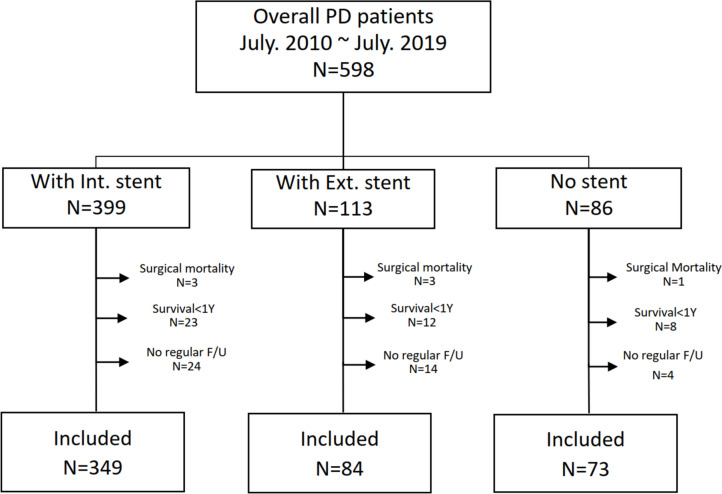
Results: Totally, 506 patients were included 349 patients in internal stent group, 84 patients in the external stent, and 73 patients in no stent group. There was no difference in preoperative P-duct size between the IS and ES group (3.39 ± 1.78 mm vs 3.26 ± 1.89 mm, p = 0.481), while the P-duct size was larger in ES group compared to the IS group (3.22 ± 2.44 mm vs. 1.94 ± 2.08 mm, p < 0.001) one year after PD. In the internal stent group, the rate of stent migration was 22.1% at 3 months and 67.9% at 1 year post-operatively. CR-POPF (OR 2.24, p = 0.015) and P-duct stent retention at PJ > 3 months (OR 0.45, p < 0.001) were the independent factors for 1-year PJ stenosis in multivariate analysis.
Conclusion: Retention of internal pancreatic duct stents at the anastomosis for more than 3 months can reduce post-PD PJ stenosis. Extended retention of internal pancreatic duct stents reduces PJ stenosis, highlighting its critical role in preventing long-term complications.
背景:随着PD患者生存率的提高,长期并发症已成为当今时代的一个问题。胰空肠吻合术狭窄是PD后常见的长期后遗症,但很少得到解决。本研究旨在探讨胰管支架在减少PD后PJ狭窄中的益处。方法:招募2006年7月至2019年7月期间接受PD治疗的患者,随访时间超过1年。患者分为内支架组、外支架组和无支架组。我们回顾了计算机断层扫描(CT)在PD后3个月和1年测量胰管直径和支架迁移。PJ狭窄定义为胰管直径bb30mm。收集围手术期变量进行分析。结果:共纳入506例患者,内支架组349例,外支架组84例,无支架组73例。IS组与ES组术前p -管大小差异无统计学意义(3.39±1.78 mm vs 3.26±1.89 mm, p = 0.481),而ES组p -管大小明显大于IS组(3.22±2.44 mm vs 1.94±2.08 mm, p = 3个月)(OR 0.45, p)结论:吻合口内胰管支架保留3个月以上可减少pd后PJ狭窄。延长内胰管支架保留可减少PJ狭窄,强调其在预防长期并发症中的关键作用。
期刊介绍:
Langenbeck''s Archives of Surgery aims to publish the best results in the field of clinical surgery and basic surgical research. The main focus is on providing the highest level of clinical research and clinically relevant basic research. The journal, published exclusively in English, will provide an international discussion forum for the controlled results of clinical surgery. The majority of published contributions will be original articles reporting on clinical data from general and visceral surgery, while endocrine surgery will also be covered. Papers on basic surgical principles from the fields of traumatology, vascular and thoracic surgery are also welcome. Evidence-based medicine is an important criterion for the acceptance of papers.





 京公网安备 11010802042870号
京ICP备2023020795号-1
京公网安备 11010802042870号
京ICP备2023020795号-1

 分享
分享
 求助内容:
求助内容: 应助结果提醒方式:
 扫码关注我们
