Probiotic biofilm modified scaffolds for facilitating osteomyelitis treatment through sustained release of bacteriophage and regulated macrophage polarization
Junwei Su , Yifan Wu , Zheng Wang , Dong Zhang , Xianquan Yang , Yong Zhao , Aixi Yu
{"title":"Probiotic biofilm modified scaffolds for facilitating osteomyelitis treatment through sustained release of bacteriophage and regulated macrophage polarization","authors":"Junwei Su , Yifan Wu , Zheng Wang , Dong Zhang , Xianquan Yang , Yong Zhao , Aixi Yu","doi":"10.1016/j.mtbio.2025.101444","DOIUrl":null,"url":null,"abstract":"<div><div>Osteomyelitis has gradually become a catastrophic complication in orthopedic surgery due to the formation of bacterial biofilms on the implant surface and surrounding tissue. The therapeutic challenges of antibiotic resistance and poor postoperative osseointegration provide inspiration for the development of bioactive implants. We have strategically designed bioceramic scaffolds modified with <em>Lactobacillus reuteri</em> (LR) and bacteriophages (phages) to achieve both antibacterial and osteogenic effects. Leveraging the tendency of bacteria to adhere to the surface of implants, bioceramics have been modified with LR biofilm to promote bone repair. The LR biofilm, sterilized by pasteurization, prevents sepsis caused by live bacteria and is biocompatible with phages. Phages, being natural enemies of bacteria, not only effectively kill bacteria and inhibit biofilm formation but also readily adsorb onto the surface of bioceramics. Hence, this scaffold, loaded with a phage cocktail, lysates specific bacterial populations, namely <em>Escherichia coli</em> (<em>E. coli</em>) and <em>Staphylococcus aureus</em> (<em>S. aureus</em>). More importantly, the inactivated LR biofilm stimulates macrophages RAW264.7 to polarize towards an anti-inflammatory M2 phenotype, creating an immune microenvironment favorable for inducing osteogenic differentiation of rat mesenchymal stem cells <em>in vitro</em>. In a rat model of infectious cranial defects, the scaffold not only effectively eliminated <em>S. aureus</em> and alleviated associated inflammation but also mediated macrophage-mediated immunoregulation, thus resulting in effective osteogenesis. Collectively, these multifunctional modified scaffolds offer an integrated approach to both bacterium elimination and bone repair, presenting a new strategy for bioactive implants in the clinical management of osteomyelitis.</div></div>","PeriodicalId":18310,"journal":{"name":"Materials Today Bio","volume":"30 ","pages":"Article 101444"},"PeriodicalIF":10.2000,"publicationDate":"2025-02-01","publicationTypes":"Journal Article","fieldsOfStudy":null,"isOpenAccess":false,"openAccessPdf":"https://www.ncbi.nlm.nih.gov/pmc/articles/PMC11764121/pdf/","citationCount":"0","resultStr":null,"platform":"Semanticscholar","paperid":null,"PeriodicalName":"Materials Today Bio","FirstCategoryId":"5","ListUrlMain":"https://www.sciencedirect.com/science/article/pii/S259000642500002X","RegionNum":1,"RegionCategory":"医学","ArticlePicture":[],"TitleCN":null,"AbstractTextCN":null,"PMCID":null,"EPubDate":"2025/1/7 0:00:00","PubModel":"Epub","JCR":"Q1","JCRName":"ENGINEERING, BIOMEDICAL","Score":null,"Total":0}
引用次数: 0
Abstract
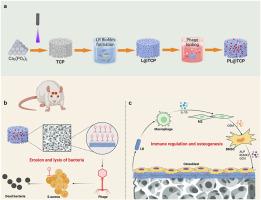
Osteomyelitis has gradually become a catastrophic complication in orthopedic surgery due to the formation of bacterial biofilms on the implant surface and surrounding tissue. The therapeutic challenges of antibiotic resistance and poor postoperative osseointegration provide inspiration for the development of bioactive implants. We have strategically designed bioceramic scaffolds modified with Lactobacillus reuteri (LR) and bacteriophages (phages) to achieve both antibacterial and osteogenic effects. Leveraging the tendency of bacteria to adhere to the surface of implants, bioceramics have been modified with LR biofilm to promote bone repair. The LR biofilm, sterilized by pasteurization, prevents sepsis caused by live bacteria and is biocompatible with phages. Phages, being natural enemies of bacteria, not only effectively kill bacteria and inhibit biofilm formation but also readily adsorb onto the surface of bioceramics. Hence, this scaffold, loaded with a phage cocktail, lysates specific bacterial populations, namely Escherichia coli (E. coli) and Staphylococcus aureus (S. aureus). More importantly, the inactivated LR biofilm stimulates macrophages RAW264.7 to polarize towards an anti-inflammatory M2 phenotype, creating an immune microenvironment favorable for inducing osteogenic differentiation of rat mesenchymal stem cells in vitro. In a rat model of infectious cranial defects, the scaffold not only effectively eliminated S. aureus and alleviated associated inflammation but also mediated macrophage-mediated immunoregulation, thus resulting in effective osteogenesis. Collectively, these multifunctional modified scaffolds offer an integrated approach to both bacterium elimination and bone repair, presenting a new strategy for bioactive implants in the clinical management of osteomyelitis.
期刊介绍:
Materials Today Bio is a multidisciplinary journal that specializes in the intersection between biology and materials science, chemistry, physics, engineering, and medicine. It covers various aspects such as the design and assembly of new structures, their interaction with biological systems, functionalization, bioimaging, therapies, and diagnostics in healthcare. The journal aims to showcase the most significant advancements and discoveries in this field. As part of the Materials Today family, Materials Today Bio provides rigorous peer review, quick decision-making, and high visibility for authors. It is indexed in Scopus, PubMed Central, Emerging Sources, Citation Index (ESCI), and Directory of Open Access Journals (DOAJ).



 京公网安备 11010802042870号
京ICP备2023020795号-1
京公网安备 11010802042870号
京ICP备2023020795号-1

 分享
分享
 求助内容:
求助内容: 应助结果提醒方式:
 扫码关注我们
